Last updated
Guilt-tripping family at the holidays: what they say, what it does, and what to say back

| What you hear | What it does | Say back |
|---|---|---|
| It might be Grandma's last Thanksgiving. | False urgency with a grave attached. Turns 'do you want to come' into 'will you regret this forever.' | I want to see her too. I can't make Thanksgiving, but I'll visit her on the tenth. |
| If you're not coming for Christmas, don't bother coming at all. | All or nothing. Removes every middle option and makes your partial yes look like the rejection. | I'd love to see you. I can come the 27th through the 29th. |
| Everyone else managed to make it. | The faceless crowd. Measures you against people whose lives are not yours. | I'm glad everyone had a good time. I'll be there next time I can. |
| After everything I've done for you. | The ledger. Old kindness becomes a bill, shown the moment you say no. | I'm grateful for what you've done. And I still can't do this one. |
| Your mom cried for two days after you called. I hope you're happy. | Someone's feelings, reported secondhand, become your crime. Leaves two doors: reverse or be cold. | I'm sorry she's sad. I'll call her. My plans haven't changed. |
| Fine. I'll just stop asking you for anything. | The martyr exit. A threat of pulling away, made so you rush in and reverse your no. | You can keep asking me for things. This time I can't. |
Reading the holiday guilt table
Each row is a real line from the book's chapter on family, with the job it does and the reply Iris Athens gives for it.
Look at the middle column first. Almost every line works the same way. It takes away the middle. The choice becomes all or nothing, grateful or cold, there or gone. That is what makes it so hard to answer on the spot.
Now look at the replies. None of them argue. None explain. Each one does a single thing: it puts a middle option back, with a date or a plain next step. Then it stops.
Two small rules make the replies work.
Use and, not but. When you thank someone and then say no, "but" sounds like you are canceling the thanks. That invites a fight. "And" lets the thanks and the no both stand.
Say it once, then stop. Don't add a fourth reason. Every reason you give is something new to argue with. If they push, say the same sentence again in the same tone. The book calls this the broken record.

Why the "last holiday" line pulls so hard
"It might be Grandma's last Thanksgiving" is the hardest one, because sometimes it's true.
Here is why it works even when it isn't. Daniel Kahneman and Amos Tversky showed in their 1979 work on prospect theory that people feel a loss more sharply than an equal gain. A line like this turns a visit into a possible loss you would carry forever. Your mind stops weighing your plans and starts trying not to lose.
The book's test is kind and simple. Offer a separate visit on a real date, and keep it. If the offer is welcome, good. If it gets brushed aside, the date was the point all along. And if a grandparent is truly ill, trust yourself and decide with care. No rule replaces that.

Rules to set before you walk in
The book suggests deciding these at home, while you are calm.
- Your end time. Say it early and kindly. Then leave at that time.
- A topic diet. A short list of safe topics: the weather, the food, the dog, the game. Keep answers short and pleasant on anything else.
- A way out of a hard moment. A short walk is a clean way to leave a moment without leaving the family.
- A note afterward. What you offered and when. Memory tends to rewrite holidays, and next year you may hear that you "skipped Christmas."
For a relative who keeps poking, the book has gray rock: short, dull, pleasant answers that give nothing to work with. "We're doing well. How's the garden?" It is a tool for getting through a visit, and we want to be clear that the book says it is not a way to live.

The table at Thanksgiving
The turkey is late. Your brother is being praised for a promotion he has mentioned twice. You say you'll need to leave by six. Long drive, work in the morning.
Your mother sets down the gravy boat. Some people drove four hours, she says to the table, but you have a schedule. Your aunt laughs. Your dad says, "Let's not do this today," and it's clear he means you.
Later, in the kitchen, she lowers her voice. Your sister was upset you didn't call on her birthday. She won't say it, but she was.
You didn't know. You're not sure it's true. You're not sure you can ask.
The book's answer to that last one is short. Call your sister and ask plainly, without blaming anyone. The direct line is what breaks a triangle, the pattern where a message about someone comes through a third person.
If you are afraid of anyone at that table, this is not a phrasing problem. The National Domestic Violence Hotline is free and confidential at 1-800-799-7233, or text START to 88788.

If you still feel guilty on the drive home
Saying the calm line is one thing. Feeling fine afterward is another. Many people say no, keep the plan, and then lie awake feeling like a bad son or daughter.
The book explains why. Family is the one place you can't fully leave. Your mother stays your mother. Family lines draw on history and on roles you were handed before you could talk, so you feel the pull even when the logic is thin.
The book's counter is a single question to ask yourself:
"Am I paying a real debt, or one I was told I owe?"
Rides, help with school, a winter coat years ago. Those were gifts when they were given. If they come back as a bill each time you set a limit, the book says to separate the gift from the debt. You can be thankful and still decline.
And you have more than two choices. It is not take it forever or never speak again. Shorter visits, fewer topics, less personal news and limited contact are all fair options. So is stepping back further if it comes to that. The book is clear that none of these make you a bad daughter, son, sibling or parent.

Where the book picks it up
This is the problem The Manipulator's Phrasebook was written for.
Family has 16 lines in five groups, including a section just for holidays and one for parents and in-laws. It says plainly that you have more options than taking it forever or never speaking again.
The Calm Toolkit gives you the broken record, gray rock and a pocket card of twelve lines to practice before the trip.
Twelve Moves With Names explains guilt levers and false urgency, the two moves under most holiday pressure. If a family talk keeps flipping so you end up apologizing, see our page on DARVO explained simply.
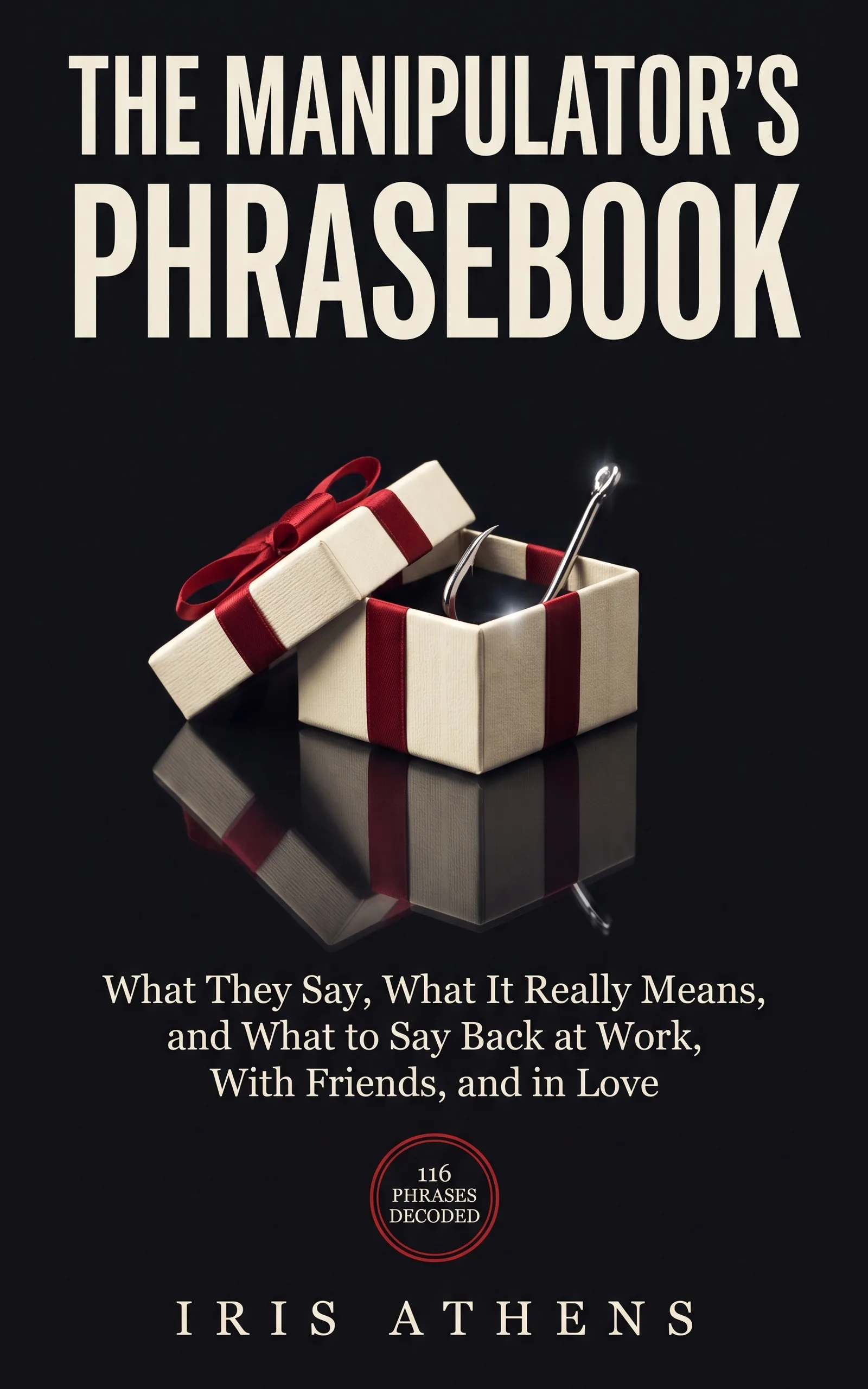
The book for this problem
The Manipulator's Phrasebook
What They Say, What It Really Means, and What to Say Back at Work, With Friends, and in Love. By Iris Athens, 214 pages.
Where this problem is in the book:
- Family
- The Calm Toolkit
- Twelve Moves With Names
Links go to Amazon. ToolGenX publishes this book under a pen name and earns from every sale. Amazon sets the price and handles delivery and returns.

Is The Manipulator's Phrasebook the right book for you?
Yes, if
- You dread the holiday call more than the holiday
- Every time you set an end time, someone gets hurt about it
- You want lines that keep the door open without giving in
Skip it if
- You want help winning the argument with a relative
- You are afraid of a family member, in which case call the hotline first
Fair doubts before you buy
Won't a planned end time feel cold to my family?
It may feel that way at first. The book's view is that a clear end time, a short topic list and short pleasant answers are how many people manage to stay in the room at all. A two-hour lunch with a clear end is still a visit. It is a way to keep showing up.
What if it really is Grandma's last Thanksgiving?
Then trust your own judgment and decide with care. The book is clear about that. Its test is gentle: offer to see her on another day. If the visit is welcome, the worry was about Grandma. If the offer gets brushed aside, the date was the point.
Get The Manipulator's Phrasebook
Manipulation hides in kind-sounding sentences; 116 of them are decoded with a calm reply for each, so you can answer or walk away with a clear head.
Links go to Amazon. ToolGenX publishes this book under a pen name and earns from every sale. Amazon sets the price and handles delivery and returns.
If you are afraid of someone, call the National Domestic Violence Hotline at 800-799-7233 or text START to 88788.

Questions people ask about this
- How do you deal with guilt trips from family during the holidays?
- Answer the request with a specific offer instead of a defense. Say you can't make the day but can come on another date, then stop talking. Don't add a fourth reason. If they refuse, say the offer is still open. A calm, specific line is hard to argue with.
- What do you say when a parent says after everything they have done for you?
- Thank them and keep your answer, joined with and, not but. Something like being grateful for what they did and still not being able to do this one. But sounds like you are canceling the thanks. And lets both stand.
- How do I respond to if you're not coming for Christmas don't come at all?
- Offer a middle option with dates, like the 27th through the 29th. If they turn it down, say the offer is still open, and leave it there. All-or-nothing lines remove the middle so your partial yes looks like rejection. You put the middle back.
- How do I set boundaries with family at Thanksgiving?
- Decide before you arrive. Pick your end time. Pick a short topic list such as the weather, the food and the dog. Keep answers short and pleasant on anything else. If a moment gets hard, step outside for a few minutes. A short walk leaves a moment without leaving the family.
- Is guilt tripping a form of manipulation?
- It can be. One sharp line on a stressful day is normal. It becomes a pattern when every limit you set triggers guilt, the guilt only goes away when you give in, and the same lines come back year after year. Watch the direction over time.
- Why do I still feel guilty after saying no to family?
- Because family pulls on history, old roles and a loyalty you were raised with, so you feel it even when the logic is thin. The book suggests one quiet question: are you paying a real debt, or one you were told you owe? You can be grateful for what they gave and still decline. A gift that turns into a debt years later was not quite a gift.
Related problems
- "I'm only saying this because I care": what that phrase and others like it really mean
Some kind words carry a heavy message. Learn to strip the wrapper, read what is left, and answer phrases like just being honest without a fight.
- DARVO explained simply: why you raise a problem and end up apologizing
You bring up one thing and leave saying sorry. What DARVO means in plain words, how to spot it, and the one calm sentence that keeps you on topic.
- A client uses urgency and guilt to get free work. Here are the rules and the words.
Tiny changes, pay me after, decide today. Seven client lines decoded with a calm reply for each, plus the simple rules that stop free work.
- Everything inside The Manipulator's Phrasebook
Every chapter, who the book is for, and every problem it helps with.