Last updated
Is my boss manipulating me, or am I reading too much into it?

The review call that felt good for about an hour
Your manager has her camera on and a warm smile. She says you're one of her best people. When they talked about bonus cuts, she fought for you. She's not supposed to tell you that.
You say thank you, and you mean it.
Then the promotion. You're so close, she says. Not quite ready. Next cycle, you're her first call. You ask what ready looks like. "It's more of a feel thing. More strategic."
Before the call ends, she hands you a messy client account two people have already quit. Because you're the one she trusts.
You hang up feeling valued. Then you try to write down what was agreed, and the page is almost empty. No raise. No date. No criteria. More work. It was a nice talk. You're just not sure it was a good deal.

Why "just trust her" keeps costing you a year
The usual advice is to keep your head down and wait. Be patient. Do great work and it will get noticed.
The trouble is that nothing in that talk can be checked. She fought for you in a room you will never see. She promised a time that isn't a date. She asked for a quality she can't define. Each line is soft on its own, and that is why it is hard to push back on.
With a boss, the ground is not level. Your boss shapes your pay, your title and what the people above hear about you. So a promise from a boss is something you plan your life around. Protection from a boss is a debt that feels risky to question.
We want to be careful here. Most bosses are not manipulators. Many are busy and vague. Research on the so-called Dark Triad, a set of traits first named by Paulhus and Williams in 2002, found these traits in ordinary people with ordinary jobs, on a scale, the way height is. That is exactly why a label won't help you. You can't measure your boss. You can measure what her sentences do.

Read the payload, not the wrapper
The book splits a slippery sentence into two parts. The wrapper is the warm outside: trust, protection, care about your growth. The payload is what the sentence actually delivers.
Take the review line about potential. You're "just not quite there yet," and when the time comes, you're "first in line." Strip the warm words and the payload is: keep waiting, and don't ask anyone else. The book calls this future faking. The future is always bright and close, and it keeps not arriving.
Here is the reply the book gives for that exact line:
"What exactly would 'ready' look like, and if I get there, when would it happen?"
Then the move that does most of the work. You confirm it in writing the same day, in two lines:
"Thanks for today. To confirm, the goals are X and Y, and we'll revisit promotion in July."
That's it. You are not accusing anyone. You are turning a soft promise into a record. If your boss is busy but fair, you now have a plan with edges. If your boss won't put criteria in writing, you have learned something that no amount of guessing could tell you.
The same tool works on the other boss lines. When "it's not a punishment" comes with the hard account, you can say thanks and ask for what you'd need to make it work, like more hands and a clear decision owner. Real trust usually comes with resources. When "the team's a little worried about you" arrives with no names, you can ask to hear the concern directly. A crowd with no faces tends to fade in an open meeting.
People who study darker traits found something else worth knowing. A 2021 study by Heym and colleagues described a group with dark traits and real empathy at the same time: people who read you very well. That is why a talk can feel kind and still leave you worse off. How you feel after the call is data too.

Count before you decide
Don't build a case on one call. The book's one rule is short: one sentence is data, three sentences are a pattern.
So keep a private log for a month. Date, exact words, how you felt after. Keep a second list of promises: what was promised, by when, and what happened. After two review cycles with no dated commitment, the book's advice is to stop treating the promise as a plan.
If threats about your review or anything like payback show up, it has moved past phrasing. Keep records and talk to HR, or an employment lawyer if it is serious.

The other signs people look for, as boss lines
Most lists of manipulative boss signs name the same things: blame, moving goalposts, gaslighting, harsh criticism and fear. The book's Bosses chapter hears each of them as a sentence. Here is how they line up, with the book's reply for each.
| Sign on the lists | How it sounds | What to say back |
|---|---|---|
| Gaslighting and blame | "That's not what I asked for. I was very clear." | "I may have misunderstood. Let's get it straight so it doesn't happen again. What do you need?" |
| Moving goalposts | "It's hard to put my finger on it. You just need to be more strategic." | "Can you give me one example where I missed that, and one where someone did it well?" |
| Harsh criticism | "I'm hardest on you because I care the most about your growth." | "I want to grow. Which behavior, in which situation, and what should I do instead?" |
| Fear | "If you're not happy here, there are a lot of people who'd love your job." | "I'm not threatening to leave. I'm raising a concern about the schedule. Can we talk about it?" |
| No paper trail | "No need to put that in writing. We're on the same page." | "Totally. I'll send a quick recap so I've got it straight." |
The pattern check is the same for every row. A stressed boss can say any of these once. Worry when instructions keep changing after the fact, always in a way that makes you wrong. Worry when feedback stays vague after you ask twice, and shows up right before a decision about your pay. And if every concern you raise gets a reminder that you can be replaced, the book says you have learned something real. You are in a job where raising problems is not safe.
The fix under all five is the same two-line email. After any spoken instruction that matters, confirm it the same day: what is wanted, and by when. Keep those emails. If things get serious, those records matter.

Where the phrasebook takes it further
This is the problem The Manipulator's Phrasebook was written for. Iris Athens gives each sentence four parts: the phrase, the payload, what it would sound like if it were honest, and a calm line to say back.
Bosses has 17 boss lines in four groups, from "We're a family here" to the open door that comes with a question about who else feels this way. Each one has a pattern check, so you know when a line is normal and when it has a direction.
Twelve Moves With Names names the moves behind the lines, like future faking and false urgency, so the pressure has an outline you can see.
The Calm Toolkit gives you replies that hold up under a power gap: paper memory, witnesses, questions instead of statements, and a pocket card of twelve boring lines that work because they are boring.
If the same pattern shows up with a peer, our page on a coworker taking credit for your work walks through the office version.
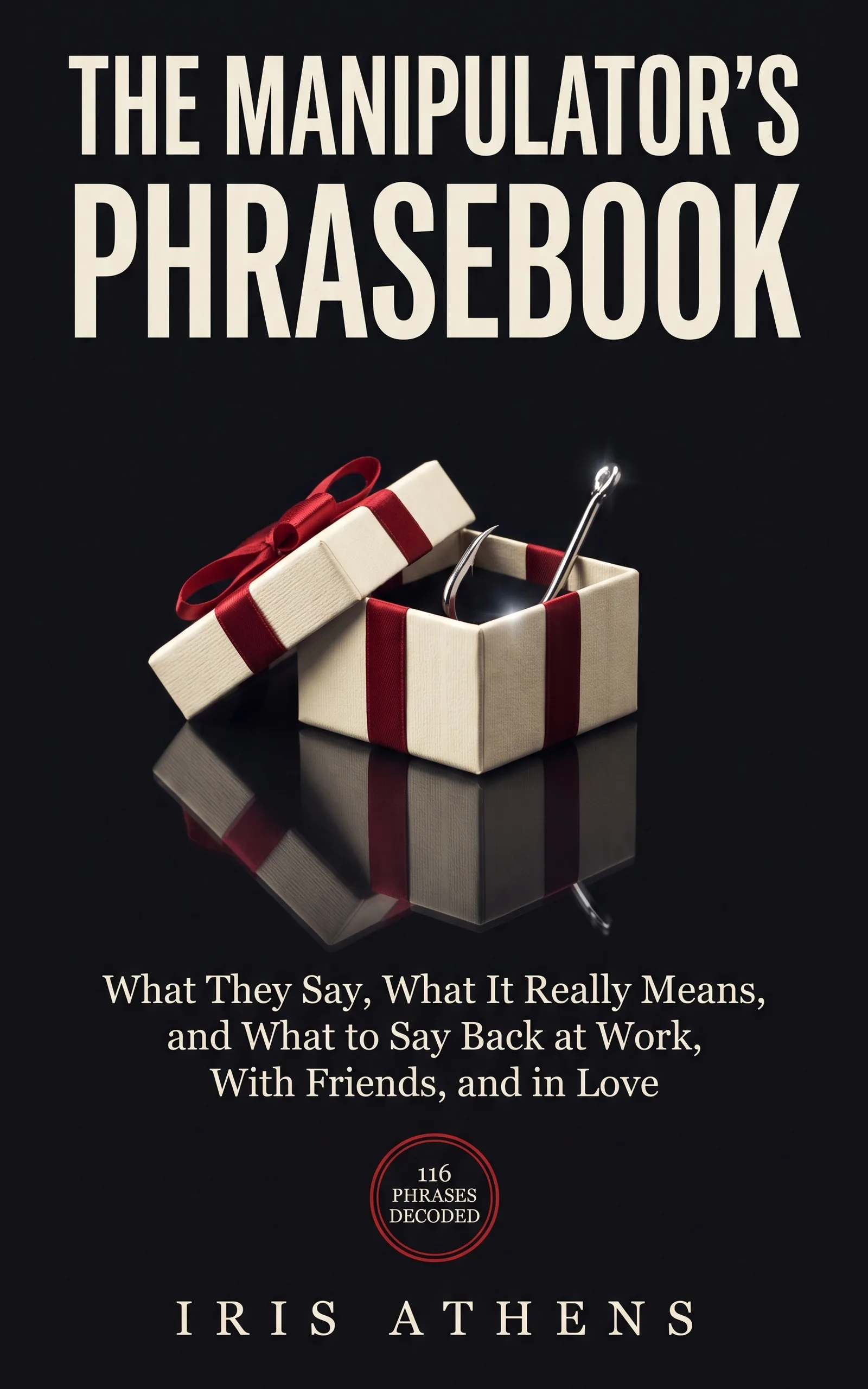
The book for this problem
The Manipulator's Phrasebook
What They Say, What It Really Means, and What to Say Back at Work, With Friends, and in Love. By Iris Athens, 214 pages.
Where this problem is in the book:
- Bosses
- Twelve Moves With Names
- The Calm Toolkit
Links go to Amazon. ToolGenX publishes this book under a pen name and earns from every sale. Amazon sets the price and handles delivery and returns.

Is The Manipulator's Phrasebook the right book for you?
Yes, if
- Your boss praises you a lot and your title and pay never move
- You leave one-on-ones feeling valued and somehow worse off
- You keep getting the messy work with a compliment attached
Skip it if
- You want someone to tell you your boss is a narcissist
- You are facing harassment or threats and need HR or a lawyer first
Fair doubts before you buy
Isn't this just a busy, vague manager?
Often it is. The book says most bosses are not manipulators, just stretched thin. That is why it gives you tests instead of labels. A busy boss will answer a clear question and reply to a recap email. You learn which one you have by asking, not by guessing.
Won't asking for things in writing make me look difficult?
Not the way the book does it. The recap is two friendly lines, sent the same day, and you send it after every important talk, with everyone. It reads as organized, not suspicious. Healthy people tend to like recaps because they save everyone trouble.
Get The Manipulator's Phrasebook
Manipulation hides in kind-sounding sentences; 116 of them are decoded with a calm reply for each, so you can answer or walk away with a clear head.
Links go to Amazon. ToolGenX publishes this book under a pen name and earns from every sale. Amazon sets the price and handles delivery and returns.
If you are afraid of someone, call the National Domestic Violence Hotline at 800-799-7233 or text START to 88788.

Questions people ask about this
- How do I know if my boss is manipulating me?
- Watch the direction over time, not one sentence. Warning signs are protection you never get to see, promises with no dates, feedback that stays vague after you ask twice, and extra work that always comes with praise but never with pay or a title. If the same kind of line keeps leaving you smaller or in debt, it is a pattern.
- What do you say to a boss who says you are not ready for a promotion?
- Ask what ready would look like and when it would happen. Then write the answer down and send it back the same day, with the goals and the date. If your boss will not put criteria in writing after two review cycles, the promise is being used like money, not treated as a plan.
- Is it manipulation when a boss says we are a family here?
- Not always. Plenty of small companies mean something kind by it. Watch when the word shows up. If it comes mainly when you are asked to give more, or right after you ask for something back, it is being used to make talk about pay and hours feel like betrayal. You can take the warmth and still talk terms.
- What if my boss says it would be a shame if this affected my review?
- Stay calm and ask what specifically would affect your review, so you can meet the standard. Then write down the date, the exact words and what happened just before. If it came right after you pushed back on something unethical or illegal, keep records and talk to HR or an employment lawyer.
- Should I keep notes about my boss?
- Yes, privately. The book suggests a simple log: the date, the exact words and how you felt after. Memory softens things. After a month you will see either a pattern or a person having a hard stretch, and both answers are worth knowing.
- What are the signs of a manipulative boss?
- Lists online name blame, moving goalposts, gaslighting, harsh criticism and fear. In the book they show up as lines. Instructions that change after the fact and always make you wrong. Feedback that stays vague after you ask twice. Put-downs relabeled as growth. Reminders of how easily you could be replaced. One line is data. The same kind of line again and again is the sign.
Related problems
- A coworker keeps taking credit for my work. Is it petty to say something?
Speaking up feels petty and staying quiet hands over your week. Calm lines for the meeting, the follow-up, and the habit that makes credit hard to take.
- "I'm only saying this because I care": what that phrase and others like it really mean
Some kind words carry a heavy message. Learn to strip the wrapper, read what is left, and answer phrases like just being honest without a fight.
- DARVO explained simply: why you raise a problem and end up apologizing
You bring up one thing and leave saying sorry. What DARVO means in plain words, how to spot it, and the one calm sentence that keeps you on topic.
- Everything inside The Manipulator's Phrasebook
Every chapter, who the book is for, and every problem it helps with.