Last updated
You bill by the hour, you are fully booked, and your freelance income stopped growing

Sunday night, and the math says the same thing again
It is Sunday night. Your week is full. It has been full for months. Referrals come in faster than you can take them.
By every sign you have made it. So you do the sums again, the way you do most Sundays. And the sums say you are stuck.
You charge by the hour. You have sold every hour. To earn more you would need more hours, and there are none left.
Then the quiet thought shows up. If I'm this busy and still can't get ahead, what happens when I get sick, or tired, or old?

Raising your rate is a taller cage, not a door
The usual advice is to raise your rate. You have probably thought about it for two years. You can do it, and it will help a little.
But here is what most advice will not say out loud. When you sell hours, your price is chained to the clock. A higher rate makes the chain longer. It is still bolted to the same wall: 24 hours in a day, and you sleep through some of them.
It gets worse. When you bill by the hour, every bit of skill you gain costs you money. Finish a site in four hours instead of six, and you are paid less for the same site. You are punished for being good at your job.
So the problem was never the number next to the word hour. The problem is the word hour.

See your ceiling in one number
I want you to do one small thing before you change anything. Find your real ceiling, in dollars.
Take your rate. Take the hours you can truly bill in a year, after you take out sleep, admin and the time you spend finding the next client. Multiply them. That is the most you could ever earn if every hour sold.
Most people never do this sum. Seeing it plainly is what makes you stop climbing the wall and start looking for a way around it.
You are not alone at this wall. The US Small Business Administration says one-person firms are about 82% of American businesses but bring in only about 3% of business money. A wide, flat plain where most people earn modestly. A small peak where a few earn much more. The same shape shows up in the creator economy figures from Goldman Sachs, where about 4% earn six figures.

The ceiling sum, line by line
Here is the book's Revenue Ceiling Calculator, so you can do it now with a pen.
| Line | What to write |
|---|---|
| Your rate | Per hour, or per day |
| Billable hours per week | Be honest, not hopeful. Only hours a client pays for |
| Working weeks per year | Take out holidays, sick days and admin weeks |
| Your ceiling | Rate times billable hours times weeks |
Then answer two questions the sheet asks. Is your ceiling a number you would be happy to retire at? And do you see that, right now, your only levers are more hours or a higher rate, and both run out?

The usual fixes, and where each one stops
Most advice for a flat freelance income lists the same few moves. They all help a little. In the book's terms, they are all adding, and adding has a ceiling.
- Raise your rate. It lifts the ceiling once. But your income is still rate times hours, and clients still compare you with everyone else who sells hours.
- Take on more clients. Only if you have hours left. A full calendar means you do not.
- Cut admin so you can bill more hours. Worth doing, and it moves the second line of the sum up a bit. The sum is still capped by the week.
The book's way past the wall is a different kind of move. Five things a one-person business can grow without adding hours: the offer, the price, a product, an AI-run delivery engine and a stack of offers that sell each other. The first one, selling the result instead of the hour, is in the next section. If your work repeats from client to client, the third one is on how to productize a service.

Stop selling the hour and name the result
The people on the peak do not work more hours than you. They changed what they sell.
Here is the move from the book. Ask what your client really wants, then keep asking "so that what?" until the answer has money, time or relief in it.
A client wants a new website. So that what? So it looks current. So that what? So people trust it enough to book. So that what? So her quiet Tuesdays fill up the way her weekends do. Stop there. That is the real thing she is buying.
Now you can sell a booking page that fills slow weekdays, with a clear edge on what is in it. There is no hour in that offer. She cannot haggle four hours off it, because there are no hours to haggle.
Be honest about one thing. Name a result your work truly moves. "A page built to turn visitors into bookings" is fair. "I'll double your sales" is a promise you cannot keep.
Tools that lift a person's output are real too. A study at the National Bureau of Economic Research found that AI help raised output about 14% on average, and the most for the least experienced workers. That matters later, once you sell results instead of time.

Where the book takes it from here
This is the problem The One-Person Million was written for.
The Introduction: The Ceiling of Hours walks you through the ceiling sum with Tool 0, the Revenue Ceiling Calculator. It also shows why the wall feels like success right up until it does not.
Chapter 1, The Offer: Sell the Outcome, Not the Hour, gives you the Offer Reframe. It is three lines: what you sell now, the outcome they want, and the new offer with no hour in it. It also lists the four ways people get this wrong, like renaming the task instead of finding the result.
The book does not promise you a set income. Its own first page says most one-person businesses never reach a million. What it gives you is the order to fix things in. You can get every sheet in the free workbook first, and if pricing is your next worry, read value-based pricing vs hourly.
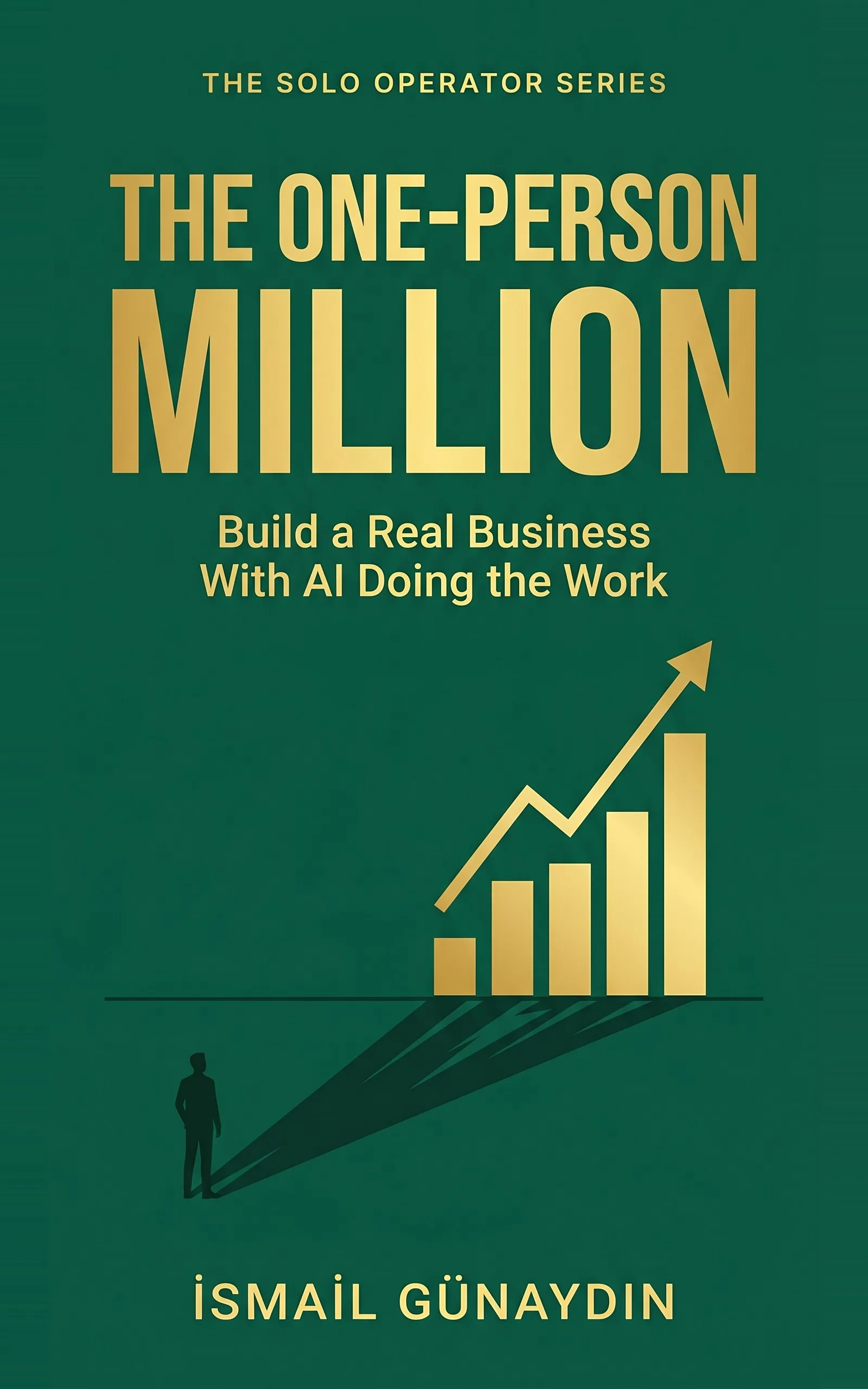
The book for this problem
The One-Person Million
Build a Real Business With AI Doing the Work. By İsmail Günaydın, 66 pages.
Where this problem is in the book:
- Introduction: The Ceiling of Hours
- The Offer: Sell the Outcome, Not the Hour
Links go to Amazon. I wrote this book and earn a royalty on every sale. Amazon sets the price and handles delivery and returns.

Is The One-Person Million the right book for you?
Yes, if
- You bill by the hour and your income has been flat for a year or more
- Your calendar is full and you still feel stuck
- You sell a service like web design, bookkeeping, writing or admin help
Skip it if
- You want a plan that tells you how fast you will earn a set amount
- You sell physical goods with stock to manage
Fair doubts before you buy
Can't I just raise my hourly rate?
You can, a little, and it helps for a while. The book is blunt about it. A higher rate is a taller cage. Your income is still rate times hours, and you have already sold all the hours. The rate also hits a limit, because clients still compare you to every other person who sells hours.
I have read plenty of business books. Why this one?
Most business books are about growth with a team. This one is short and built for one person. Each chapter ends with a one-page tool you fill in for your own work, starting with a sheet that shows your exact ceiling in dollars.
Get The One-Person Million
Income tied to your hours has a fixed ceiling; five layers (offer, price, product, engine, stack) lift it without adding hours.
Links go to Amazon. I wrote this book and earn a royalty on every sale. Amazon sets the price and handles delivery and returns.
Part of The Solo Operator Series, five short books that can be read in any order.

Questions people ask about this
- Why is my freelance income not growing even though I'm busy?
- Because your income is your rate times the hours you can sell, and you have sold them all. Being busy is the sign of the ceiling, not a way past it. A full calendar is proof you have run out of room.
- How do I calculate my maximum income as a freelancer?
- Take your rate and multiply it by the hours you can really bill in a year, after sleep, admin and the unpaid hunt for the next client. That number is the most you could ever earn if every hour were sold. The book calls this the Revenue Ceiling Calculator.
- Is it normal for freelancers to plateau?
- Yes. US Census data in the book counts more than 30 million one-person businesses that together earned about 1.8 trillion dollars in 2023, roughly 59,000 dollars each on average. Most earn modestly. The plateau is the common shape, not a sign you did something wrong.
- What should I sell instead of hours?
- Sell the outcome. A dentist does not want forty hours of web design. She wants a chair that is not empty on Tuesday afternoons. When you sell that result, the price is set by what it is worth to her, not by how long it took you.
- Does getting faster at my work help if I charge hourly?
- No, it works against you. When you bill by the hour, the faster you finish, the less you earn for the same result. Your skill and your income end up on opposite sides.
- How can I increase my freelance income without working more hours?
- Change what grows. More hours and a higher rate both run out. The book names five things that grow without adding hours: sell the result instead of the hour, price by value, turn repeat work into a product, let AI carry routine delivery, and build offers that sell each other. Start with the first. It changes what you can charge.
Related problems
- Value-based pricing vs hourly: which one should a freelancer use?
Hourly, cost-plus, project or value-based pricing? A side-by-side table of the four ways to price, what caps each one, and how to move up.
- A client said your quote is too low. How do you raise your price on the next one?
A client just told you that you charge too little. Here is what to do today, and how to set and say a higher price on your very next quote.
- Is a one-person million-dollar business realistic, or is it just a story people sell?
An honest answer: most solo businesses never reach a million. What the data shows, why a few do, and what you can build either way.
- Everything inside The One-Person Million
Every chapter, who the book is for, and every problem it helps with.