Last updated
A client said your quote is too low. How do you raise your price on the next one?

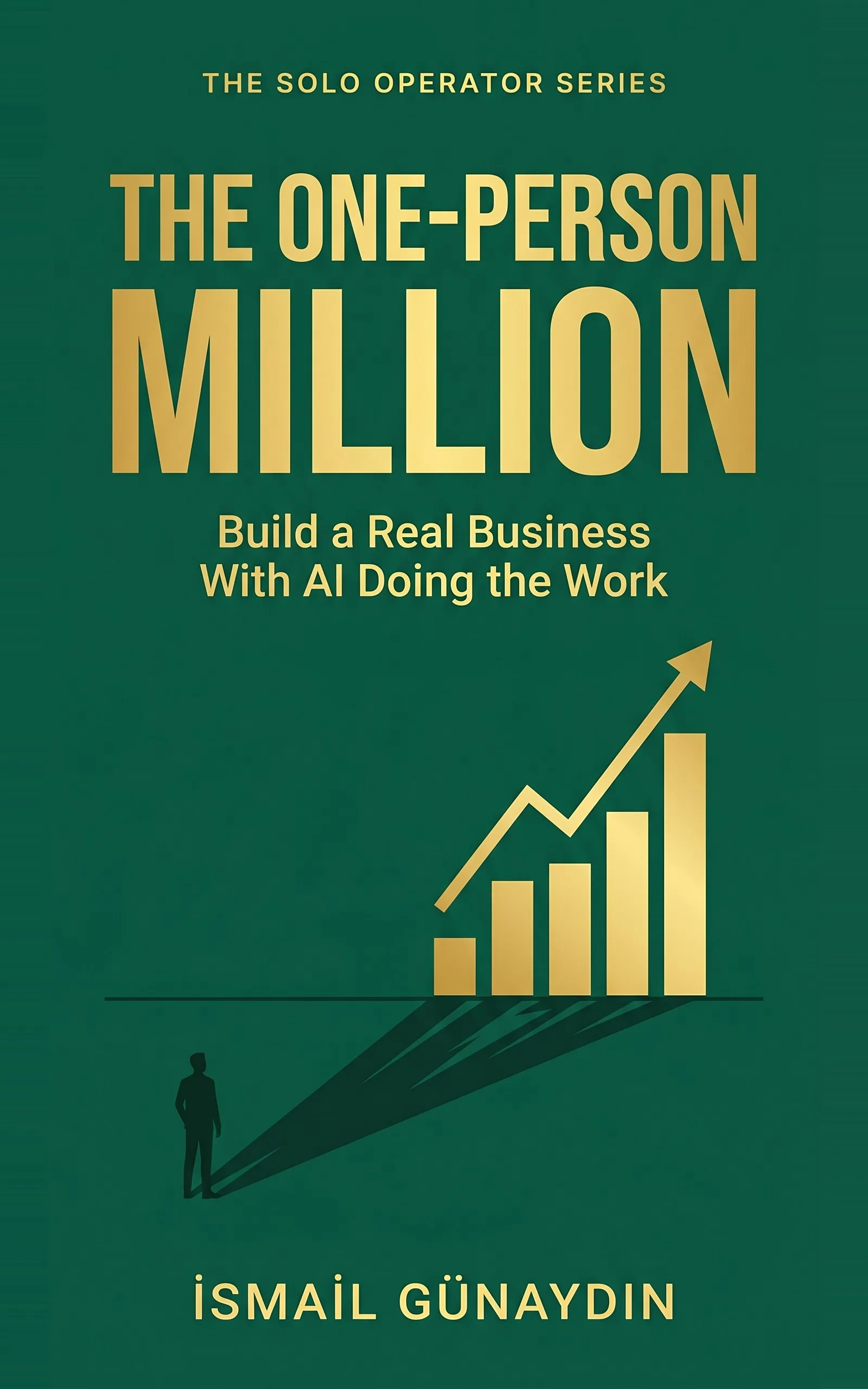
The book for this problem
The One-Person Million
Build a Real Business With AI Doing the Work. By İsmail Günaydın, 66 pages.
Where this problem is in the book:
- The Price: Charge for the Value, Not the Time
Links go to Amazon. I wrote this book and earn a royalty on every sale. Amazon sets the price and handles delivery and returns.
Do this before you send the next quote
You do not need to fix everything today. You need to fix the next number. Here is the order.
- Leave the last client alone. Do not re-quote them. That job goes at the price you gave. It hurts, but it keeps the trust.
- Write down the result, not the task. For your next job, ask "so that what?" until you hit money, time or relief. "A new site" becomes "patients who stop going to the practice down the road."
- Ask the value question on the call. Before you name any price, ask: "If this works, what is one extra customer worth to you over the time they stay?" Let them say the number.
- Name one price. Put it below the value they just named and well above your hours. Say it as a single number.
- Do not explain the hours. The hours are not the reason. A long list of your effort is what invites the bargaining.
That is it for today. The rest can wait until after the call.

Put clear edges on the next quote
A higher price needs a clear shape around it. Many freelancers who underprice also leave the job open-ended, so the work grows and the price does not. The book's fix is to package the result and draw its edge.
Name the result, say what is in, and say what is not. The book's example: "The Booked-Out Site: a one-page booking funnel built to turn your visitors into enquiries, live in three weeks." Then the line that protects you: it is one booking funnel and the copy to fill it, not a ten-page brand site, which is a different package.
Now the client knows what they are buying, you know what you are committing to, and nobody has to argue later about where "done" was. There is no hour anywhere in it.

And when the next client says it is too high
Raise your price and, sooner or later, someone will say the opposite. Two rules from the book help here.
Do not defend the price with your hours. The moment you list your effort, you teach the client to value your time, not their result, and they will haggle the hours down. Go back to the result they named and what it is worth to them.
Offer a smaller step, not a smaller price. Some people are not ready to trust you with the full job yet. They are not a lost sale. They need a smaller, lower-risk offer first, like a template or a short fixed starter. Cutting the price of the full job teaches them your number was never real. A smaller offer keeps the number honest.

The afternoon the floor tilted
The book has a scene that may feel close to home. A web designer named Theo sends a quote to a growing dental practice. Forty hours at his rate, a round number, fair and safe.
The client pauses on the call. "Honestly, I expected it to cost more. The last person quoted nearly triple. Are you sure this is everything?"
He says yes. And he feels the floor tilt. He has been fully booked for eight months, tired and stuck. And a client has just told him, kindly, that he charges less than half what the work is worth.
Not because his work was worse. Because he priced the hours, and the hours were all he knew how to count.

Your price is a choice you make, not a sum
Here is the hard part, said plainly. Your price is not a calculation. It is a decision.
You have been treating it like arithmetic. Fill in the hours, and the spreadsheet hands you the price. But the hours are a fact about you. The price should be a fact about them: what the result is worth to the person who gets it.
That is why the quote came out low. You answered "what did this cost me?" when the real question was "what is this worth to them?"

Why saying the number feels so hard
When you work alone, there is no rate card signed by someone else. The number comes out of your own mouth. If they say no, it feels personal, because there is no one else for it to be about.
The fear has a shape. It is not really "they'll say no." It is "they'll say no, and that will prove I'm not worth it." But the price was never a score of your worth. It is a guess at the result's worth to the client. And this client already told you the result was worth more.
I will be honest about the other side too. Value pricing does not mean picking a huge number from a podcast. It means a price you can point to in the client's own math. That is what lets you say it without your voice shaking.
You are not the only one stuck here. The Goldman Sachs look at the creator economy found more than half of creators earn under 15,000 dollars a year. Low prices are common. That does not make them right for you.
There is also a quiet cost to staying hourly as tools speed you up. A 2023 study in Science found AI cut writing time by about 40%. Priced by the hour, every saved hour is money gone.

The chapter that covers this
This is the problem The One-Person Million was written for.
Chapter 2, The Price: Charge for the Value, Not the Time, is built around the exact scene above. It lays out the four ways to price, the three reasons hourly feels safe, and how to estimate what a result is worth without seeing the client's books. It ends with Tool 2, the Value Price Ladder, which you fill in for the very next quote you send.
In the book, Theo takes the higher price to the next practice that calls. The client pauses, then says it sounds reasonable. That is one example, not a promise. Your market is your own.
You can print the ladder from the free workbook. If you want the four methods side by side first, see value-based pricing vs hourly.

Is The One-Person Million the right book for you?
Yes, if
- A client just told you your price was low, and it ruined your afternoon
- You have a quote to send this week and want it to be different
- You freeze when you have to say a bigger number out loud
Skip it if
- You want a script to raise prices on clients you already have, today
- You want to charge a big number with no result behind it
Fair doubts before you buy
Won't a higher price scare clients away?
Some may say no. The book's point is that a price far below the value often reads as a sign the work is cheap. In its example, the next client heard a much higher number, paused, and said it sounded reasonable, because it was tied to a result they had just valued out loud.
I just need one tip. Do I need a whole book?
For today, no. The steps on this page are enough to fix the next quote. The book is for after that: it shows why the price was low, and the four things that keep it low, one chapter at a time.
Get The One-Person Million
Income tied to your hours has a fixed ceiling; five layers (offer, price, product, engine, stack) lift it without adding hours.
Links go to Amazon. I wrote this book and earn a royalty on every sale. Amazon sets the price and handles delivery and returns.
Part of The Solo Operator Series, five short books that can be read in any order.

Questions people ask about this
- What does it mean when a client says your price is too low?
- Usually that you priced your effort and not their result. The client is weighing what the work does for their business. You were weighing your hours. Those two numbers live in different worlds.
- Should I go back and raise the price after a client says it is too low?
- The book says no. That relationship has already taken your number, so let it stand. Use the lesson on the next client, where no one has to absorb a change.
- How do I raise my prices as a freelancer without losing clients?
- Raise them on new clients first. Ask what the result is worth before you quote. Then say one number, plainly, with no long list of hours behind it. The long list is what invites the haggling.
- How do I say a higher price without sounding nervous?
- Say it as one number tied to the result the client just named. Then stop talking. The book says the number stops feeling outrageous around the third time you say it out loud, so the only way through is to say it.
- Is it wrong to keep my prices low to be affordable?
- Sometimes it is a real choice. Often it is fear dressed up as a principle. Be honest about which one yours is. A price set by your nerves is a quiet tax you pay on every job.
- What if a client says my new price is too high?
- Do not cut it and do not list your hours to defend it. Go back to the result they want and what it is worth to them. If they are not ready for the full job, offer a smaller step, like a short fixed starter, instead of a discount. Some people will still say no, and that is part of pricing by value.
Related problems
- Value-based pricing vs hourly: which one should a freelancer use?
Hourly, cost-plus, project or value-based pricing? A side-by-side table of the four ways to price, what caps each one, and how to move up.
- You bill by the hour, you are fully booked, and your freelance income stopped growing
If you bill by the hour and every slot is full, your income has a fixed ceiling. See how to find yours and the first step to get around it.
- How to productize a service when you are the only one doing the work
Turn a custom service into a fixed package, then a product. Three tests to pick what to productize first, and why you should slide, not leap.
- Everything inside The One-Person Million
Every chapter, who the book is for, and every problem it helps with.