Last updated
How to productize a service when you are the only one doing the work

The nineteenth time you build the same thing
It is a Tuesday in March. You are building a menu you have built nineteen times before.
New client, new logo, a slightly different blue. But the work underneath is the same. The header. The mobile menu. The contact form that emails you when someone fills it in.
You could do it in your sleep. That is the cruel part. Because the money only shows up when you are awake at the keyboard doing it.
You have gotten faster over the years. It bought you nothing. Faster just means the next identical job shows up sooner.

Why "make something people want" is the wrong first question
Most advice on products starts with "what should I make?" That points you at invention. You start dreaming up something new and clever.
And that is how most first products die. They get built from the maker's excitement, not the customer's request. You launch, and you hear silence.
The other half of the usual advice is the beach. Build it once, sell it forever, sleep while it earns. I want to be plain about this. The sleeping part is real. The passive part is not.
A product earns without you at the moment of sale. It does not get built without you. It does not get sold without you either. The first one often takes more work than the service it replaces.

Slide one step, do not leap
Here is the real shift from the book. Service and product are not two boxes. They are two ends of one line, and you move along it one notch at a time.
Pure service is on the left. Every job is custom and you are there for every hour.
Productized service is in the middle. Same skill, but the offer is fixed. One set of pages, one flat price, one two-week delivery, one intake form instead of a fresh quote. You still do the work. But the deciding, quoting and explaining happen once.
Template or digital product is on the right. You built it once, and it sells without you in the room.
The book's example is a web designer. He froze his standard small-business site into a package: five named pages, one round of changes, two weeks. He swapped the discovery emails for one form with the eight questions he always asked anyway. None of it was new work. Within a month, the hours of quoting and scope talk were gone.
Then, and only then, he built the right-hand rung. He took the parts he had built by hand nineteen times and made them into one clean starter template, written up well enough that a buyer could install it without asking him a thing. It took two focused weeks. The first month it sold a handful of copies. Modest. But every one arrived without him at the keyboard.

What goes into the package
Most guides on productizing say the same thing: a fixed scope, a fixed price, and a clear line around what is and is not included. The book agrees, and adds the parts that make it buyable without a call. Here is the checklist, built from the book's examples.
| Part | What to write | From the book's example |
|---|---|---|
| A name for the result | What the client gets, not your hours | "The Booked-Out Site" |
| What it is built to do | The outcome your work really moves | "Built to turn your visitors into enquiries" |
| What is included | The fixed scope | Five named pages, the standard parts, one round of changes |
| What is not included | The edge, so "done" is agreed | "Not a ten-page brand site. That is a different package" |
| Delivery time | One set timeline | Two weeks |
| One flat price | No fresh quote each time | One price for the package |
| One intake form | The questions you always end up asking | Eight questions, in place of the discovery emails |
In the book, the package ended up sold from a page instead of a sales call. That only works once every row above is written down.
Set the price by what the result is worth, not by counting the hours inside it. If you build the flat price as hours times your rate, it is still hourly with a round number on top. See value-based pricing vs hourly.

Pick the right thing with three tests
So what goes first? Run each idea through three tests. It must pass all three.
You already repeat it. A thing done once is a guess. A thing done nineteen times is a pattern.
Clients already ask for it. If three different clients asked for roughly the same thing, you do not have an idea. You have an order queue.
It works without your live explanation. If it falls apart the second you stop talking someone through it, it is still a service.
The winner is almost never your most impressive work. It is your most repeated work. Leave the parts that need your judgment as the service they honestly are.
Keep your hopes honest too. Goldman Sachs estimates the creator market at about 250 billion dollars, heading toward 480 billion by 2027. Inside it, the income is steeply skewed. A small product that earns a quarter of your income on a tenth of your time is still a real gain. Once orders grow, AI can carry much of the delivery. The NBER study on AI in support work found the biggest gains, around 34%, went to the least experienced workers.

Where the book picks this up
This is the problem The One-Person Million was written for.
Chapter 3, The Product: Make Money While You Sleep, covers the line from service to product, the three tests, and the four ways people get it wrong, like building a product nobody asked for. It ends with Tool 3, the Product Ladder: one pass that lays your work out from most of you to least of you, and marks what moves where.
Chapter 1, The Offer: Sell the Outcome, Not the Hour, matters here too. Time does not package. A service still defined as your hours cannot become a product until you name the result it sells.
The Product Ladder is in the free workbook. Once a product sells, the next worry is often too many orders to deliver alone.
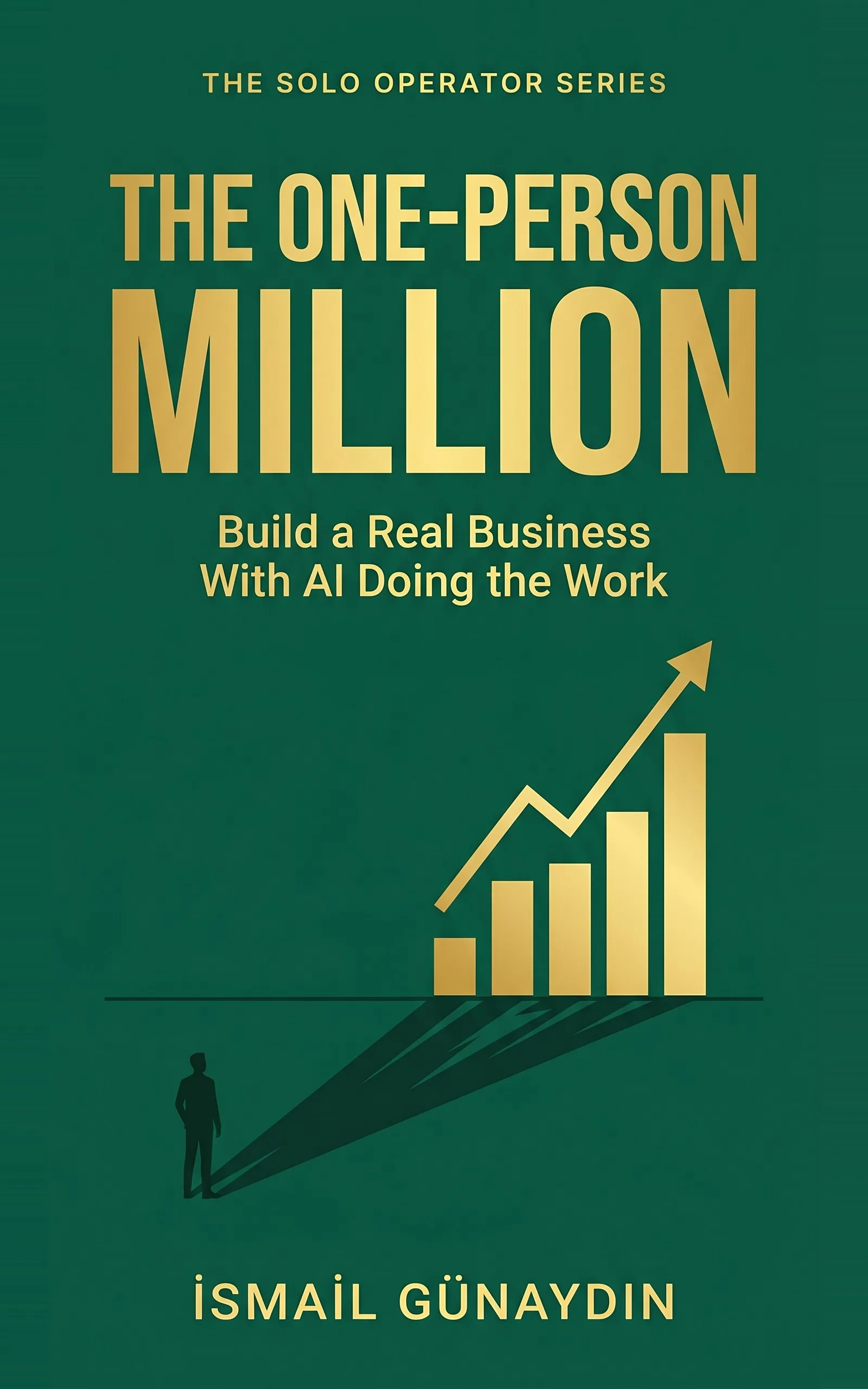
The book for this problem
The One-Person Million
Build a Real Business With AI Doing the Work. By İsmail Günaydın, 66 pages.
Where this problem is in the book:
- The Product: Make Money While You Sleep
- The Offer: Sell the Outcome, Not the Hour
Links go to Amazon. I wrote this book and earn a royalty on every sale. Amazon sets the price and handles delivery and returns.

Is The One-Person Million the right book for you?
Yes, if
- You quote every job from scratch even though the work is mostly the same
- You want income that does not need you in the room
- You are unsure which part of your service could become a product
Skip it if
- You want passive income with no upfront work
- Your work is all live judgment, with nothing that repeats
Fair doubts before you buy
Isn't a productized service just a price list?
It is more than that. It is a fixed scope, a set delivery time, one flat price and one intake form, so the deciding and quoting are done once and reused. The book calls it the highest-return step in the chapter, because it costs almost nothing and removes the part of your time that was never the real work.
I could find a course on this. Why a book?
Many courses start with the product. This book starts one step earlier, with the offer and the price, because you cannot package a service still sold as hours. It is short, and the product chapter ends with one sheet, the Product Ladder.
Get The One-Person Million
Income tied to your hours has a fixed ceiling; five layers (offer, price, product, engine, stack) lift it without adding hours.
Links go to Amazon. I wrote this book and earn a royalty on every sale. Amazon sets the price and handles delivery and returns.
Part of The Solo Operator Series, five short books that can be read in any order.

Questions people ask about this
- What does it mean to productize a service?
- It means turning custom work into a fixed package with a set scope, set price and set delivery, and later into a product that sells without you. The book treats it as a line, not a jump: pure service, then productized service, then template or digital product.
- What service should I productize first?
- The one you repeat most. Run each idea through three tests: you already do it often, clients already ask for it, and it works without your live explanation. Stop at the first idea that passes all three. It is usually your most boring work.
- Can a productized service be passive income?
- Not really. You still do the work. What it removes is the custom quoting, the scope talks and the back-and-forth emails. Passive only describes the moment of sale for a true product, not the build or the marketing.
- How much do digital products really earn?
- Most earn modestly. Goldman Sachs found that only around 4% of creators earn six figures, while more than half earn under 15,000 dollars a year. The book's goal is income that is not tied to your hours, not sudden wealth.
- Should I launch a course before I standardize my service?
- The book says no. You cannot package what you have not standardized. Fixing the service first teaches you what really repeats, and that is exactly what a clean product needs.
- How do I price a productized service?
- Price the result, not the hours inside it. Ask what the outcome is worth to a typical client, and set one flat price below that value and well above your time. The book's test: if you cannot name the package price without first counting hours, you have not left hourly. You have just hidden the math.
Related problems
- What to sell after your first digital product, so the second one sells the first
One product is one income line. How to pick a second offer that sits below or above the first, and connect them so each one leads to the next.
- Too many orders to deliver alone? Before you hire help, do this
Your product finally sells and delivery is burying you. A fast plan to clear the load this week without giving your margin to a new hire.
- Value-based pricing vs hourly: which one should a freelancer use?
Hourly, cost-plus, project or value-based pricing? A side-by-side table of the four ways to price, what caps each one, and how to move up.
- You bill by the hour, you are fully booked, and your freelance income stopped growing
If you bill by the hour and every slot is full, your income has a fixed ceiling. See how to find yours and the first step to get around it.
- Everything inside The One-Person Million
Every chapter, who the book is for, and every problem it helps with.