Last updated
Value-based pricing vs hourly: which one should a freelancer use?

| Method | Where the price starts | What caps it | When you get faster |
|---|---|---|---|
| Cost-plus | Your costs plus a margin on top | Your own costs, so it shrinks as you improve | Your costs fall, so you can justify less |
| Hourly | Your rate times your hours | The clock and the rate clients will accept | You are paid less for the same result |
| Project | One price for the whole job | Only capped if you secretly count hours to set it | You keep the time you save |
| Value-based | What the result is worth to the client | Nothing your hours impose | Same price, less time, more room to deliver again |
How to read the four rows
There are only four ways to set a price. Every quote you have ever sent is one of them. The table puts all four side by side for one job.
Look at the second column first. Cost-plus and hourly both start from you: your costs, your clock. So both are capped by you, because there is only so much of you.
Project and value-based start from the job and the result. Only value-based has no ceiling set by your hours, because it is not measured in your hours.
Now look at the last column. It is the one that should sting. With hourly or cost-plus, getting better at your work earns you less. With value-based pricing, getting faster means the same price for less of your time.

The sneaky row in the middle
Project pricing looks like the way out. Often it is not.
Most people who quote by the project still count the hours in secret. They guess forty hours, times the rate, and call it a project price. That is hourly pricing in a nicer coat.
Here is a quick test from the book. If you cannot name your project price without first counting hours, you have not left hourly. You have only stopped showing the math.
Done honestly, a project price is a real step. You quote one number. You finish in thirty hours, not forty. You keep the gap, and you are paid more for being good, not less.

Ask the value question before you name any number
Value-based pricing sounds hard because the value lives in the client's business, not yours. You do not need their books. You need one honest talk.
Ask what the result is for. Not "what should I build?" but "what changes for you if this works?" Keep going until there is a number they care about: more bookings, fewer no-shows, a leak that costs them every week.
Then let them size it. "If the new site brought you a few extra patients a month, what is a patient worth to you over the years they stay?" They answer. Now the number in the room is theirs, not yours.
You will not get it exact. You do not need to. A rough guess at their value beats a precise count of your time, because one has a ceiling and the other does not.

Count the cost of not fixing it
Most value-pricing guides stop at the upside: what more sales are worth. The book adds a second number, and it is often the bigger one. What does the problem cost the client every week they wait?
A dental practice with a broken booking page is not just missing growth. It is losing patients right now, every week, to the practice down the road whose site works. So the job is no longer "a website." It is "stop the leak that costs me patients." Most clients have never counted that leak. Count it with them, honestly, and the price has something real under it.

When the result is not yours to control
The most common warning about value pricing is fair. Many results depend on things you do not control, like the client's own prices, service and follow-up. If you promise "I'll double your bookings," you have staked your name on all of that.
The book's answer is not to drop value pricing. It is to change the promise. Name the outcome your work really moves, and say what the thing is built to do. "A booking page built to turn visitors into enquiries" is honest and strong. "I'll double your revenue" is a debt you cannot pay.
Price against what the result is worth. Promise only the part that is in your hands.

Why hourly feels so safe
I will say the part most people skip. Hourly is hard to leave because it feels fair, certain and easy to defend. All three are traps.
When a client questions an hourly price, you point at the hours. But the moment you defend a price with your effort, you teach the client to value your time, not their result. Then they bargain your hours down forever.
The fear is real too. As one person, the price comes out of your own mouth to a real person who might say no. The book's advice is plain: raise it on the next client, say the number without a long list of reasons, and expect it to feel strange until about the third time you say it.
This is a pattern, not a personal flaw. Research on AI at work, like the Noy and Zhang study in Science, shows tasks can now take far less time, about 40% less for writing. If you charge by the hour, that speed is money you lose. The NBER study by Brynjolfsson and colleagues found a similar lift in support work. Faster work only pays you if your price is not tied to the clock.

Where the book helps you set the number
This is the problem The One-Person Million was written for.
Chapter 2, The Price: Charge for the Value, Not the Time, gives you Tool 2, the Value Price Ladder. You run one real job up all four rungs, with your reasons next to each. In the book's example, the same forty hours of work carried four very different prices. The work never moved. The question changed.
Chapter 1, The Offer: Sell the Outcome, Not the Hour, comes first for a reason. You cannot price a result you have not named. If your offer is still stated in hours, the ladder only hands you hours to multiply.
The sheets are free in the workbook. If a client just told you your quote was too low, start with this page on the quote.
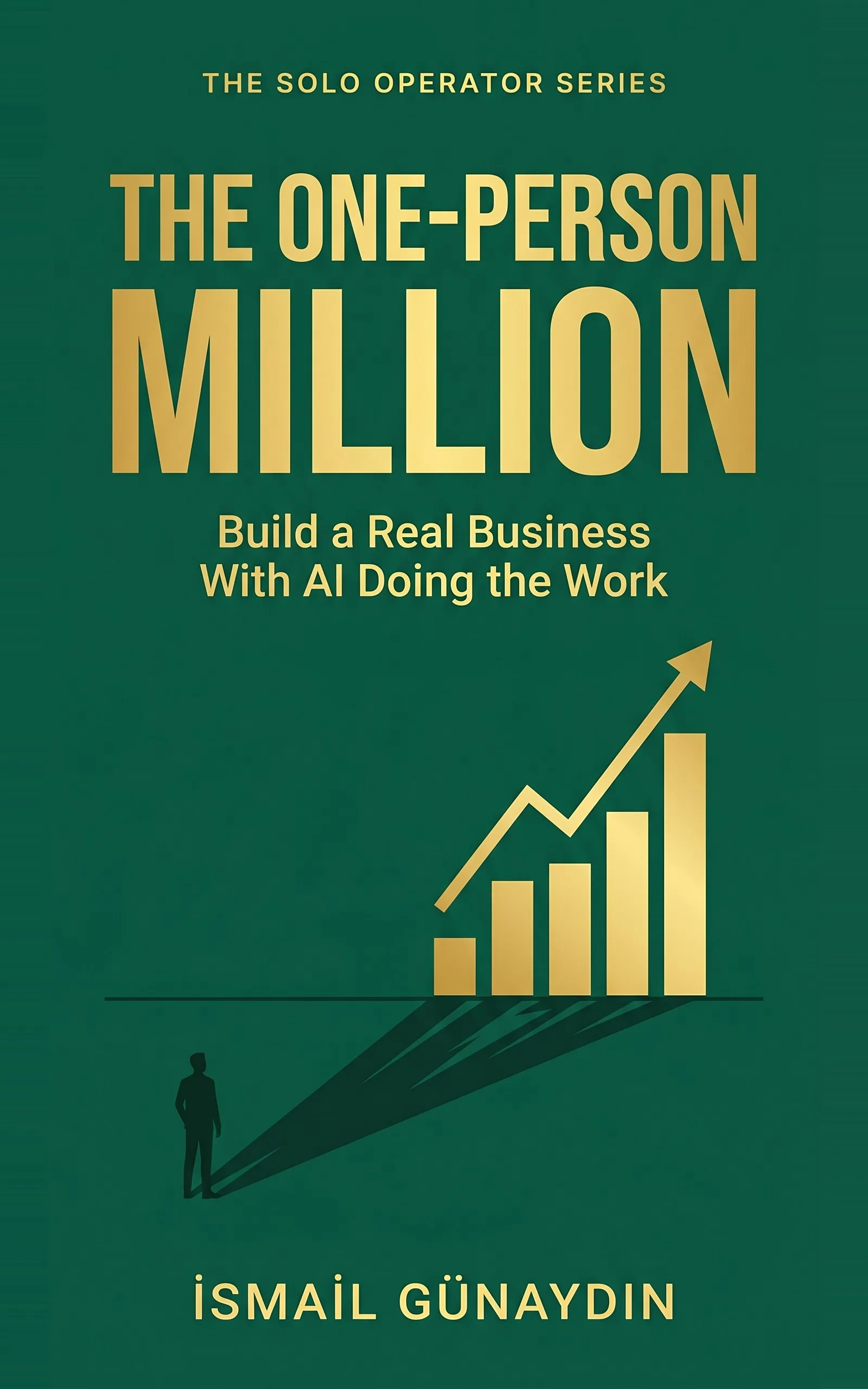
The book for this problem
The One-Person Million
Build a Real Business With AI Doing the Work. By İsmail Günaydın, 66 pages.
Where this problem is in the book:
- The Price: Charge for the Value, Not the Time
- The Offer: Sell the Outcome, Not the Hour
Links go to Amazon. I wrote this book and earn a royalty on every sale. Amazon sets the price and handles delivery and returns.

Is The One-Person Million the right book for you?
Yes, if
- You price every job as your rate times the hours
- You have heard of value-based pricing but do not know how to work out the value
- A client once told you your quote was too low
Skip it if
- You want a rate card or a number to copy
- You want a way to charge as much as you can get away with
Fair doubts before you buy
Isn't hourly the fair way to charge?
It feels fair because the sum is in plain view. But fair to your clock is not the same as fair to the result. In the book, a dental practice told the designer his quote was less than half what the last person asked. His fair hourly number was the problem.
Can't I just watch a video on value pricing?
You can, and some are good. What the book adds is the order. You cannot price by value until you have named the value, so Chapter 1 reframes the offer first and Chapter 2 prices it. It also gives you the exact questions to ask on the call.
Get The One-Person Million
Income tied to your hours has a fixed ceiling; five layers (offer, price, product, engine, stack) lift it without adding hours.
Links go to Amazon. I wrote this book and earn a royalty on every sale. Amazon sets the price and handles delivery and returns.
Part of The Solo Operator Series, five short books that can be read in any order.

Questions people ask about this
- What is the difference between value-based pricing and hourly pricing?
- Hourly pricing charges for your time. Value-based pricing charges for what the result is worth to the client. The first is capped by the hours you can sell. The second is not measured in your hours at all.
- Is project pricing the same as value-based pricing?
- No. A project price is one number for the whole job. It only frees you from the clock if you did not build it by counting hours. If you estimate the hours and multiply by your rate, it is still hourly with a round number on top.
- How do I figure out what my work is worth to a client?
- Ask them. Ask what changes for them if this works. Then let them do the sum: if this brought you a few extra customers a month, what is one customer worth to you? Their answer puts a real number in the room. Your price sits below that value and well above your hours.
- Should I switch existing clients to value-based pricing?
- The book says to start with the next client, not the current one. That way no current relationship has to take the shock, and you get to practice the new number on someone fresh.
- Can value-based pricing go too far?
- Yes. Value pricing is not a big number pulled from the air. It is a price in proportion to a result you can point to, in the client's own math. A number with nothing under it is just a guess the client can feel.
- When does value-based pricing not work?
- When there is no result you can point to, or when you promise a result that rests on things outside your hands. If you cannot get the client to name what the outcome is worth, you have nothing under the number. And if you promise to double their sales, you are on the hook for their prices and service too. Promise what your work is built to do, and price against what that is worth.
Related problems
- A client said your quote is too low. How do you raise your price on the next one?
A client just told you that you charge too little. Here is what to do today, and how to set and say a higher price on your very next quote.
- You bill by the hour, you are fully booked, and your freelance income stopped growing
If you bill by the hour and every slot is full, your income has a fixed ceiling. See how to find yours and the first step to get around it.
- How to productize a service when you are the only one doing the work
Turn a custom service into a fixed package, then a product. Three tests to pick what to productize first, and why you should slide, not leap.
- Everything inside The One-Person Million
Every chapter, who the book is for, and every problem it helps with.