Last updated
Is a one-person million-dollar business realistic, or is it just a story people sell?

Another headline about one person and a million
You saw it again today. Someone, alone, with a laptop and AI, made a million dollars. Maybe a video. Maybe a post with a screenshot.
You look at your own year. You work hard. You are good at what you do. You are nowhere near that.
So the question sits there. Is it real? Is it me? Or is it a story someone is selling?

The honest number first
Let me say it plainly, because I put it on the first page of the book. Most one-person businesses never reach a million dollars. Nothing in the book promises that you will.
Here are the figures behind that. The US Census Bureau counts more than 30 million one-person businesses. Together they earned about 1.8 trillion dollars in 2023. Divide it out and the average is roughly 59,000 dollars a firm.
But the average lies, the way averages do. The US Small Business Administration says one-person firms are about 82% of all American businesses and bring in only about 3% of the money. That is not a gentle hill. It is a long, flat plain where most earn modestly, and a small, steep peak where a few earn many times more.
The same shape shows up in a totally different field. In the creator economy, Goldman Sachs found that only about 4% of creators earn six figures, while more than half earn under 15,000 dollars a year. When two unrelated sets of data draw the same picture, the picture is true.
So the million is real. It is just rare. Anyone who tells you only the first half of that is selling you the beach.

A million in sales is not a million in pay
One thing many of the headlines skip. A "million-dollar business" almost always means a million in sales, not a million the owner keeps.
The Census figures above work the same way. In its Nonemployer Statistics glossary, the Census Bureau counts "receipts," which it defines as gross receipts, sales, commissions and business income. That is money in before costs. Tools, fees, ads, contractors and taxes all come out after. So the 59,000-dollar average is what came in, not what the owner took home.
That is worth knowing for two reasons. It makes the screenshots in your feed look a little less like your bank balance should. And it is one more reason the book cares about structure more than the top-line number. A business that brings in less, on fewer of your hours and with low costs, can leave you better off than a bigger one that eats every evening.

Why working harder does not get you up the peak
The usual advice is hustle. More clients, more hours, more days. Plenty of people on the plain work themselves to the bone. Hard work is not what separates them from the peak.
The people on the plain are adding. They stack hours on hours until they hit the ceiling of the calendar. The people on the peak are multiplying. They found a few things that grow without costing another hour.
Adding has a ceiling. You may have already met it. Multiplying does not.

What changed, and what did not
Multiplying used to need other people. To sell once and deliver a thousand times, you needed staff. That is why the peak mostly belonged to firms with employees.
What changed is that one person can now build delivery as a system with AI doing much of the work. A study at NBER found AI raised support output about 14% on average, and about 34% for the least experienced workers. A solo owner is new at most of the jobs around their one craft, so that lift lands where you need it.
The ceiling is the same height it always was. The ladder is new. A ladder still has to be climbed, and most people never reach the top of it.

A better goal than the number
The book's own example ends honestly. The designer at its center does not reach a million by the last page. What he gets is the thing that makes the number thinkable: his income stops being chained to his calendar. A year on, he works fewer hours and earns more. Whether he reaches the peak is up to his market and his work.
So here is the useful test. Do not ask "will I make a million?" Ask "is my income still a function of my hours?" If it is, that is the thing to change, whatever number you end up at.

Where the book is honest about this
This is the problem The One-Person Million was written for.
The Introduction: The Ceiling of Hours lays out the data above, the plain and the peak, and the idea the whole book turns on: adding versus multiplying. It also has Tool 0, the Revenue Ceiling Calculator, which shows the most you could earn on hours alone.
The Conclusion: The Million Is a Structure, Not a Sprint puts the five steps in order across 90 days. The book is clear that this is to build the structure, not to reach a million in 90 days, which would be a lie. Its advice: build one step fully rather than five halfway, usually starting with the offer.
The sheets are in the free workbook. If you bill by the hour today, the first step is on this page about flat freelance income.
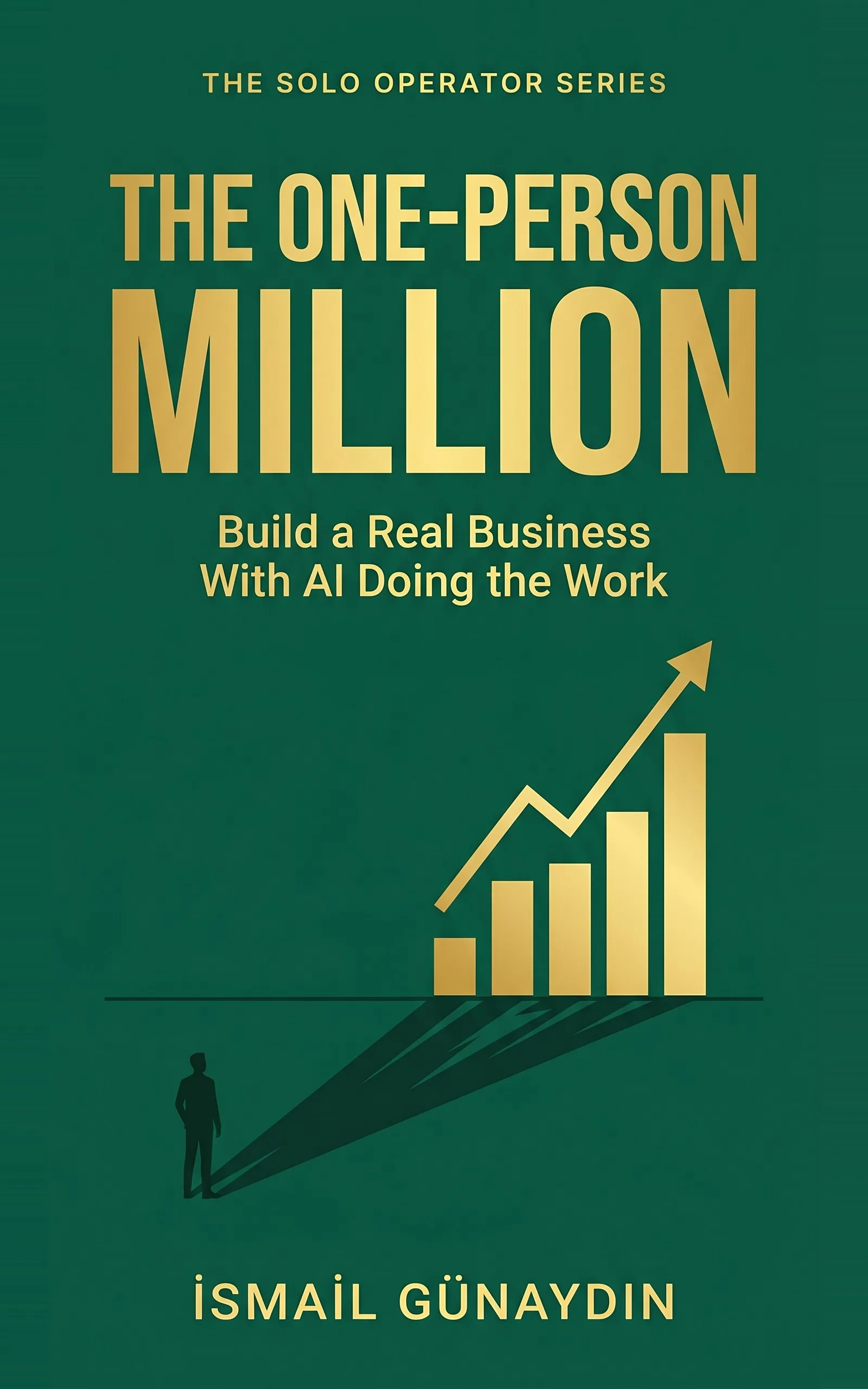
The book for this problem
The One-Person Million
Build a Real Business With AI Doing the Work. By İsmail Günaydın, 66 pages.
Where this problem is in the book:
- Introduction: The Ceiling of Hours
- Conclusion: The Million Is a Structure, Not a Sprint
Links go to Amazon. I wrote this book and earn a royalty on every sale. Amazon sets the price and handles delivery and returns.

Is The One-Person Million the right book for you?
Yes, if
- You keep seeing one-person million stories and wonder if they are real
- You want an honest look at the odds before you change your business
- You would rather build a sound structure than chase a number
Skip it if
- You want a timeline to a million (the book says most one-person businesses never get there)
- You want a get-rich plan or typical results
Fair doubts before you buy
If most people never get there, why read a book called The One-Person Million?
Because the title names a structure, not a promise. The book says so on its first page. What it gives you is the set of moves that let your income stop being tied to your hours. That change is worth having even if the number never comes.
Isn't this just more AI hype?
The book leans on research, not hype. It cites a Goldman Sachs report showing only about 4% of creators earn six figures, and NBER and Science studies on how much AI really helps. It is open about the skew and about what AI should never touch.
Get The One-Person Million
Income tied to your hours has a fixed ceiling; five layers (offer, price, product, engine, stack) lift it without adding hours.
Links go to Amazon. I wrote this book and earn a royalty on every sale. Amazon sets the price and handles delivery and returns.
Part of The Solo Operator Series, five short books that can be read in any order.
Questions people ask about this
- How many one-person businesses make a million dollars?
- Few. The book does not give an exact count, on purpose. It shows the shape instead: one-person firms are about 82% of US businesses but bring in only about 3% of business receipts, per the US Small Business Administration. Most earn modestly. A small peak earns much more.
- What is the average income of a one-person business?
- About 59,000 dollars per firm, if you divide the roughly 1.8 trillion dollars that more than 30 million US one-person businesses earned in 2023. But the average hides a steep skew.
- Can AI help one person build a big business?
- It can help one person do work that used to need a team, like onboarding, support replies and first drafts. Research cited in the book found the biggest gains go to the least experienced workers. That makes it possible for more people. It does not make it likely for any one person.
- How long does it take to build a million-dollar solo business?
- The book will not give a timeline, because there is no honest one. It offers a 90-day plan to put the structure in place, not to reach a million in 90 days. Whether you go further depends on your market and your work.
- What do solo businesses at the top do differently?
- They multiply instead of add. Instead of more clients and more hours, they found a few things that grow without costing another hour: the offer, the price, a product, an AI-run delivery engine and a stack of offers that sell each other.
- Does a million-dollar business mean a million in profit?
- No. The phrase nearly always means a million in sales. Costs, fees, contractors and taxes come out of that before the owner is paid. The US Census Bureau's figures for one-person firms count receipts, which are gross sales and business income, so even the roughly 59,000-dollar average is money in, not take-home pay.
Related problems
- You bill by the hour, you are fully booked, and your freelance income stopped growing
If you bill by the hour and every slot is full, your income has a fixed ceiling. See how to find yours and the first step to get around it.
- Value-based pricing vs hourly: which one should a freelancer use?
Hourly, cost-plus, project or value-based pricing? A side-by-side table of the four ways to price, what caps each one, and how to move up.
- How to productize a service when you are the only one doing the work
Turn a custom service into a fixed package, then a product. Three tests to pick what to productize first, and why you should slide, not leap.
- Everything inside The One-Person Million
Every chapter, who the book is for, and every problem it helps with.