Last updated
My business stops when I take a day off. What can I set up before I go?

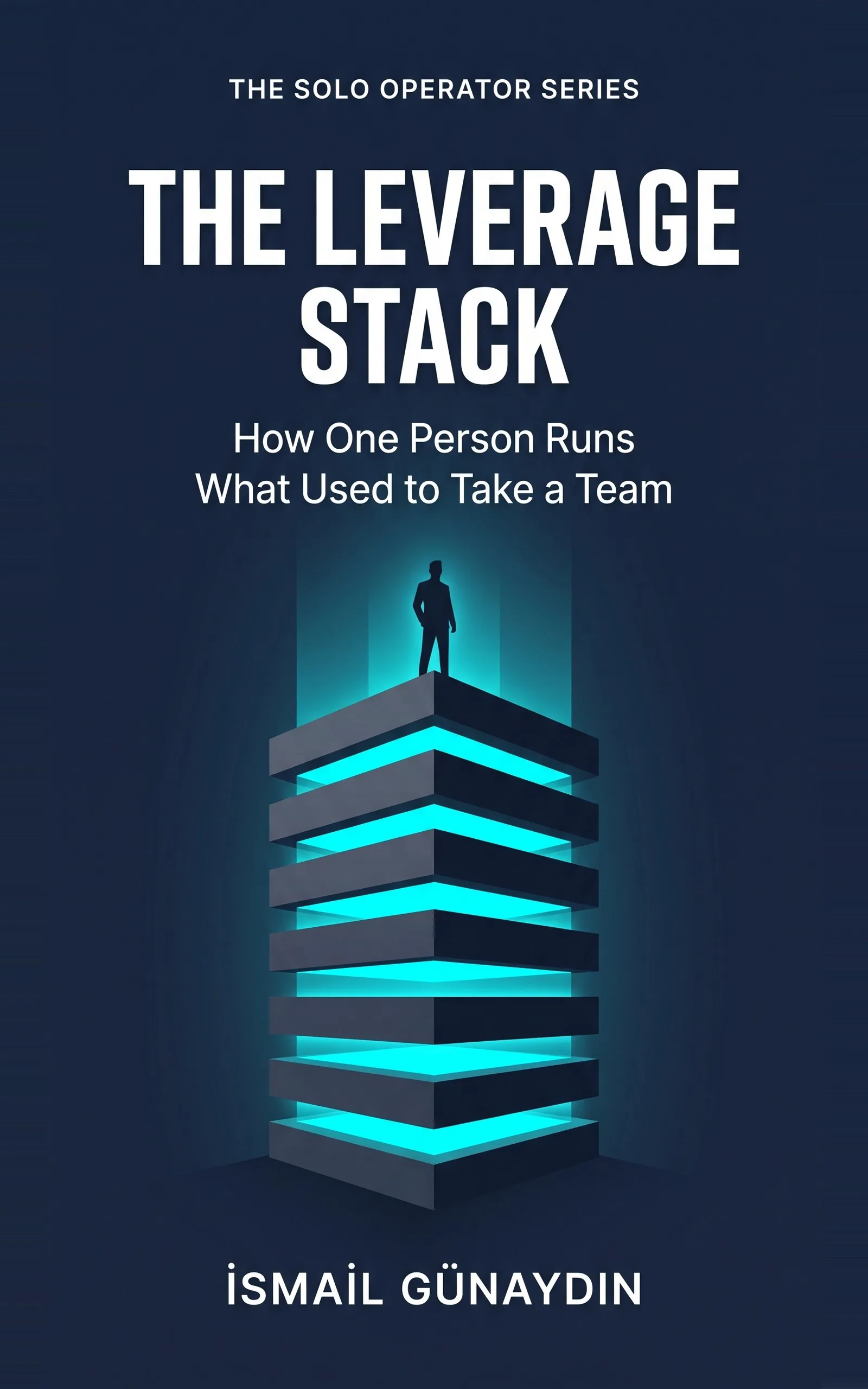
The book for this problem
The Leverage Stack
How One Person Runs What Used to Take a Team. By İsmail Günaydın, 80 pages.
Where this problem is in the book:
- The Handoffs
- The Dashboard
- The Bottleneck
Links go to Amazon. I wrote this book and earn a royalty on every sale. Amazon sets the price and handles delivery and returns.
Do these four things before you log off
You have a day off coming. Maybe it is tomorrow. Here is the short version.
- Narrate one normal job out loud. "The client says yes, and then I send the contract, and then I watch for the deposit, and then I chase it." Every "and then" is a step you carry by hand. Write each one down.
- Mark each step. Automate it, or Keep it on purpose. No blanks. A step with no mark is the one that stalls while you are gone.
- Switch on one. The one that fires most often and costs least if it misfires. A late-payment reminder is a good first pick. Test it once on yourself.
- Set two alarms and no more. One for "something broke." One for "this needs your call." Send them to one place you use for nothing else. Everything that worked stays silent.
That is it for today. Do not try to wire six things tonight. If they break, you will not know which one did it.

Tell people before they wonder
Rules keep the work moving. People still need to know you are away, or a quiet day reads as a slow reply.
The quickest step is an away reply. In Gmail it is the vacation responder: open Settings, then See all settings, and on the General tab turn it on, add the dates, a subject and a short message, then save. Gmail sends it once to most people, not on every email, and sends it again only if they write after four days or you change the message. You can limit it to your contacts.
Keep the message short and plain. Say when you are back. Say when they can expect a reply. If a booking or payment is time-sensitive, say what still goes out on its own, such as "contracts and confirmations still send as normal." Only promise what you actually switched on.
If you know the day off is coming, tell your current clients a few days ahead too. That turns a gap into a plan.

You are the glue, and glue cannot take a day off
Here is what is going on. Each part of your work may run fine. But between the parts, you are the one who carries things across. You paste the draft. You see the payment and send the next email. You "just check" the deposit before sending the files.
Those moves are so small they never make a to-do list. So no cleanup ever touches them. And the day you are not there, they do not happen.
The book has a name for this: handoffs. When this happens, that should start. Your job is to find every place you are the "should."

What to keep in your own hands
Not every step should run on its own. Ask two questions about each one.
Could you write down exactly how you do it, so a stranger would do it the same way? If yes, it is a rule, not judgment.
What would go wrong if a rule did it? If the answer is "nothing, I just like doing it," that step can go.
A real keep fails the first question and passes the second. Nadia, the wedding photographer in the book, kept one step out of seven: deciding if a couple is the right fit. She could not write that rule down, and a wrong call meant a wedding she would dread. The other six went to rules in one afternoon.

The phone in the bag
Nadia had built her steps to run, and she still checked her phone between shots. In her first week of trusting the quiet she opened her systems eleven times. Every time, all was fine. The next week it was five.
By the third week she shot a whole wedding with her phone in her bag. Not as a test. She just forgot to check. Only two things could pull her out, and they would have done it loudly.
That is the day off you want. Not one where nothing happens. One where silence means fine.
You are not the only one stuck here. The US Census Bureau reports that businesses with no staff have grown faster than businesses with staff for over a decade, and Census counts more than 30 million of them. I wrote the book for that crowd.

Where The Leverage Stack goes deeper
This is the problem The Leverage Stack was written for.
Chapter 6, The Handoffs, is the When, Then, Who map, with the four ways to spot steps you cannot see, and the order to switch them on: frequent and low-risk first.
Chapter 7, The Dashboard, sets up the three answers every system owes you: what ran, what failed, and what needs a human. Only the last two are allowed to ping you.
Chapter 1, The Bottleneck, is where to start if you want to see the whole jam, not just the handoffs.
When you get back, the free workbook has the Handoff Map ready to print. If the peeking is the real problem, read why you keep checking if your automations ran.

Is The Leverage Stack the right book for you?
Yes, if
- You have a day off, a trip or a sick day coming and you dread the pile after
- Clients wait on small steps that only you remember to do
- You check your phone on every day off because nothing moves without you
Skip it if
- You want to vanish for a month with nothing set up
- Your whole job is live, hands-on work that nobody else can do
Fair doubts before you buy
I don't have time to build systems before I leave.
Then don't build systems. Build one rule. The book is firm that wiring everything at once breaks things you cannot trace. Pick the one plain step that fires most often, like the late-payment reminder, and switch only that one on.
What if something goes wrong while I'm away?
That is exactly what the second step is for. You set it up so a real failure, like a declined card or a contract that did not send, pings you. Everything that worked stays quiet. So silence means fine, not 'I'm not sure'.
Get The Leverage Stack
You are not disorganized, you are the bottleneck: eight layers catch the work that does not need your judgment, so only real decisions reach you.
Links go to Amazon. I wrote this book and earn a royalty on every sale. Amazon sets the price and handles delivery and returns.
Part of The Solo Operator Series, five short books that can be read in any order.

Questions people ask about this
- How do I take a day off when I'm self-employed?
- Find the steps that only move because you carry them, switch the frequent and low-risk ones to run on their own, and set alerts only for real failures and real decisions. Then leave the phone alone unless it pings.
- What should I automate before going on vacation?
- The steps that fire often and cost little if they go wrong. A booking confirmation. A late-payment reminder. Adding a booking to the calendar. Leave rare, high-stakes steps manual until you have watched the simple ones work.
- Why does my small business fall apart when I'm not there?
- Because you are the link between the steps. The draft is done, and you paste it in. The payment lands, and you send the next email. Each move is tiny, so it never makes a list, and the day you are gone it just does not happen.
- How do I stop checking work emails on my day off?
- Make only two things able to reach you: something broke, or something needs your call. Send those to one place you use for nothing else. Everything else logs quietly. When nothing pings, do nothing. Each check that finds nothing teaches you that silence is not enough.
- Should I set an out-of-office reply for just one day off?
- Yes, if clients write to you often. It costs a minute and stops a quiet day from reading as a slow reply. Say when you are back and when they will hear from you. In Gmail, the vacation responder sends it once to most people rather than on every email. Only mention steps that really run without you.
Related problems
- You run a one-person business and you can't keep up. Here is what is actually broken.
Working more hours won't fix a one-person business that is behind. Find the tasks that only pass through you out of habit, then hand them off.
- I automated my admin, but I keep checking if it actually ran. Is that normal?
You automated the work and now you watch it all day. Here is why the checking happens, and how to set things up so silence means fine.
- I'm a freelancer drowning in client emails. What do I do this morning?
Forty-plus unread client emails and real work waiting? Sort them in one pass, cut the ones that should not exist, and draft the rest from a brief.
- How do I turn ChatGPT into a daily routine instead of something I use now and then?
ChatGPT helped once, then you went back to doing it by hand. Here is how to wire one task into a routine that starts without you remembering.
- Everything inside The Leverage Stack
Every chapter, who the book is for, and every problem it helps with.