Last updated
Does tai chi help balance, or is that just something people say?

The cover that promised you would never fall again
You are in the bookshop, or scrolling at night. A smiling woman on a cover sits in a chair. The title says something about balance. A line underneath says falls.
You want it to be true. Last winter you had a near miss on the step. Now you hold the rail every time, and you have stopped going out on wet days.
So you wonder. Does tai chi help balance, really? Or is it one of those things everybody says and nobody checked?
That is a fair question. Very few tai chi books answer it.

Why the usual answer mixes up two things
Ask around and you will hear "yes, tai chi is great for balance." That answer is not wrong. It is just blurry.
Most of the strong research is on standing tai chi. People stood up, stepped and shifted their weight, often for months, often three times a week. They lived at home, not in care homes.
Then that finding gets put on the cover of a chair tai chi book. The study and the book are about different things. You would not know unless someone told you.

What the studies actually say, in plain numbers
We will keep this short and give you the numbers the book gives.
Standing tai chi and falls. In 2019, a Cochrane review looked at exercise for falls in people aged 60 and over living at home. It pooled 108 trials and 23,407 people. With tai chi, 20 percent fewer people had a fall, and the reviewers rated that high certainty. The total number of falls may also have been 19 percent lower, but that part was low certainty.
One trial, up close. In 2005, Li and colleagues studied 256 inactive adults aged 70 to 92. After six months of tai chi three times a week, 28 percent had fallen, compared with 46 percent in a stretching group.
Care homes. For people in care facilities, a 2018 Cochrane review found the effect of exercise on falls was uncertain.
Chair tai chi. No trial has tested it for falls. A search done for the book found about 35 published records on seated tai chi and qigong. None measured falls.
Sitting balance. A trial of 59 older adults in four Hong Kong care homes found they could shift their weight while sitting 29.0 percent better after three months of seated tai chi. That is balance while sitting. A 2021 review of seated tai chi did not find enough support for sitting balance across studies.
So here is the honest picture. Standing tai chi: SOLID for people at home. Chair tai chi and falls: STORY ONLY, because nobody has tested it.

How much tai chi did the studies use?
People often ask how often they would need to practice. The trials give a rough idea. They did not use ten minutes now and then.
| Study | Who | How much |
|---|---|---|
| Li, 2005 (standing) | 256 inactive adults aged 70 to 92 | Three times a week for six months |
| Lee, 2015 (seated) | 59 people in four Hong Kong care homes | One hour, three times a week, for three months |
| Hsu, 2016 (seated) | 60 wheelchair users in one Taiwan care home | 40 minutes, three times a week, for 26 weeks |
A 2017 review by Lomas-Vega found the effect on falls was strongest in the first year and smaller over the longer term. The book reads that as a good reason to keep practicing.
The book's own plan is gentler than any of these trials. It suggests about ten minutes on most days. That is a habit, not a copy of a study.

What this means if you are nervous about your balance
It means two things, and both are kind.
First, the chair moves may be a gentle way in. You learn the slow pace, the breath and the turns while sitting safely. That is useful on its own.
Second, if your doctor agrees, there is a next step. The book has four optional standing moves done behind your chair, holding on with both hands. The National Institute on Aging describes a way to build up slowly: two hands, then one hand, then one finger. You never have to get past two hands.
Please talk to your doctor about your own balance before you try any of it. A near miss on a step is worth mentioning at your next visit.

A book that tells you what is not proven
This is the problem Classic Chair Tai Chi for Seniors was written for. Nancy Whitaker's book does not promise fewer falls. It says why.
The Evidence in One Page puts every common claim in one table with its badge, from falls and balance to sleep, mood and belly fat.
What the Research Says goes study by study, with the number of people, the ages and how sure the researchers were.
Four Standing Moves is the optional part, done behind a chair against a wall, only if your doctor agrees and ideally with someone in the room the first few times.
Before you try any move, read Safety First in the book, with its 70 percent rule and stop signs. For a side-by-side look, see our page on seated vs standing tai chi.
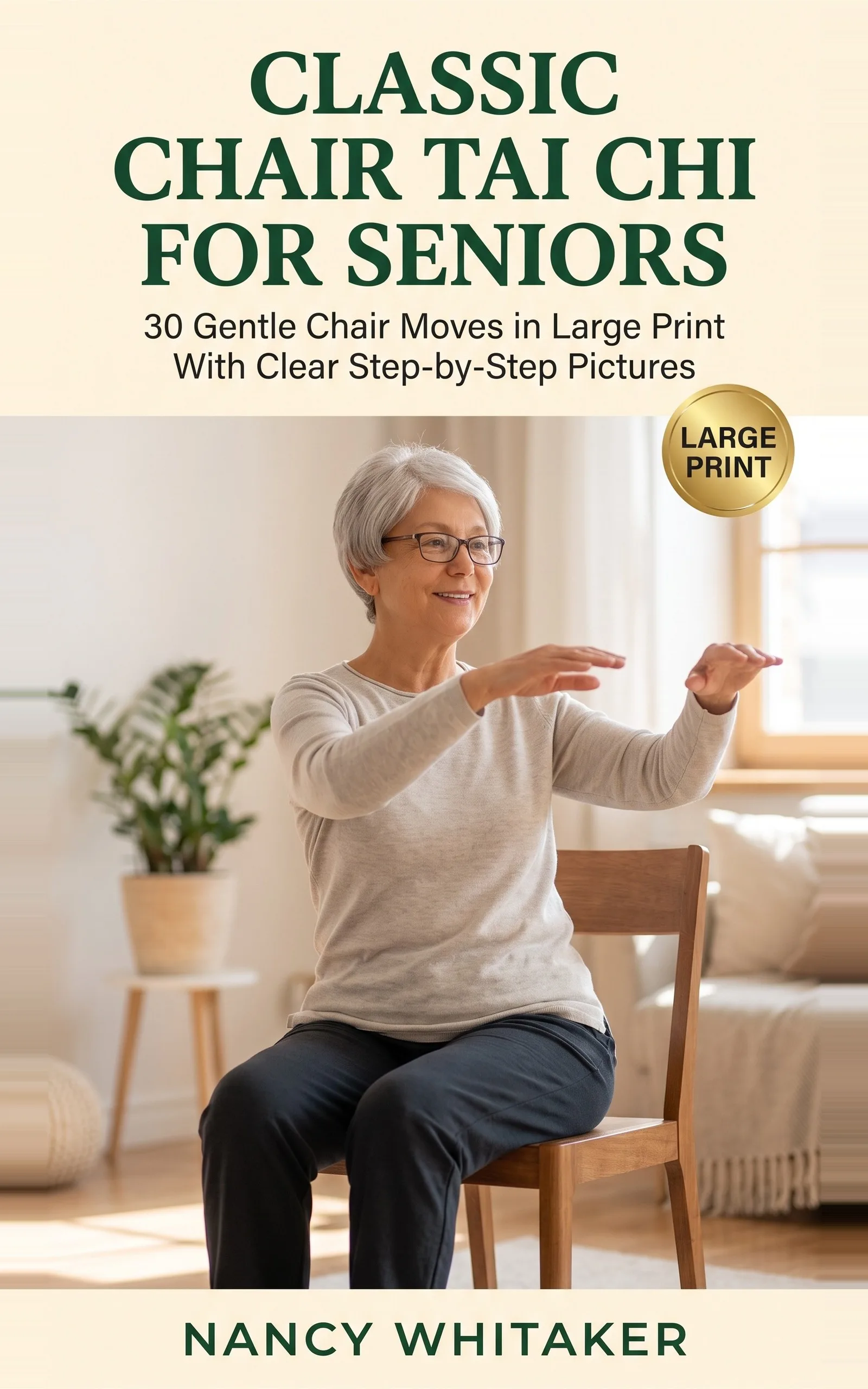
The book for this problem
Classic Chair Tai Chi for Seniors
30 Gentle Chair Moves From the Traditional Tai Chi Form and the Eight Brocades, in Large Print With Clear Step-by-Step Pictures, and What the Research Really Says. By Nancy Whitaker, 199 pages.
Where this problem is in the book:
- The Evidence in One Page
- What the Research Says
- Four Standing Moves
Links go to Amazon. ToolGenX publishes this book under a pen name and earns from every sale. Amazon sets the price and handles delivery and returns.

Is Classic Chair Tai Chi for Seniors the right book for you?
Yes, if
- You keep seeing tai chi sold as a cure for falls and you want the real numbers
- You worry about your balance and want to know what is proven
- You want to know how chair tai chi differs from standing tai chi in the research
Skip it if
- You want a book that promises you will stop falling
- You want medical advice about your own balance problem
Fair doubts before you buy
If the book doesn't promise better balance, why would I read it?
Because it tells you what is known, and then gives you a gentle way to move. Many covers promise an end to falls. This book puts a plain badge on every claim, SOLID, PROMISING, STORY ONLY or MYTH, so you can see how sure the researchers were. Then it teaches 30 moves, mostly seated, in large print.
Can't I just read the studies myself?
You can, and the book lists every source so you can. The hard part is that a study of standing tai chi in people at home is often quoted as if it covered chair tai chi in a care home. The book keeps those apart for you, study by study.
Get Classic Chair Tai Chi for Seniors
Every seated move is drawn from behind so your left is your left, in large print, with the research told honestly.
Links go to Amazon. ToolGenX publishes this book under a pen name and earns from every sale. Amazon sets the price and handles delivery and returns.
Talk to your doctor before starting any new exercise. This book makes no medical claims.

Questions people ask about this
- Does tai chi improve balance in seniors?
- For standing tai chi, the evidence is good. In a 2005 Oregon trial, the tai chi group improved on every balance test. A 2023 review of 13 trials found better balance while moving, but not clearly better balance while standing still. All of this was standing tai chi, not chair tai chi.
- Does tai chi reduce falls in older adults?
- Standing tai chi did, in large studies of people living at home. A 2019 Cochrane review of 108 trials found 20 percent fewer people fell, rated high certainty. In a 2005 trial of 256 adults aged 70 to 92, 28 percent of the tai chi group fell against 46 percent in a stretching group. No trial has tested chair tai chi for falls.
- Does chair tai chi help with balance?
- It is not proven. One trial of 59 older adults in Hong Kong care homes found better weight shifting and reach while sitting after three months. That is sitting balance, not standing balance. A 2021 review of seated tai chi did not find enough support for sitting balance across studies.
- Does tai chi help with fear of falling?
- Maybe. The 2005 Oregon group felt less afraid of falling. A 2023 review also found less fear of falling, but the result sat right on the edge of what could be chance. An older 2010 review said the evidence was not enough to be sure.
- Is tai chi better than other exercise for balance?
- The book does not claim that. In one 2018 trial of 670 adults at high risk of falling, a tai chi program led to 31 percent fewer falls than a mixed exercise program. That was standing tai chi. Ask your doctor which kind of exercise fits your own balance.
- What are the downsides of tai chi for older adults?
- Mostly minor aches. A 2014 review of 153 trials found side effects, where reported, were usually aches in muscles and joints, such as knee and back pain, with no serious harm caused by tai chi. Only about a third of the trials reported side effects at all. A 2019 review of 24 trials found no more side effects than in the comparison groups. Most of these trials used standing tai chi.
Related problems
- Seated vs standing tai chi: which one fits you right now?
Seated vs standing tai chi, side by side: where the moves come from, what each asks of your legs, and what the research has and has not tested.
- Chair tai chi for beginners: how to start when you have never done it
New to chair tai chi? Start with the right chair, one seated posture and the 70 percent rule, then add one or two moves a week. Talk to your doctor first.
- Exercise for seniors with knee or hip problems, once your doctor says yes
Your doctor cleared you for gentle exercise after knee or hip trouble. Here are the seated rules: what to skip, what to shrink, and when to stop.
- Everything inside Classic Chair Tai Chi for Seniors
Every chapter, who the book is for, and every problem it helps with.