Last updated
Seated vs standing tai chi: which one fits you right now?

| Topic | Seated tai chi (this book) | Standing tai chi |
|---|---|---|
| Where it comes from | The author's own adaptation of the 24-form; no agreed seated form exists | The 24-form, made in China in 1956 from Yang style |
| Arms, waist and eyes | Same arm paths, waist turns and eye line | The original paths |
| Legs | Steps become small foot slides; weight shifts become a gentle lean | Real steps, weight shifts, kicks and low stances |
| Turning | Chest turns no farther than 10 or 2 o'clock | Whole body turns with the steps |
| Falls research | No trial has tested it | 20% fewer people fell, people at home, high certainty (2019) |
| Balance research | Small studies found better sitting balance; a 2021 review was not yet convinced | Good evidence |
| Who it suits | People for whom standing is not safe right now, including many wheelchair users | People cleared to stand and step, ideally with a teacher |
How to read the table above
Start with the second row. It is the reason chair tai chi is still tai chi. The arms travel the same path. The waist turns the same way. Your eyes look where they would look standing up.
Now look at the legs row. That is where the two split. Standing, you step forward, shift your weight and sometimes sink into a low stance. In the chair, a step becomes a small slide of the foot, heel down. A shift of weight forward becomes what the book calls "lean in," a tip of about 10 degrees from the hips with a long, straight back. Coming back up is "sit back."
The turning row matters more than it looks. The book uses a clock face. You face 12 o'clock, and your chest never turns past 10 or 2. That keeps every turn small enough for a chair.

What the research rows really tell you
The two research rows are the honest heart of the table.
The falls finding is real. In 2019, a Cochrane review of 108 trials found 20 percent fewer people fell when they did standing tai chi, for people living at home. But no trial has tested chair tai chi for falls. That is not bad news about chair tai chi. It is simply a gap.
For balance, small seated studies found better balance while sitting. A 2021 review of seated tai chi by Zhao and colleagues did not find enough support for it across studies yet. So the book gives chair tai chi a PROMISING badge, and standing tai chi a SOLID one.
We would rather you know this before you choose, and so would the book. That is why we put the research rows in our table at all.

The class flyer on the fridge
Your friend has a flyer for a tai chi class at the library. Standing, Tuesdays, an hour. She wants you to come.
You would like to. But an hour on your feet, stepping and turning, sounds like a lot. And you are not sure what your knee would say.
Here is a calm way to think about it. Ask your doctor whether standing and stepping are safe for you. If yes, the class can be a fine thing. If not yet, the seated moves give you the same shapes and the same slow breath, sitting down. You can still go with your friend another time.

Can you do both, sitting and standing?
Many tai chi videos offer a sit or stand option for each move. You do not have to pick one side of the table for good. The book works in stages.
For the first five weeks of its six-week plan, every move is seated. In week 6, it adds four standing moves, but only if your doctor agrees and you can stand up from a chair safely on your own.
Those standing moves are done behind your chair, holding on. Here is how the book sets it up.
- Turn the chair so the front of the seat touches a wall. The chair back faces you and cannot slide away.
- Rest both hands on top of the chair back. Wear flat shoes with good grip.
- Keep a second chair or a wall close by, so you can sit or steady yourself at any moment.
- Have someone in the room the first few times. They only need to be there.
The National Institute on Aging describes a way to build up support: two hands on the chair, then one hand, then one finger. You never have to get past two hands. And on a tired day, the book says to skip the standing moves.

Does either one help you lose weight?
People often search for this, so here is the plain answer from the book. Neither kind of tai chi is a weight-loss method.
The best trial the book found studied 543 adults aged 50 and over with extra weight around the middle. After 12 weeks, waists in the tai chi group shrank 1.8 cm more than in a group that made no change. That is about three-quarters of an inch. A regular exercise group came in at 1.3 cm.
For seated practice, a 2025 study of seated Eight Brocades in Taiwan found no change in body fat.
So pick seated or standing for comfort and safety, not for your waist.

The seated side of the table, taught move by move
This is the problem Classic Chair Tai Chi for Seniors was written for. Nancy Whitaker's book teaches the seated side of this table and is plain about the rest.
Where Tai Chi Comes From explains the 24-form of 1956 and the much older Eight Brocades, and checks the myths, such as "5,000 years old."
The First Six Moves shows how each standing move becomes a chair move, with frames drawn from behind so your left is your left.
The Evidence in One Page gives every claim its badge, so you can see which results came from standing practice.
Four Standing Moves is optional, done holding a chair against a wall, only with your doctor's okay. Before any move, read Safety First with its 70 percent rule and stop signs. The US National Center for Complementary and Integrative Health also suggests telling your health care providers about any practice like this.
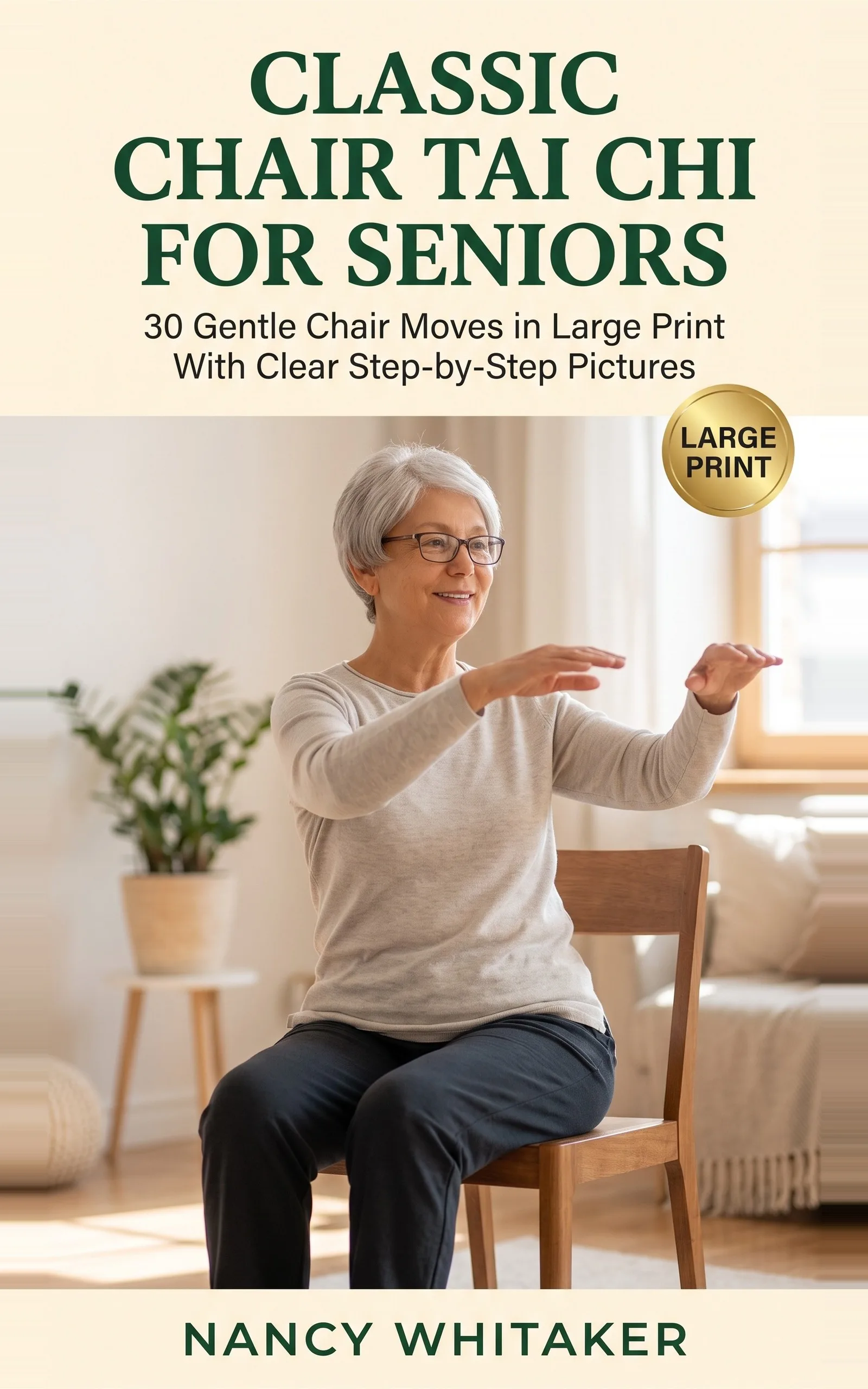
The book for this problem
Classic Chair Tai Chi for Seniors
30 Gentle Chair Moves From the Traditional Tai Chi Form and the Eight Brocades, in Large Print With Clear Step-by-Step Pictures, and What the Research Really Says. By Nancy Whitaker, 199 pages.
Where this problem is in the book:
- The Evidence in One Page
- Where Tai Chi Comes From
- The First Six Moves
- Four Standing Moves
Links go to Amazon. ToolGenX publishes this book under a pen name and earns from every sale. Amazon sets the price and handles delivery and returns.

Is Classic Chair Tai Chi for Seniors the right book for you?
Yes, if
- You are choosing between a chair class and a standing class
- Standing for long feels unsafe, but you want the real thing
- You want to know what the seated version keeps and what it leaves out
Skip it if
- You want to learn the full standing 24-form step by step
- You want a promise that one kind is healthier for you
Fair doubts before you buy
Isn't seated tai chi just a watered-down modern version?
Partly false, the book says. Old Chinese sources describe a seated set of the Eight Brocades, and researchers have used seated tai chi in their studies. What is true is that there is no agreed seated form of the 24-form, so the chair moves in the book are the author's own adaptations, and the book says so on page one.
Why not just go to a standing class?
If your doctor agrees and you can stand and step safely, a good local class can be a fine thing. The book suggests asking about a teacher's training and experience. The seated moves are for the days, or the years, when standing is not the safe choice.
Get Classic Chair Tai Chi for Seniors
Every seated move is drawn from behind so your left is your left, in large print, with the research told honestly.
Links go to Amazon. ToolGenX publishes this book under a pen name and earns from every sale. Amazon sets the price and handles delivery and returns.
Talk to your doctor before starting any new exercise. This book makes no medical claims.

Questions people ask about this
- Is chair tai chi as good as standing tai chi?
- Nobody can say, because they have not been tested the same way. Almost all of the strong research is on standing tai chi. Chair tai chi studies are few and small, mostly in care homes and with wheelchair users, and the book rates their results as promising.
- What is the difference between seated and standing tai chi?
- The arms, waist turn and eye line stay the same. The legs change. In a chair, steps become small slides of the foot along the floor, and a shift of weight becomes a small lean from the hips with a long, straight back. Kicks and deep stances are left out.
- Can you do real tai chi sitting down?
- The twelve chair moves in the book come from the real 24-form and keep their traditional names, such as Part the Wild Horse's Mane. The seated versions are adaptations, not an official form, because no agreed seated version exists. A 2020 research paper by Zhao and colleagues said the same.
- Does standing tai chi prevent falls better than chair tai chi?
- Standing tai chi reduced falls in large studies of people living at home. Chair tai chi has never been tested for falls, so there is nothing to compare. That is why the book makes no promise about falls for the seated moves.
- Can I move from chair tai chi to standing tai chi?
- Some readers may later move on to standing practice with a teacher. The book has four optional standing moves done behind a chair, holding on, only if your doctor agrees. Talk to your doctor before you add any standing work.
- What is the 70 percent rule in tai chi?
- It is a simple safety rule many tai chi teachers use, set out by the Tai Chi for Health Institute. For the first few weeks, move only about 70 percent as far as you could, and stop well before any strain. It applies to seated and standing practice alike. You should feel you could go farther, but you choose not to.
Related problems
- Does tai chi help balance, or is that just something people say?
Does tai chi help balance? Standing tai chi has good evidence. Chair tai chi has only small studies and no falls trials. Here are the numbers.
- Chair tai chi for beginners: how to start when you have never done it
New to chair tai chi? Start with the right chair, one seated posture and the 70 percent rule, then add one or two moves a week. Talk to your doctor first.
- Exercise for seniors with knee or hip problems, once your doctor says yes
Your doctor cleared you for gentle exercise after knee or hip trouble. Here are the seated rules: what to skip, what to shrink, and when to stop.
- Everything inside Classic Chair Tai Chi for Seniors
Every chapter, who the book is for, and every problem it helps with.