Last updated
A 10-minute daily exercise routine for seniors you can do in a chair

| Order | Move | How many |
|---|---|---|
| 1 | W01 Neck turns | 3 to each side |
| 2 | W02 Shoulder rolls | 5 back, 5 forward |
| 3 | W06 Breathing with arm rise | 5 times |
| 4 | T01 Commencing Form | 3 times |
| 5 | T02 Part the Wild Horse's Mane | 3 to each side |
| 6 | T03 White Crane Spreads Its Wings | 3 times |
| 7 | T08 Wave Hands Like Clouds (leave out until week 4) | 3 to each side |
| 8 | T12 Closing Form | Once |
How to read the routine table
The table above is the book's everyday routine. Here we copied it in the same order the book gives it. The code at the front of each move, like W01 or T02, is where you find its page in the book. The last column is how many times to do it.
The first three moves are warm-ups. They wake up your neck and shoulders and set the slow pace with your breath. Then come four tai chi moves from the 24-form, a short form made in China in 1956 for ordinary people. Closing Form ends it.
One row has a note. Wave Hands Like Clouds is added in week 4 of the book's six-week plan. Until then, leave it out. The routine is a little shorter, and that is fine.
Times are rough. A slow day takes longer.

How the ten minutes add up
The routine has three parts. The book gives a rough time for every move, so here is how they add up.
| Part | Moves | About |
|---|---|---|
| Warm-up | Neck turns, shoulder rolls, breathing with arm rise | 3 to 4 minutes |
| Tai chi | Commencing Form, Part the Wild Horse's Mane, White Crane, Wave Hands Like Clouds | 6 minutes |
| Close | Closing Form, then 30 seconds sitting still | 1 to 2 minutes |
Before week 4, when you leave out Wave Hands Like Clouds, the whole thing takes about 8 or 9 minutes. That is fine. Slow is the point.

Set up your chair before you start
Most 10-minute chair routines skip this part, and it is the part that keeps you safe. The book's chair rules are short.
- Use a sturdy chair with no arms and no wheels. A plain kitchen or dining chair often works well. Armrests get in the way of wide arm moves, and wheels can roll when you lean.
- Push the back of the chair against a wall if you can, so it cannot slide.
- Keep the floor clear. No loose rugs. Stretch your arms out to the sides and to the front. You should not touch anything.
- Sit on the front half of the seat. Feet flat, about hip-width apart. Knees above your ankles, bent at about a right angle.
- Wear flat shoes that grip. Socks on a smooth floor can slide.
If you use a wheelchair, put the brakes on first and use the range your armrests allow.

The four pacing rules that go with it
The routine is the what. These rules from the book are the how.
Move at the speed of your breath. Let each in-breath and out-breath set the speed of your arms. If your breath feels rushed, your arms are going too fast.
Use about 70 percent of your range. For the first weeks, go only about two-thirds to three-quarters of the way. This rule is set out by the Tai Chi for Health Institute.
Never hold your breath. If a breathing cue feels forced, just breathe normally and keep moving.
Stop on pain. Stop any move that causes pain, dizziness, chest pain or shortness of breath. Get medical advice before you go on.
When you finish, sit still for three easy breaths. Then stay seated for 30 seconds before you stand up.

Want to work your legs too?
Many seated routines you will find online add leg work, such as marching in place, leg lifts and heel raises. The everyday routine above is mostly neck, arms, waist and breath. If you want your legs in it, the book has two seated moves you can add.
W04 Ankle circles and toe taps (about 2 minutes). Hold the sides of the seat. Slide one foot forward with the heel on the floor and draw slow circles with your toes. Then, with both feet back under your knees, lift your toes, then your heels, like keeping time to a slow song. Add it after the shoulder rolls.
B08 Raising and lowering the heels (about 1 minute). Sit tall with your feet flat. Breathe in and lift both heels as high as is comfortable. Breathe out and lower them softly. Add it just before Closing Form.
With both added, the routine runs about 13 minutes. On a short day, keep the leg moves and leave out Wave Hands Like Clouds.

Is ten minutes a day enough?
Ten minutes every day adds up to 70 minutes a week. That is a good habit, but it is not the full amount. The CDC says adults 65 and older need three kinds of activity each week:
- At least 150 minutes of moderate activity, such as brisk walking
- At least 2 days of activity that makes your muscles work harder
- Activities that help your balance
Gentle chair tai chi is slow and light. Think of it as your daily base, the part you never skip, not the whole plan. Ask your doctor what to add on top for your health, such as a walk or a strength class.

Ten minutes before the kettle boils
It is morning. You have had a long night and your neck feels like wood. The coffee is not ready yet.
You sit on the front half of a kitchen chair, feet flat. You turn your head slowly, three times each way. You roll your shoulders. Your arms float up with one breath and down with the next.
By the time you reach Closing Form, the kettle has clicked off. Nothing dramatic happened. You moved, gently, on purpose. Tomorrow you will do the same.
That is the whole idea. A habit small enough that you keep it. Before you begin, check with your doctor, and read the safety rules from the US National Center for Complementary and Integrative Health, which says tai chi appears to be safe but should never stand in for seeing a doctor.

Every move in the routine, with pictures
This is the problem Classic Chair Tai Chi for Seniors was written for. Nancy Whitaker's book gives you the routine above, plus the pictures to do each move.
Routines and a Six-Week Plan has the 10-minute routine, a 20-minute routine, the evening wind-down and a page for stiff or tired days.
Six Warm-Ups and The First Six Moves hold the pages for every move in the routine, each with numbered frames drawn from behind so your left is your left.
Your Practice Log is six weeks of pages to tick off each day and note how you felt.
Read Safety First in the book before you start, for the chair, the shoes and the stop signs. New to all this? Our page on chair tai chi for beginners starts at the very first step.
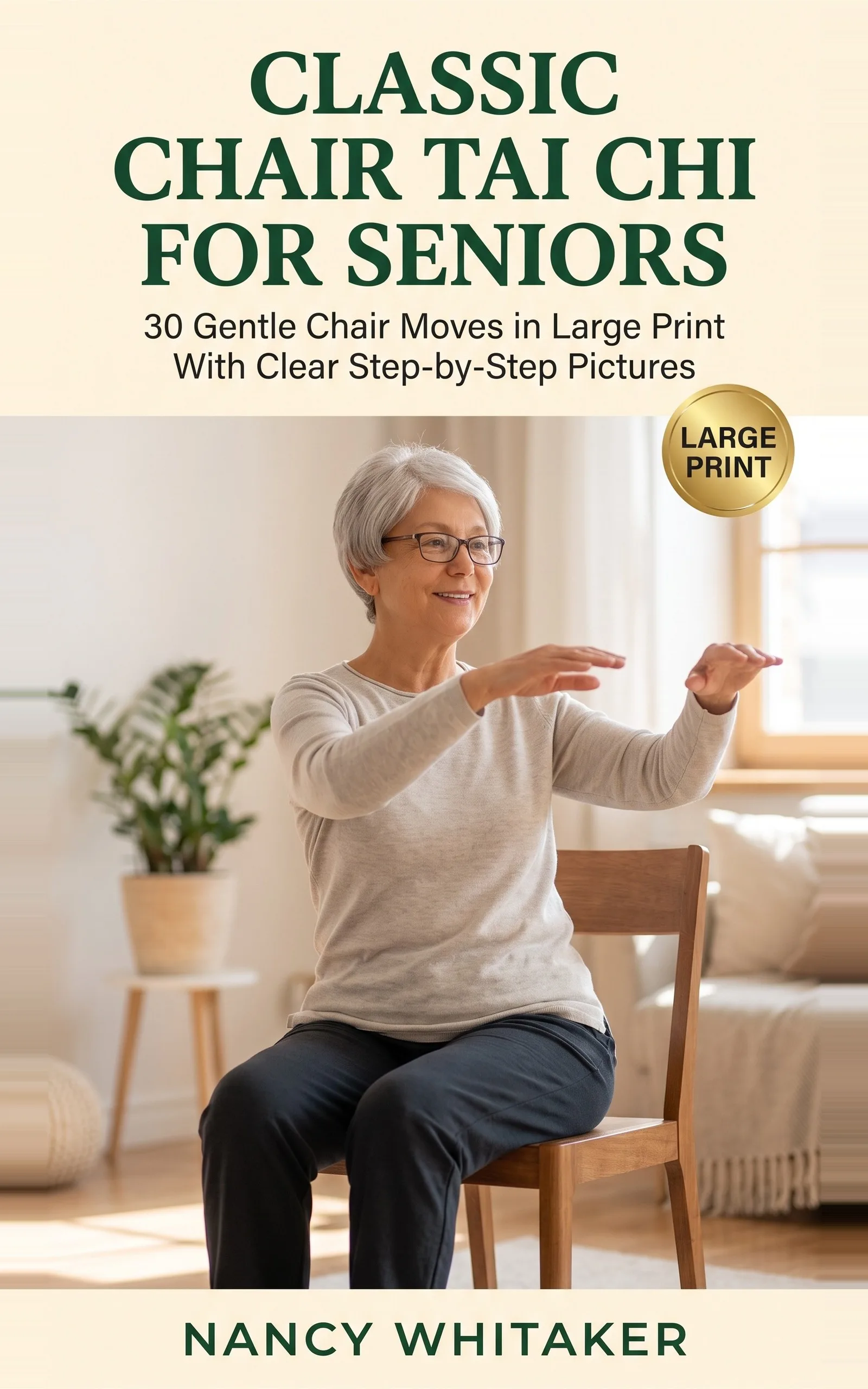
The book for this problem
Classic Chair Tai Chi for Seniors
30 Gentle Chair Moves From the Traditional Tai Chi Form and the Eight Brocades, in Large Print With Clear Step-by-Step Pictures, and What the Research Really Says. By Nancy Whitaker, 199 pages.
Where this problem is in the book:
- Routines and a Six-Week Plan
- Six Warm-Ups
- The First Six Moves
- Your Practice Log
Links go to Amazon. ToolGenX publishes this book under a pen name and earns from every sale. Amazon sets the price and handles delivery and returns.

Is Classic Chair Tai Chi for Seniors the right book for you?
Yes, if
- You want one short routine you can repeat every morning
- You sit for long stretches and want to move a little
- You do not want to decide what comes next each time
Skip it if
- You want a workout that raises your heart rate a lot
- You have not yet checked with your doctor about exercise
Fair doubts before you buy
Is ten minutes really enough to bother with?
The book's view is little and often. Ten minutes on most days is easier to keep than one long session a week. It does not promise a health result from those ten minutes. It gives you a habit you can actually keep.
Can't I just make up my own routine?
You can. The catch is that you then decide every day, and deciding is where many habits stop. The ready-made routine means you sit down and start. The book also has a 20-minute routine and an evening wind-down for variety.
Get Classic Chair Tai Chi for Seniors
Every seated move is drawn from behind so your left is your left, in large print, with the research told honestly.
Links go to Amazon. ToolGenX publishes this book under a pen name and earns from every sale. Amazon sets the price and handles delivery and returns.
Talk to your doctor before starting any new exercise. This book makes no medical claims.

Questions people ask about this
- What is a good 10-minute exercise routine for seniors?
- The book's seated routine is eight moves: neck turns, shoulder rolls, breathing with an arm rise, then Commencing Form, Part the Wild Horse's Mane, White Crane Spreads Its Wings, Wave Hands Like Clouds and Closing Form. Check with your doctor first.
- Is 10 minutes of exercise a day enough for seniors?
- Ask your doctor what amount is right for you. The book suggests ten minutes on most days as a habit that is easy to keep. It makes no claim that ten minutes of chair tai chi will change a health condition.
- What time of day should seniors exercise?
- The book says the 10-minute routine works well in the morning, or any time you have been sitting still for a while. For the end of the day, it has a separate, slower evening wind-down with no brisk moves or big turns.
- What should I do on days I feel too stiff to exercise?
- Do less, not nothing, unless something is wrong. The book suggests warm-ups only, the easier version of each move, or half the repeats. If you are very tired, sit tall and do breathing with an arm rise five times, then rest. Fresh pain or swelling means rest and call your doctor.
- How do I keep a daily exercise habit as a senior?
- Keep it short and the same. Use one ready-made routine and tick a box each day in a log. The book's practice log has a column for how you felt, from 1 for stiff to 5 for easy. A blank day is fine. Just start again the next day.
- Can a 10-minute chair workout burn belly fat?
- Not in any way you would notice. The book looks at the best trial: in 2021, 543 adults over 50 with extra weight around the middle did tai chi for 12 weeks, and their waists shrank 1.8 cm more than in a group that made no change, about three-quarters of an inch. That change is real but tiny. Tai chi is not a weight-loss method. Do it for the habit and the gentle movement.
Related problems
- Chair tai chi for beginners: how to start when you have never done it
New to chair tai chi? Start with the right chair, one seated posture and the 70 percent rule, then add one or two moves a week. Talk to your doctor first.
- Chair exercises for seniors at home: a gentle place to begin
Looking for chair exercises for seniors at home? Set up a safe chair and space, then try slow seated tai chi moves. Check with your doctor first.
- Exercise for seniors with knee or hip problems, once your doctor says yes
Your doctor cleared you for gentle exercise after knee or hip trouble. Here are the seated rules: what to skip, what to shrink, and when to stop.
- Everything inside Classic Chair Tai Chi for Seniors
Every chapter, who the book is for, and every problem it helps with.