Last updated
You keep asking ChatGPT if a business decision is right, just to make the doubt stop
It is 11:40pm and the stone in your chest will not move
A client wants to make a big move. The numbers half support it. Your gut does not.
You open the laptop and type, "Is this a good move?" The AI answers in four tidy paragraphs. Yes, here is why, here are the risks, here is how to manage them.
The doubt does not leave. But it goes quiet. You close the laptop and think, "There. Settled."
In the book, this is exactly what Jonah does. He sends the advice in the morning. It turns out wrong, in just the way his gut was trying to tell him at midnight.
Why "just be confident" makes this worse
The usual advice is to trust yourself, silence the inner critic and project certainty. Founders hear it all the time.
That advice treats doubt as a flaw. The book treats it as data. Doubt is often what judgment feels like before it has the words. Some part of you noticed something, and the unease shows up before the reason does. Kill the feeling and you kill the signal.
You are not alone in feeling this strongly. In one study, entrepreneurs reported a lifetime history of mental health conditions at about 72 percent, against 48 percent in a comparison group (Freeman et al., Small Business Economics). That is one study of one group. It is not a diagnosis of you. If stress is hurting your health, please talk to a qualified professional.
The other half of the usual advice, "trust your gut," fails too. Not all doubt is wisdom. Some of it is just a long day.
Sort the doubt before you ask the machine
The book gives you three bins.
A warning is specific. It sticks to a real thing: a clause, a number that does not add up, a tone in an email that does not match the words. It gets louder the closer you look. Move: find that one fact before you decide.
Tiredness is vague. It shows up late, often after many decisions in a row. Field research found the quality of high-stakes decisions drops across a working day as decisions pile up. It fades after sleep with no new facts. Move: do not decide tonight.
Fear is about you, not the choice. It gets worse when you picture people watching. Ask, "What would I do if no one would ever know how this turned out?" If the answer feels obvious, it was fear. Move: set it aside and choose on the facts.
The AI cannot do this sorting. It cannot feel the stone in your chest. It only reads your words, and it answers with the same calm tone whether the right reply is "go ahead" or "run."
Use AI to inform the doubt, not to silence it
This does not mean keep AI out of hard calls. Ask it to list the risks, find the clause you missed, or argue the other side. That is the tool at its best.
The line is simple. If you are typing to know more, good. If you are typing to feel better, stop your hand.
Months after the bad call, Jonah gets a similar night. He notices his hand moving to the keyboard, and he stops. He sits with the doubt for about ten minutes. Then he writes it out. One strand is a warning: the new vendor's support has gone quiet on the client's last two tickets. One is fear of looking timid. One is just tiredness at 11:40 on his eighth real decision of the day.
He uses the AI to pull the vendor's reliability data. It confirms the gap. He sleeps, and in the morning he advises "not yet, here is what to fix first." That was what his gut had been reaching for.
There is a quieter cost to the reassurance habit too. A 2025 study of 666 people linked heavy AI use with weaker critical thinking (Gerlich, Societies). It is a link, not proof of cause, but reading your own doubt is a skill, and skills fade without use. I would rather sit with ten uneasy minutes than lose it.
How to stop asking ChatGPT for reassurance
The machine will never tell you to stop. It answers the same worried question as many times as you type it, in the same calm voice. So the stop has to come from you. The book's method is four steps, in order.
- Name it. Put the doubt into one sentence. "I am uneasy about this client" is a feeling. "They changed scope twice and have not paid the deposit" is information.
- Sort it. Warning, tiredness or fear. Use the three bins above.
- Read it. A warning says there is a fact you have not found yet. Tiredness says your judgment is not reliable tonight. Fear says the choice feels risky to you, which is not the same as it being wrong.
- Move. Find the fact, sleep on it, or choose on the facts as if no one were watching.
Only then open the chat, and only to learn something. A good test before you hit send: am I asking to know more, or to feel better? If it is the second, close the tab and do step 1 on paper.
The book also warns about the long run. Each time you hand the discomfort to the machine, you get less practice sitting with it. Do that long enough and you can end up needing an outside voice to feel okay about any choice at all.
When reassurance seeking is more than a habit
For most business owners this is a habit, and the steps above help. For some people it is part of something bigger. The NHS lists asking for reassurance among the common compulsions in obsessive compulsive disorder (OCD).
The book is not a mental health book, and this page cannot tell you which one you have. If you ask the same question again and again, the relief fades within minutes, and it is getting in the way of your work or your life, please talk to your doctor or a qualified therapist.
The chapter written for this habit
This is the problem AI Won't Run Your Business. You Will. was written for.
The Doubt: Information to Read, Not Weakness to Suppress is the whole chapter on this. It covers the three bins, the four questions (name it, sort it, read it, then move), and the four common ways people misread their own doubt.
The Decision: AI Offers; You Choose, and You Live With It picks up once the doubt is read, with a four-line sheet for owning the choice.
The free Judgment Workbook includes the Doubt Decoder, the four-column sheet Jonah filled that night. If the bigger worry is that your thinking feels weaker overall, read feeling dumber after relying on AI.
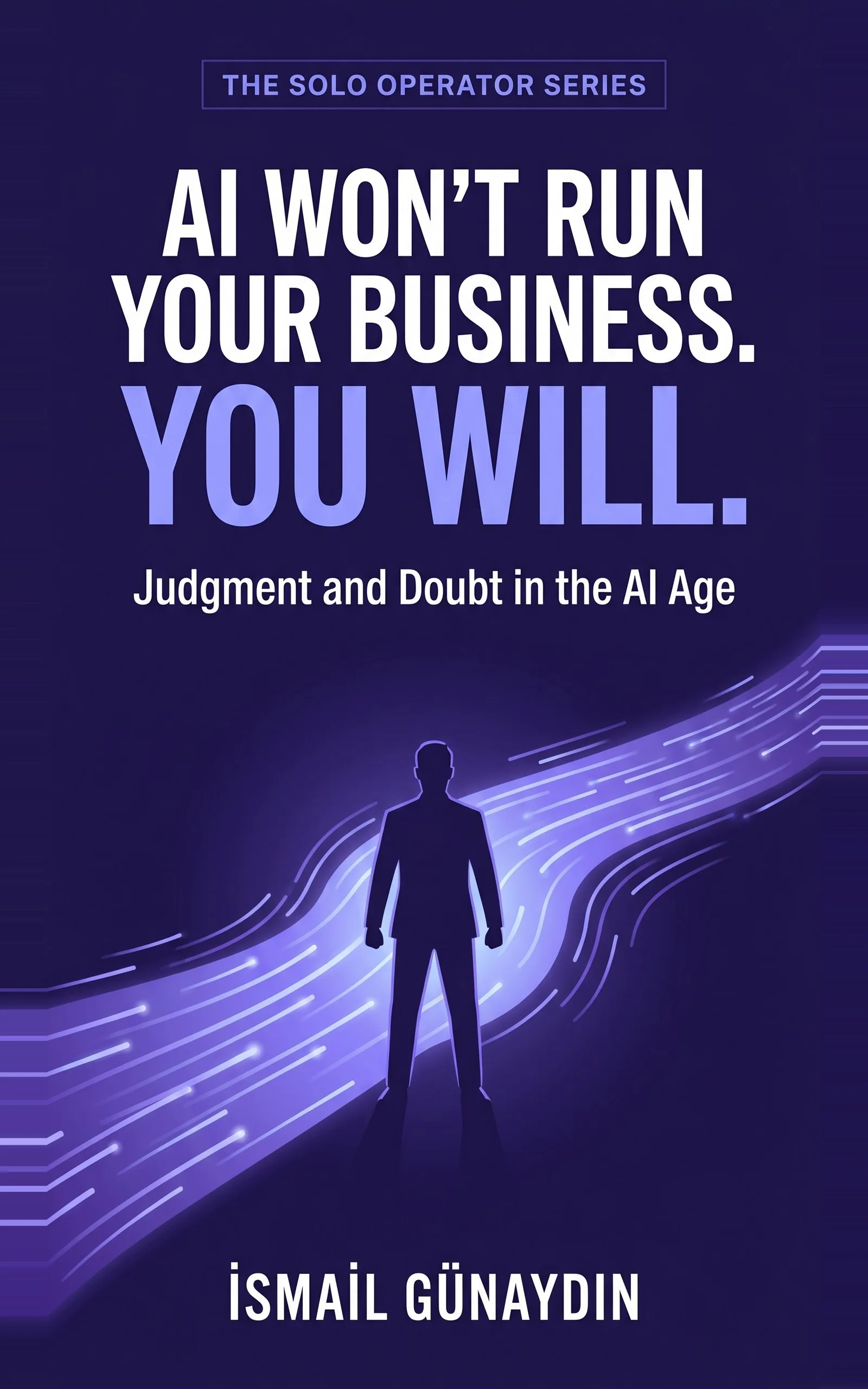
The book for this problem
AI Won't Run Your Business. You Will.
Judgment and Doubt in the AI Age. By İsmail Günaydın, 60 pages.
Where this problem is in the book:
- The Doubt: Information to Read, Not Weakness to Suppress
- The Decision: AI Offers; You Choose, and You Live With It
Links go to Amazon. I wrote this book and earn a royalty on every sale. Amazon sets the price and handles delivery and returns.
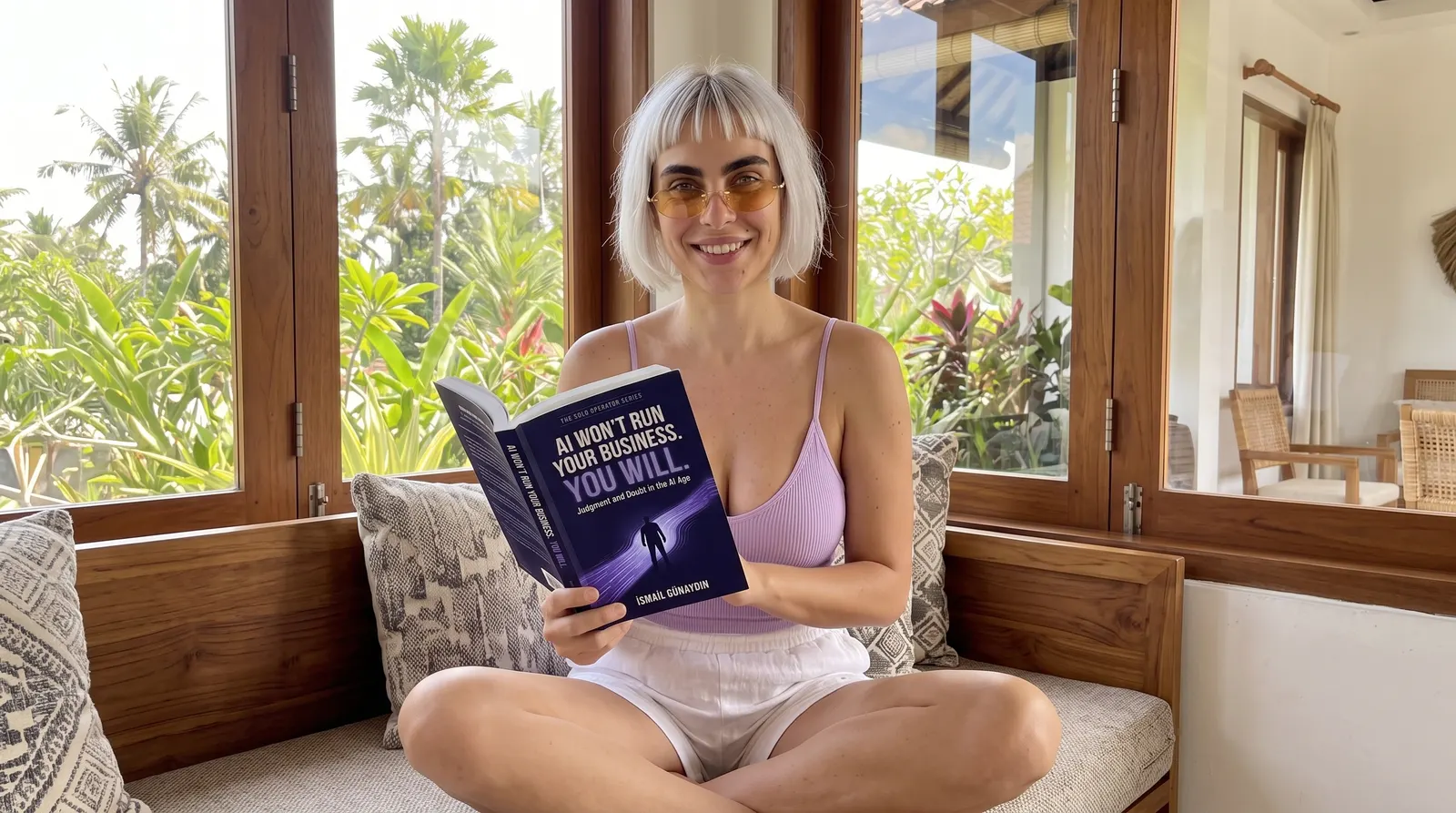
Is AI Won't Run Your Business. You Will. the right book for you?
Yes, if
- You type a decision into ChatGPT late at night just to feel settled
- Your gut said no once, the AI said yes, and your gut was right
- You cannot tell if your unease is a real warning or just nerves
Skip it if
- You want therapy or mental health help (talk to a qualified professional)
- You want to be told to always trust your gut
Fair doubts before you buy
Isn't doubt just a confidence problem I should get over?
The book argues the opposite. Doubt is often your judgment arriving before you can put it in words. Some doubt is noise, like tiredness or fear, and the book shows you how to set that aside. But treating all doubt as weakness throws away your best early warning.
I already journal. Is this different?
It is narrower. The Doubt Decoder is four columns: the doubt, which kind it is, what it is telling you, and your move. It is built for one decision at a time, and each kind of doubt gets a different move.
Get AI Won't Run Your Business. You Will.
AI is right often enough that you stop checking; five human jobs keep your hand on the wheel when it is confidently wrong.
Links go to Amazon. I wrote this book and earn a royalty on every sale. Amazon sets the price and handles delivery and returns.
Part of The Solo Operator Series, five short books that can be read in any order.
Questions people ask about this
- Is it bad to ask ChatGPT for reassurance?
- It can be. Using it to find facts is great. Using it to make a bad feeling stop is the risk, because it gives a calm, sure answer no matter what your doubt was. If the doubt was a real warning, the answer quietly erases it.
- How do I know if my gut feeling is right about a business decision?
- Try to name it. A real warning can usually be named, like a deposit not paid or scope changed twice, and it gets sharper as you look. If you cannot name anything, and it is late, it is likely tiredness. If it fades when you imagine no one would ever know the result, it was fear.
- Why do I second-guess every business decision?
- Part of it may be load. Field research found the quality of high-stakes decisions drops across a working day as decisions pile up. The doubt you feel on your ninth decision at 11pm is often a tired mind, not new information. Sleep on it and look again.
- Should I make big decisions when I am tired?
- The book says no. When your doubt sorts as tiredness, the move is never decide anyway. It is decide tomorrow, rested. A delayed decision beats one made on an empty tank.
- Is it normal for business owners to feel a lot of self-doubt?
- Very common. One study found entrepreneurs reported a lifetime history of mental health conditions at about 72 percent, against 48 percent in a comparison group. That is one study of one group, not a verdict on you and not a diagnosis. It suggests people who start things often feel things strongly.
- Is asking ChatGPT for reassurance a sign of OCD?
- Not by itself. Most people ask for reassurance now and then. The NHS does list asking for reassurance among the common compulsions in OCD, though. If you feel you must ask the same thing over and over, the relief does not last, and it is affecting your life, talk to your doctor or a qualified therapist. This page cannot diagnose you.
Related problems
- You feel dumber, or less sure of yourself, since you started relying on AI. You are not imagining it.
Less sure of your own thinking after a year of ChatGPT? What the research says, why it happens, and one weekly habit that brings it back.
- When to overrule AI: the signs its confident answer is wrong for your business
AI sounds just as sure when it is wrong. Here are the signs it has gone past what it knows, and exactly what to do with each one before you act.
- Can I trust ChatGPT for business decisions, or only for advice?
ChatGPT is a great advisor and a risky decider. See the difference side by side, and the four-line check that keeps the decision yours.
- Everything inside AI Won't Run Your Business. You Will.
Every chapter, who the book is for, and every problem it helps with.