Last updated
Too much admin as a one-person business: where to start, and in what order

| Days | What you do | What you have at the end |
|---|---|---|
| Before day 1 | Take the four-minute audit that scores the eight layers | A starting score and the chapter to read first |
| Days 1 to 3 | Map one ordinary day, sort every task, stop the needless ones | A short list of real jams, and some tasks gone for good |
| Days 4 to 10 | Write one brief and wire one routine for your most frequent task | One task that starts and drafts without you |
| Days 11 to 20 | Add a short fact check, then map the steps you still carry | One task that runs safely end to end |
| Days 21 to 30 | Set alerts for failures and decisions, then draw your keep line | A quiet system, and a clear list of what stays yours |
| Day 30 | Take the same audit again | A second score to compare with the first |
Read the table from the top, one row at a time
The table is the rule. Each row is a layer. You build them in order, and you do not start a row until the one above it works.
Why this order? Because each layer stands on the one before it. You cannot hand off a task you have not named. You cannot check a routine that does not run yet. And you cannot stop watching a system that has no alerts.
The first row costs nothing. Days 1 to 3 are about seeing, and about cutting. A task you stop never needs a system, a check or a single minute again.

Days 1 to 3, in detail: see it, then cut it
Pick one ordinary day. Not your worst. A Tuesday.
Write down every task that touched your hands. Next to each one, write who else could do it today, as things stand. Most lines will say "only me." Then ask: is it only me because it needs my judgment, or only me out of habit?
Now sort the habit tasks four ways. Stop it. Automate it. Hand the draft to AI. Keep it. Ask in that order, and stop at the first yes.
Do the stops that same day. And kill the reminder that would start each task again, or it crawls back within a month.

Common admin tasks, and where they usually land
Most guides on admin overload list the same jobs: status updates, invoices and receipts, quotes and rate questions, follow-ups. Here is how the book's four-way sort handles four of them. Treat it as a first guess, not a rule. Your own map decides.
| Admin task | Usually lands as | Why |
|---|---|---|
| The Friday "all on track" update | Stop | Nothing breaks if it stops. The client only needed the bad news, which you would send anyway |
| Typing a paid invoice or receipt into the bookkeeping file | Automate | Same data, same place, every time. It fits on one index card |
| The "can you send me your rates?" reply | Hand the draft to AI | You say nearly the same thing each time, warmed a little per person. That warmth can be written into a brief |
| Choosing which client to call back first | Keep | You tried to write the rule and could not. It shifts with what you know about each client |
Notice that three of the four felt like they needed you, and only one really did. The test is simple: if you can write the rule, it is not a Keep.
The book also flags the small task that seems too minor to bother with, like the receipt shuffle. That is often the one quietly eating an hour a week, so it belongs in your first pass.

Days 4 to 30: one task, all the way through
Pick one task. The one you do most often. Not the one that annoys you most.
Write a brief for it. Wire it so it starts on an event, like an email arriving, and the draft lands in one folder for a short look. Let it run a week.
Then add a short check: prices, dates, names, promises, checked against a real source. Then look for the small moves you still make between steps, the copy-paste, the "and then I." Then set two alerts, one for failure, one for "needs you," and let the rest go quiet. Last, draw the line around what stays yours.
One task, fully built, teaches you more than eight half-built ones. The confidence to build the second comes only from watching the first one work without you.

The Sunday night you try to fix it all at once
You know this one. It is Sunday. You are fed up. You open five tabs of tools and decide that this is the weekend you sort it all out.
By Wednesday half of it has broken. You can't tell which part. You go back to doing it by hand, and now you also feel like you failed.
That is not a lack of grit. It is the same instinct that kept you stuck in the first place: more effort, applied harder.
Nadia, the wedding photographer in the book, did it the slow way. She did not hire anyone. She built four routines over a couple of months, drew her line, and stopped checking her phone. Her seven-month backlog closed.
I put the order in its own chapter because people skip straight to the tools. You are not the only one. The US Census Bureau counts more than 30 million businesses with no staff. And the NBER study of AI at work found the least experienced workers gained the most from AI help, up to 34% more per hour.

The Leverage Stack chapters behind each row
This is the problem The Leverage Stack was written for.
The Conclusion: Don't Build the Whole Stack at Once is the 30-day order itself, with the 30-Day Rollout page. The Bottleneck covers days 1 to 3, the map of one ordinary day. The Inventory covers the four-way sort and the order that keeps you from speeding up waste. The Pipeline covers days 4 to 10, the five links that make one task start on its own.
The audit, the rollout and every other tool are in the free workbook. If you are not sure what to stop and what to hand off, start with automate, delegate or stop doing a task.
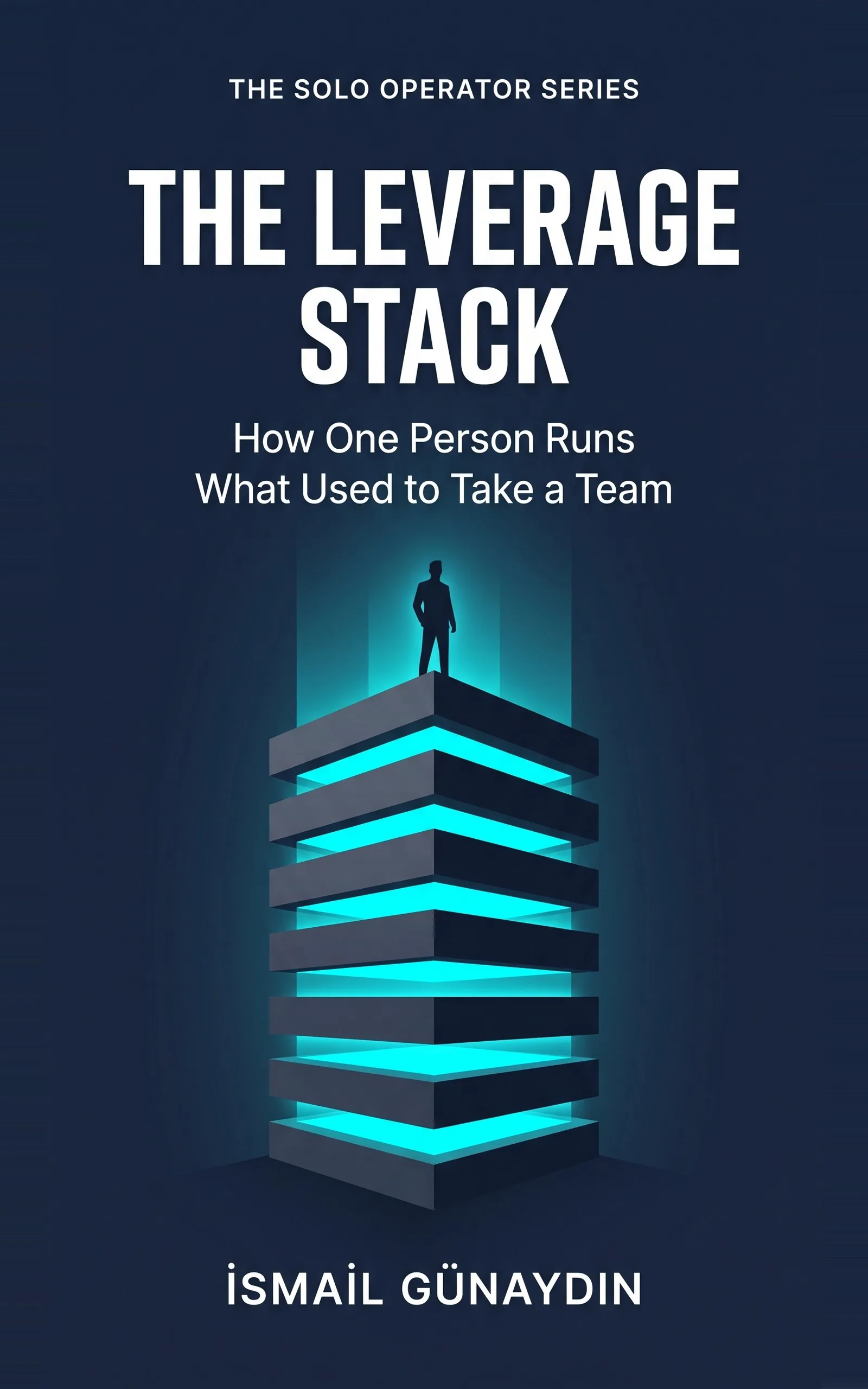
The book for this problem
The Leverage Stack
How One Person Runs What Used to Take a Team. By İsmail Günaydın, 80 pages.
Where this problem is in the book:
- Conclusion: Don't Build the Whole Stack at Once
- The Bottleneck
- The Inventory
- The Pipeline
Links go to Amazon. I wrote this book and earn a royalty on every sale. Amazon sets the price and handles delivery and returns.

Is The Leverage Stack the right book for you?
Yes, if
- You know admin eats your week but every fix you start stalls by Wednesday
- You want a fixed order so you stop deciding what to do next
- You have tried to set up many tools in one weekend and given up
Skip it if
- You want everything automated by Monday
- Your admin is already handled by staff
Fair doubts before you buy
Thirty days is too slow. Can't I do it all this weekend?
You can try. The book says a stack built in a panic weekend falls over by Wednesday, because none of it is wired into your real week. The first three days are fast, though. Stopping the tasks that should not exist is free and done that same afternoon.
I don't use AI much yet. Is this still for me?
Yes. The first step uses no tech at all, and the biggest early win in the book is simply deleting a task. AI comes in at the handoff step, as a first draft you review, not as a robot that runs things.
Get The Leverage Stack
You are not disorganized, you are the bottleneck: eight layers catch the work that does not need your judgment, so only real decisions reach you.
Links go to Amazon. I wrote this book and earn a royalty on every sale. Amazon sets the price and handles delivery and returns.
Part of The Solo Operator Series, five short books that can be read in any order.

Questions people ask about this
- How do I reduce admin work as a solopreneur?
- First list every task from one normal day. Then sort each one: stop it, automate it, hand the draft to AI, or keep it. Stop the needless ones first, because that costs nothing. Then fix one frequent task fully before you touch the next.
- What admin should I automate first?
- The task you do most often, not the one you hate most. A weekly task wired once pays you back 52 times a year. Then automate the small steps between tasks that fire often and cost little if they misfire.
- How long does it take to systemize a small business?
- The book lays out a 30-day order for one task done from end to end. After that you add the next task the same way. The book's photographer built four routines over a couple of months, without hiring anyone.
- Why do my productivity systems never stick?
- Often because they are built all at once, and when things break you cannot tell which part broke. Or because the start of each routine depends on you remembering. Build one piece, let it run a week, then build the next.
- Should I hire a virtual assistant to handle my admin?
- Not as the first step. The book's first question is who or what could take a task today, and the answer is often a template, a rule or an AI draft, not a person. Map and sort your admin first. If you still want help after that, you will know exactly which tasks to hand over, and that makes any hire easier to brief.
Related problems
- You run a one-person business and you can't keep up. Here is what is actually broken.
Working more hours won't fix a one-person business that is behind. Find the tasks that only pass through you out of habit, then hand them off.
- Should I automate this task, delegate it to AI, or just stop doing it?
Not sure whether to automate a task, hand it to AI or keep it? Run it through four questions in a fixed order and stop at the first yes.
- How do I turn ChatGPT into a daily routine instead of something I use now and then?
ChatGPT helped once, then you went back to doing it by hand. Here is how to wire one task into a routine that starts without you remembering.
- My business stops when I take a day off. What can I set up before I go?
Taking a day off and dreading the pile when you come back? Here is what to switch on first so the routine work keeps moving without you.
- Everything inside The Leverage Stack
Every chapter, who the book is for, and every problem it helps with.