Last updated
Can one person really do a marketing department's work alone with AI?
The Tuesday night blank page
It's Tuesday, late. You have a new product, and you know it is good. You also know you need a launch email, a few posts and some kind of plan. You have none of them.
You open a blank document. You stare at it. You think about the bigger competitor who seems to have a fresh campaign every month.
They have a marketing team. You have you, after a full day of the actual work.
So you tried AI. It gave you a page of copy in seconds. It sounded like every other company on earth. You deleted it and went to bed.

Why "just use AI for marketing" falls flat
The usual advice is to let AI help with marketing. That is half right, and the missing half is why your first try sounded like nobody.
A marketing department does two kinds of work. One kind is production: drafts, variations, calendars, copy. The other is judgment: deciding which campaign is on-brand, which story is true, what ships and what dies. AI is good at the first and has nothing to offer on the second. It can write ten angles. It cannot tell you which one is you.
When you ask AI to "do marketing," you hand it both halves. It fills the judgment half with the safest, most average answer it has. That is how you end up with copy that sounds like a big brand. And a big brand's voice is exactly what customers trust least.
Split each output before you hand it over
Here is the shift from the book. Before you ask AI for anything, take one sheet and write three columns for one department:
- The output a big company pays a team for. Be concrete. Not "marketing." "A launch campaign for the new product."
- How you run a version with AI. The drafts it can produce from your own notes.
- What stays you. The judgment, written as a hard line.
In my book, a one-person coffee roaster fills this in after losing a cafe deal to a national brand. For marketing, AI drafts the full email sequence, ten post variations, a month's calendar and three ad angles, all from her notes on the coffee. What stays her is which angle is honestly true, the story of why she chose that bean, the voice, and the yes or no on every line.
Then she runs it. She gives AI her real notes and gets a draft launch set in about ninety seconds. She kills most of it. She rewrites the opening in her own words, cuts the line that sounded like a brand, keeps the one angle that was honestly true, and ships. The draft saved her the blank page. The judgment made it hers.
What to give the AI so the draft sounds like you
Many guides on this question land on the same point: the skill is not typing a request, it is knowing what to ask for. The book makes that concrete. The roaster's drafts sounded like her for two reasons.
- She gave it real notes, not a topic. Not "write a launch email for coffee." The farm, the reason she chose the bean, how it tastes, who it is for. The AI can only draft from what you hand it, so hand it the specific things only you know.
- She showed it her voice. For an earlier launch, she gave it three of her old emails first. The draft came back in her voice, and she edited it into her at her warmest rather than her at her most rushed.
Then she cut hard. Most of the first draft went. A draft is a starting point, not a finished campaign.
The same split for the other three departments
Marketing is usually the first row, because it is the one losing deals. The book's map has three more. Here is where the line falls in each, from the roaster's own map.
| Department | What AI drafts | What stays you |
|---|---|---|
| Design | Label ideas, packaging mockups, color and layout options to compare | Which concept is the brand, and the final say a printer builds from |
| Research | A one-page summary of fifty articles, a scan of what similar sellers offer and charge | What the data means for your bet, and which option you back |
| Support | Replies to the repeating questions, from your own past answers, in your voice | The unhappy customer, the odd question, and any moment that needs you, not a fast answer |
Add these one at a time, after marketing runs clean on real work. Firepower you can't trust is just more things that can break at once.

Why this works best for someone untrained
Here is the part most owners miss. AI does not help everyone equally. In a large study of real support work, it raised output by about 14% on average, but beginners gained about 34% and experts barely moved (NBER, 2023). On writing tasks, it cut time by about 40%, raised quality by about 18%, and pulled weaker writers up toward stronger ones (Science, 2023).
A big firm's marketer is already an expert. The tool nudges them a little. You are a beginner at marketing, doing it in the hours left over. You are the person it lifts most.
One more honest note. Do not set up marketing, design, research and support in one weekend. The book is blunt about what happens: a campaign goes out in the wrong voice and a support draft answers an angry customer like a robot, all in the same week. Run one department. Watch it run clean. Then add the next.

The chapter built around one department at a time
This is the problem The Unfair Solopreneur was written for.
Firepower: One of You, the Output of a Whole Department gives you the full AI Department Map with all four rows filled in, and the four mistakes that hand the win back to the giant, like shipping an AI draft without your approval. Speed: You Move While They Meet shows how faster drafts turn into small, frequent launches a big company cannot match.
The map is in the free workbook. If a bigger firm just beat you on material, read what to do after losing a client to a bigger agency.
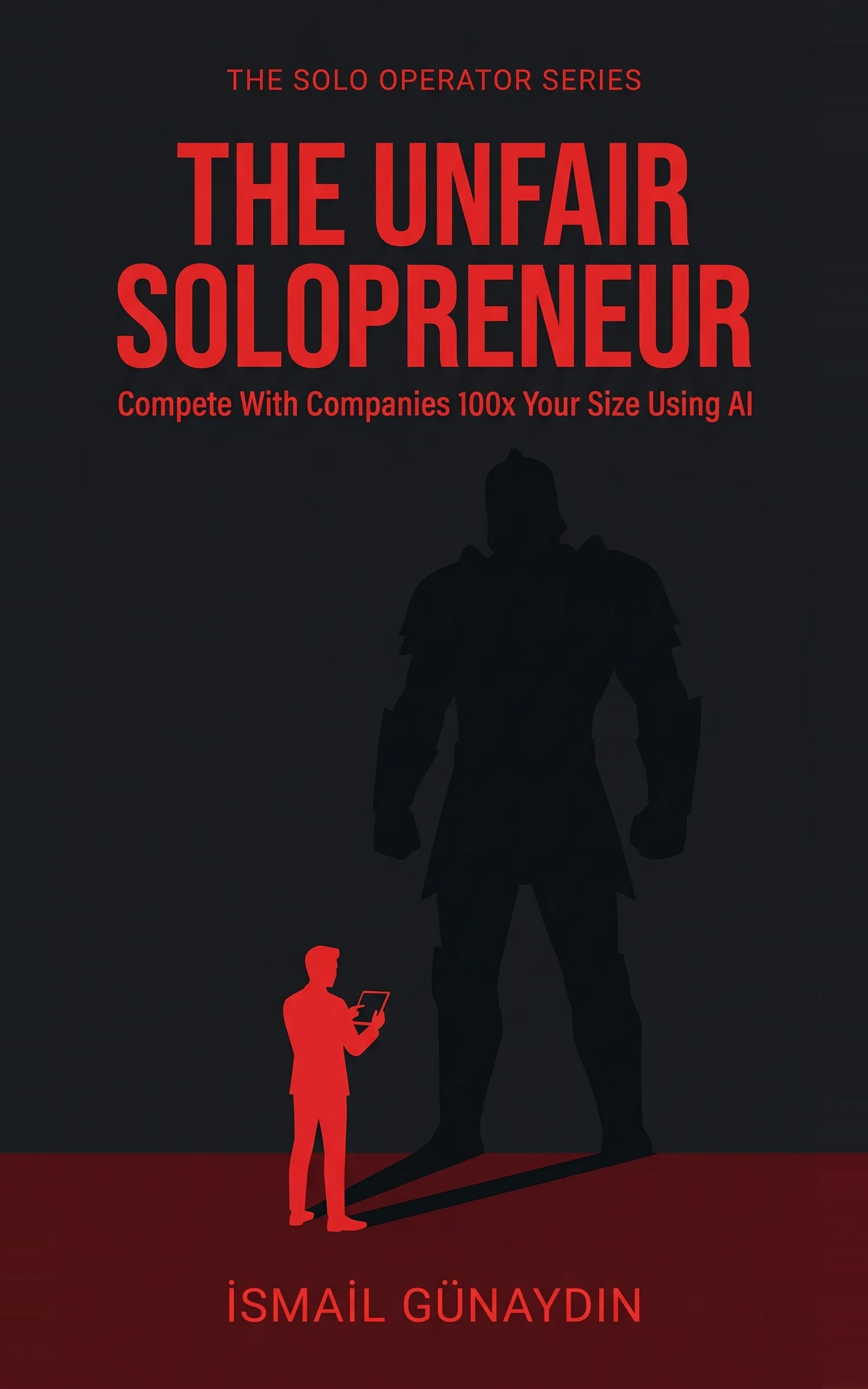
The book for this problem
The Unfair Solopreneur
Compete With Companies 100x Your Size Using AI. By İsmail Günaydın, 60 pages.
Where this problem is in the book:
- Firepower: One of You, the Output of a Whole Department
- Speed: You Move While They Meet
Links go to Amazon. I wrote this book and earn a royalty on every sale. Amazon sets the price and handles delivery and returns.
Is The Unfair Solopreneur the right book for you?
Yes, if
- You want to produce what a marketing department does, alone
- You lost deals to firms that showed up with more polished material
- You tried AI for marketing and the output sounded like nobody
Skip it if
- You want AI to run your marketing with no review from you
- You already have a marketing team and want to manage it
Fair doubts before you buy
I already use ChatGPT for posts. What would the book add?
A line. Most owners either do everything by hand or hand over too much, including the taste that made customers pick them. The AI Department Map makes you write, for each output, what AI drafts and what stays you, before you start. That one column is what keeps the work from sounding generic.
Isn't 'AI replaces a department' just hype?
The book is careful here. It says AI gives you a usable version of a department's output, not the department. Judgment does not draft. It also notes that the smallest firms still lag in using these tools, so this is a window that is open, not a game already won.
Get The Unfair Solopreneur
Small is not the underdog: speed, trust, focus, closeness to customers and AI are edges a big company cannot copy without stopping being big.
Links go to Amazon. I wrote this book and earn a royalty on every sale. Amazon sets the price and handles delivery and returns.
Part of The Solo Operator Series, five short books that can be read in any order.
Questions people ask about this
- Can AI replace a marketing team for a small business?
- It can replace much of the production, not the judgment. AI can draft an email sequence, ten post variations, a month's calendar and several ad angles from your notes. It cannot tell which angle is honestly you. A small business gets a usable version of the output and keeps the final call.
- What marketing tasks can I hand to AI?
- First drafts. Launch emails, social posts, a content calendar, ad copy, label or packaging ideas to compare, and summaries of research you never had time to read. Start from a draft instead of a blank page, then cut and rewrite until it sounds like you.
- What should a small business never automate in marketing?
- Taste, the relationship and your name on the work. The choice of which story is true about your product, the reply to an unhappy customer, and the yes on what ships. Those are why a customer picks you over a big company. Automate them and you become a smaller, slower copy of it.
- Does AI help small businesses more than large ones?
- In controlled studies, yes, at the level of the worker. In support work, AI lifted beginners about 34% against a 14% average, with experts barely moving. A solo owner is a beginner at marketing, design and research, so the lift is larger than for a big firm's trained specialist.
- How should I start using AI for marketing as a solo owner?
- Pick the one department that is costing you deals, usually marketing. Give AI your real notes on one product and ask for a draft launch set. Edit it hard and ship it. Let that run cleanly on real work for a while before you add design, research or support.
- Can one person cover every marketing channel with AI?
- The book does not promise that. It says AI gives one person a usable version of a department's output, and that you should run one department at a time and let it run clean before adding the next. Pick the work that is costing you deals, do it well, and add more only when you can still review every line.
Related problems
- You just lost a client to a bigger agency. Here is what to do this week.
You lost the deal to a firm with a full team. Find the output that beat you, rebuild one piece with AI this week, and keep the part that is yours.
- How a small business can use speed to beat bigger competitors
Big companies need months to approve what you can decide in minutes. Here is how to map that gap and spend it on small, fast launches.
- Small business vs big company: who has the advantage, and where?
A side-by-side look at where a big company wins, where a small business wins, and why each edge comes from size itself.
- Everything inside The Unfair Solopreneur
Every chapter, who the book is for, and every problem it helps with.