Last updated
You just lost a client to a bigger agency. Here is what to do this week.
The book for this problem
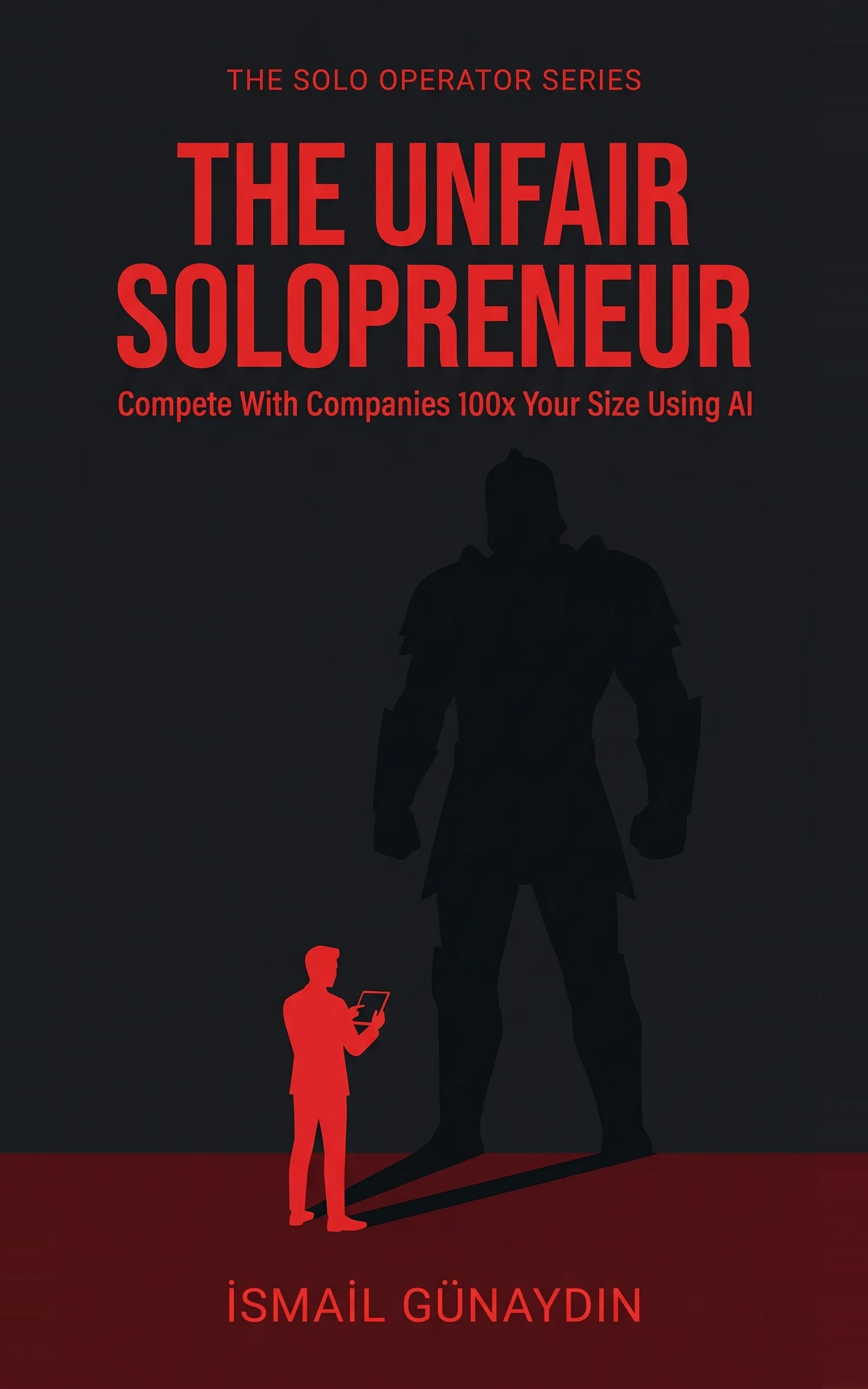
The Unfair Solopreneur
Compete With Companies 100x Your Size Using AI. By İsmail Günaydın, 60 pages.
Where this problem is in the book:
- Firepower: One of You, the Output of a Whole Department
- Trust: You're a Person, They're a Logo
Links go to Amazon. I wrote this book and earn a royalty on every sale. Amazon sets the price and handles delivery and returns.
Do these four things before Friday
You do not need a new strategy tonight. You need one list and one draft.
- Write down what the winner showed up with. Not "they were bigger." The real items. A full campaign? Mockups? A one-page fact sheet? Answers within the hour? Put each one on its own line.
- Circle the one that hurt most. Usually it is the thing you promised to "get back to them on." That sentence lost the room.
- Give AI your own notes and ask for a draft of that one thing. Your real facts, your real reasons. Not "write me a pitch." A draft built on what you know.
- Cut most of the draft. Keep the lines that are true about you. Rewrite the opening in your own voice. Throw out anything that sounds like a brand instead of a person.
That is it for this week. One row, done well. Do not try to rebuild the whole agency by Sunday.
Leave the door open on the way out
How you take the loss matters, because the client may not be gone for good. People change jobs, budgets move, and a big agency can disappoint. A few plain moves keep the door open:
- Reply once, warmly, as yourself. Thank them, wish them well, and mean it. No guilt, no last-minute discount.
- Ask one question. "If you have a minute, what tipped it?" The answer tells you which piece to rebuild first, and whether it was even about you. Sometimes a new boss brings in a firm they already know.
- Hand over cleanly. If they need files, logins or notes, send them fast and without fuss. It is the last thing they remember about working with you.
- Stay the same reachable person. The book's trust chapter says trust is a pattern people watch over time, not one warm moment. A useful note months later, with no pitch attached, is the kind of small, unseen contact the book says a big firm cannot keep up.
None of this wins the client back on its own. It just means that if things change, your name is the easy one to call.
The email that said "we went another way"
You read it twice. They liked you. They said so on the call. Your work was better, and you both knew it.
Then the other firm sent a deck, a plan and a stack of samples the next morning. You sent a kind note and a promise to follow up.
It feels like you lost on size. You did not. You lost on how much showed up on their desk, and how fast.
Why the agency got there first
A big agency is not smarter. It has people doing different jobs at the same time. One writes. One designs. One pulls the research. One answers the client's email. You do all four jobs, one after another, in the hours left over.
That gap used to be fixed. It is not now. In a study of real support work, AI help raised output by 14% on average, but the least experienced workers gained about 34%, and experts barely moved (NBER, 2023). On writing tasks, AI cut the time by about 40% and lifted quality by about 18% (Science, 2023).
You are a beginner at most of the jobs around your real skill. That is exactly who these tools help most. The agency's trained writer gains a little. You gain a lot.

Keep the part a client actually buys from you
Here is the trap. You panic, you hand everything to AI, and you send a generic pitch. Now you look like a smaller copy of the agency. You will lose that fight every time.
Three things stay yours. Your taste, meaning the call on what is good. The relationship, meaning you answer as yourself. And your name on the work. The agency cannot give a client one person who made the thing and picks up the phone. You can.
The book that maps the work an agency did for you
This is the problem The Unfair Solopreneur was written for. In my book, the coffee roaster who loses the cafe is the start of the last chapter, not the end of her story.
Firepower: One of You, the Output of a Whole Department gives you the AI Department Map. You list each team a big firm pays for, what you can draft with AI, and what must stay you. It also covers the four ways this goes wrong, like running every team at once.
Trust: You're a Person, They're a Logo shows why being one named person is the part clients trust most, and how to show it without faking anything.
The map and the other six tools are in the free workbook. If you keep losing to bigger firms, not just this once, read why you keep losing clients to bigger companies.

Is The Unfair Solopreneur the right book for you?
Yes, if
- You lost a pitch this week and the other side had a whole team
- The client liked your work but picked the firm that looked bigger
- You keep saying you will get back to them on the rest
Skip it if
- You lost because the work itself was weak and you know it
- You want a way to win every pitch against every agency
Fair doubts before you buy
I just lost. Is now really the time to read a book?
The first fix on this page takes one evening and needs no book. The book helps with the next step, when you want a map of every job the agency did and which ones you can now draft with AI. It is short, about 60 pages, so it fits into the same week.
Can't I just ask ChatGPT to make me a pitch deck?
You can, and you should use it. The catch is which half you hand over. AI is good at the first draft. It cannot tell which draft is honestly you. The book is about drawing that line so you do not send a generic pitch that looks like the agency you just lost to.
Get The Unfair Solopreneur
Small is not the underdog: speed, trust, focus, closeness to customers and AI are edges a big company cannot copy without stopping being big.
Links go to Amazon. I wrote this book and earn a royalty on every sale. Amazon sets the price and handles delivery and returns.
Part of The Solo Operator Series, five short books that can be read in any order.
Questions people ask about this
- Why do clients choose big agencies over freelancers?
- Often because the agency produces more, faster. In the book, a coffee roaster loses a cafe to a national brand that showed up with a campaign, label mockups, a sourcing sheet and an answer to every question inside an hour. Her coffee was better. She lost on output, not on the product.
- How do I compete with an agency that has more people?
- Stop trying to match their headcount and match their first drafts instead. Name the exact thing each of their teams produced, have AI draft a version from your notes, and keep the final call yourself. You will not have their people. You can have a usable version of their output.
- Should I lower my price after losing to a bigger company?
- The book does not tell you to cut price. Price and reach are the ground where size wins. It tells you to fight where size loses: a real person who answers, a fast decision, and a narrow slice of work the big firm will not bother with.
- How fast can one person make a campaign with AI?
- Fast enough to stop losing on time. In the book, the roaster gives AI her real notes on a new coffee and gets back a draft launch plan of five emails, a month of posts and three ad ideas in about ninety seconds. Then she cuts most of it and rewrites the rest in her own voice.
- Should I ask a client why they chose the bigger agency?
- Yes, once and briefly. A short thank-you with one question, like what tipped it, can show you whether you lost on output, price or something that had nothing to do with you, like a new manager bringing in a firm they know. Then rebuild the one piece the answer points to.
- Can I win back a client I lost to a bigger agency?
- Sometimes, but nobody can promise it. What helps is how you left: a warm reply, a clean handover and staying in touch as the same reachable person, with no pitch. If the agency later moves slowly or sounds like no one, you are the easy name to call. Meanwhile, fix the gap that cost you the deal.
Related problems
- You keep losing clients to bigger companies. Is it really their budget?
If bigger firms keep winning your clients, you may be fighting on their ground. See where size wins, where it loses, and how to move the fight.
- Can one person really do a marketing department's work alone with AI?
AI can draft what a marketing team produces, but not decide what is you. See where the line falls, and why to start with one department, not four.
- Small business vs big company: who has the advantage, and where?
A side-by-side look at where a big company wins, where a small business wins, and why each edge comes from size itself.
- Everything inside The Unfair Solopreneur
Every chapter, who the book is for, and every problem it helps with.