Last updated
A client uses urgency and guilt to get free work. Here are the rules and the words.

| What the client says | What it does | Say back |
|---|---|---|
| Let's finish it first, then I'll pay you. Trust me. | Moves all the risk to you. Once it's delivered, you have nothing left to bargain with. | I start every project with a deposit. As soon as it clears, I'll get going. |
| It's just a tiny change. | Scope creep with guilt attached. Each slice is small. The whole salami is not. | Happy to look at it. It's outside the current scope, so I'll send you a quick quote. |
| My nephew could do this in two hours. | Shrinks your work and sets a low anchor before the money talk. | That might be a good option for you. For this scope, my price is what I quoted. |
| Our last guy totally ripped us off. | Casts you as the hero and pre-writes the ending if things go badly. | Sorry that happened. What went wrong? |
| You have to decide today or it's gone. | False urgency. Takes away your time to think. | I don't decide big things the same day. I'll get back to you tomorrow. |
| Wow. I thought we were friends. | Turns a money line into a betrayal. The friendship is the handle. | We are friends. That's why I want the money part to be clear. |
| Come on, we don't need paperwork. | Asks for blur. An unwritten deal gets remembered in whatever version suits them. | I trust you. I just don't trust my memory. I put things in writing with everybody. |
How to use the free-work rules
Every line in the table is from the book's chapter on money and deals, with the job it does and the reply Iris Athens gives.
Read the middle column and you'll see one idea over and over. The line makes things blurry, or it moves the risk to you. No deposit. No scope. No date. No paper. Every blurry term is room for the client to move later: what was included, what was promised, when the money was due.
Now read the right column. Every reply makes things clear again, without accusing anyone. That's the design. Honest clients barely notice a deposit or a recap email. The clients who push back hard are telling you something before any money moves.

The rules, written once
The book's advice is to decide your rules while you are calm, then just follow them. A rule is easier to say than a reason, and nobody can argue you out of a rule.
- Deposit first. Work starts when it clears.
- Late payment pauses work. Say it once, at the start, in a calm tone.
- Every extra is a quote. "Tiny" doesn't change that.
- Keep a change log. Date, what they asked for, what you quoted, what they approved. Send each one in writing.
- Recap the same day. After any call, a short note: here is what we agreed.
- No same-day decisions on big things. You'll get back to them tomorrow.
- Know your walk-away. Before any big deal, finish this line for yourself: if this falls through, you will do what?
Why the last two matter so much: Daniel Kahneman and Amos Tversky showed in their 1979 work on prospect theory that people feel a loss more sharply than an equal gain. A deadline turns a deal into something you might lose, and your attention shifts from weighing it to keeping it. One day of patience brings the weighing back. A fair client says "Sure." Someone running the move pushes harder. That reaction is one of the clearest pictures you'll get.

Lena and the car wash owner
Picture a freelance web designer. Call her Lena. She runs a one-person business from her spare bedroom. A new client owns three car washes. On the first call he's warm and funny. He calls her "kiddo."
He doesn't want to get bogged down in contracts. He's a handshake guy.
She sends a quote with a fifty percent deposit. He doesn't reply to the email. He calls instead. Half up front? Come on. Finish it and he'll pay in full. Ask around.
She starts without the deposit. In week two he wants online booking. Tiny thing. In week four, a loyalty program. When she mentions the invoice, he laughs and says his nephew could build the whole site in an afternoon.
By week six she has a finished site, no signed scope, and a text thread where every promise was made on the phone. He finally sends part of the money with a note: "Great start!"
Nothing he said was a lie she could point to. That was the design.
We think the hardest part is the moment you want to explain yourself. In a tense call, the book suggests talking to yourself as "you" or by name. A 2014 study by Ethan Kross and colleagues found it gave people more distance under stress. What does Lena need to do right now? Usually, just say the rule.

When the pay is a promise of more work later
A lot of free-work requests come with a sweetener instead of money. It will look great in your portfolio. There will be lots of paid work after this one. They know people.
The book's version of this line is the partner who says you do the work and they bring the connections. The shape is the same. Your side is concrete: your hours and your skills. Their side is vague and hard to check. If it goes nowhere, you lost weeks and they lost a few phone calls.
The book's test is to ask for something concrete, early. If the future work is real, ask for one small paid piece now, or one named introduction in the first two weeks. Then write one page: who puts in what, what it pays and when. A client who means it is fine with that. If the promise stays offstage and the page never gets written, you have your answer.

When it is time to walk away
You don't have to fire a client in a big scene. The book's First Thirty Days card scores what you see. Some flags count for 3 points, and three of them show up in free-work clients again and again:
| Flag | Points |
|---|---|
| Scope creep plus guilt | 3 |
| Resistance to writing | 3 |
| Manufactured urgency | 3 |
Any two 3-point flags in the first month put a client in the red. The book's step for red is a quiet, procedural exit. Finish what is owed. Take on nothing new. No last-chance meeting where you get talked back in.
This is common sense, not legal advice. The book says big deals need a lawyer or an accountant, and that goes for a signed contract or money still owed to you.

Where the book goes from here
This is the problem The Manipulator's Phrasebook was written for.
Money, Deals, and Partners has 16 lines in four groups, including clients who won't pay and buyers and sellers. Each comes with a payload, an honest version, a reply and a pattern check. It also says plainly that this is common sense, not legal advice, and that big deals need a lawyer or an accountant.
The First Thirty Days gives you a private scored card for any new client. Scope creep plus guilt is a 3-point flag. So is resistance to writing. Two 3-point flags together mean a quiet, procedural exit.
The Calm Toolkit has the broken record, BIFF for written replies and predictability armor, the book's name for the rules above. If the guilt sounds familiar from home, see our page on guilt-tripping family at the holidays.
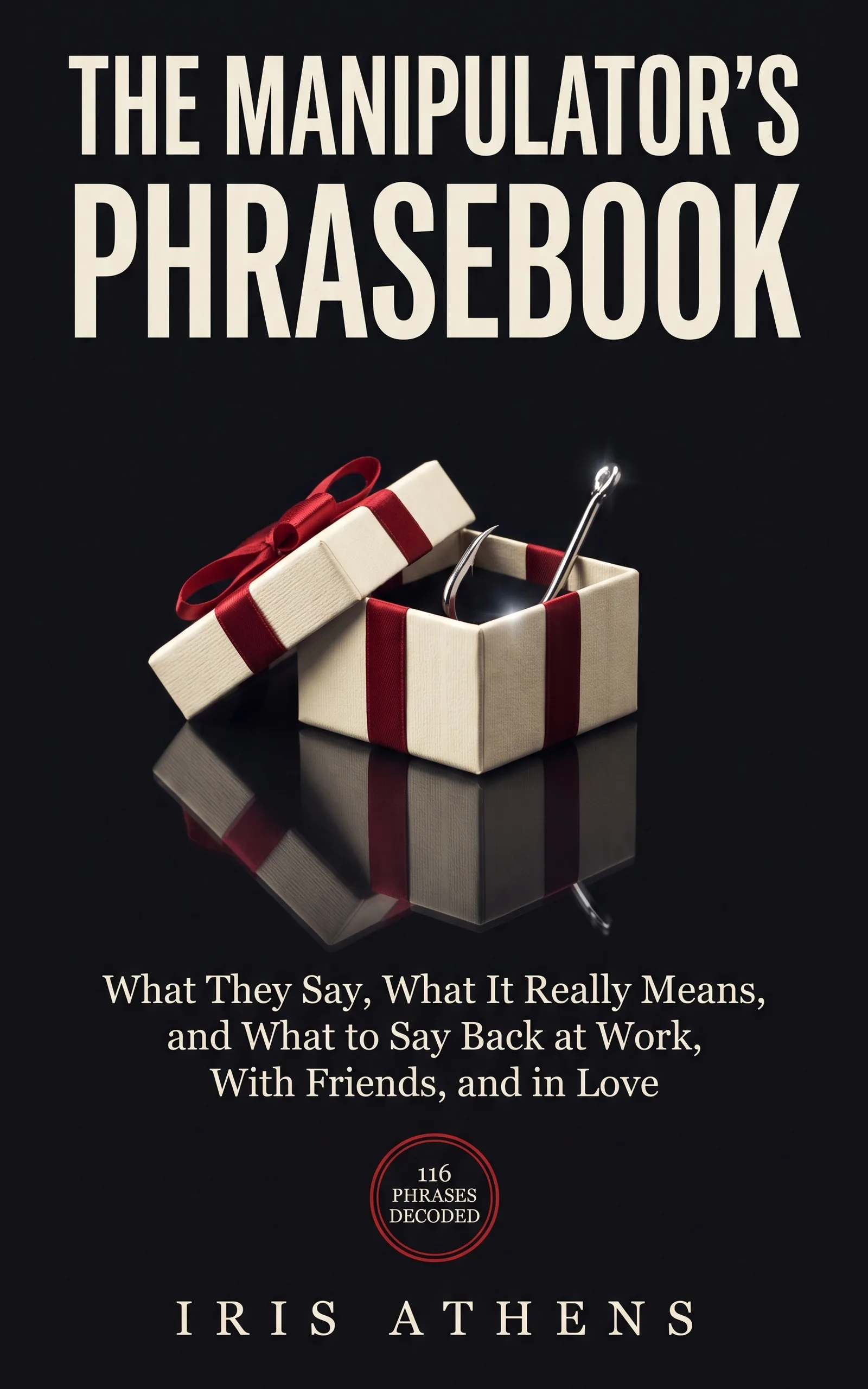
The book for this problem
The Manipulator's Phrasebook
What They Say, What It Really Means, and What to Say Back at Work, With Friends, and in Love. By Iris Athens, 214 pages.
Where this problem is in the book:
- Money, Deals, and Partners
- The First Thirty Days
- The Calm Toolkit
Links go to Amazon. ToolGenX publishes this book under a pen name and earns from every sale. Amazon sets the price and handles delivery and returns.

Is The Manipulator's Phrasebook the right book for you?
Yes, if
- You freelance or run a small studio and the free extras keep piling up
- Every time you mention the invoice, you are made to feel greedy
- A client says everything is urgent and pushes you to start before terms are set
Skip it if
- You want legal advice on a contract or a debt, which needs a lawyer
- You want tactics to squeeze more money out of a client
Fair doubts before you buy
Won't a deposit scare off good clients?
The book's view is that it shows you who they are, fast. Some good clients have just never paid a deposit. Explain it once and see what happens. Pressure, a guilt trip or a line about whether you trust them in week one saves you from learning the same thing in week six.
What if I want to do a small favor for a client I like?
You can. The book says that is your call inside a good working relationship. Just count. By the third tiny change in a month, each one landing after scope is set and each one met with irritation when you mention cost, you have a pattern.
Get The Manipulator's Phrasebook
Manipulation hides in kind-sounding sentences; 116 of them are decoded with a calm reply for each, so you can answer or walk away with a clear head.
Links go to Amazon. ToolGenX publishes this book under a pen name and earns from every sale. Amazon sets the price and handles delivery and returns.
If you are afraid of someone, call the National Domestic Violence Hotline at 800-799-7233 or text START to 88788.

Questions people ask about this
- How do you tell a client that extra work costs more?
- Keep it warm and plain. Say you are happy to look at it, it is outside the current scope, and you will send a quick quote. Then send the quote in writing and log it. Honest clients know extra work is extra work, even when they hope it is cheap.
- What do you say when a client says pay you after it's done?
- Say you start every project with a deposit, and as soon as it clears you will get going. If they agree, add the rule that work pauses if a payment runs late. Once the work is delivered, you have nothing left to bargain with, so the deposit comes first.
- How do I handle a client who says it's just a tiny change?
- Treat it as scope, not as a test of your niceness. Offer to quote it. Keep a simple change log with the date, the request, your quote and their approval, and send each entry in writing. Speaking up at the first slice is easier than at the tenth.
- What do I say when a client says their nephew could do it cheaper?
- Agree that might be a good option for them, and say that for this scope your price is what you quoted. If they want to spend less, offer less work at the same rate by cutting the scope to fit the budget. Don't defend the price at length.
- How do I deal with a client who says I need to decide today?
- Say you don't decide big things the same day and will get back to them tomorrow. Before any big deal, write one line for yourself about what you will do if it falls through. Knowing your walk-away lets you let a deal go without panic.
- When should I stop working with a client who keeps asking for free work?
- The book's scored card gives a clear line. Scope creep plus guilt is a 3-point flag, and so are resistance to writing and false urgency. Any two 3-point flags in the first month point to a quiet, procedural exit: finish what is owed, take nothing new, and skip the last-chance meeting. For a contract or a debt, talk to a lawyer.
Related problems
- Guilt-tripping family at the holidays: what they say, what it does, and what to say back
Last Thanksgiving, all or nothing, everyone else made it. Six holiday guilt lines decoded, a calm reply for each, and rules to set before you arrive.
- Is my boss manipulating me, or am I reading too much into it?
Warm words, no raise, a heavier load. Learn the boss phrases that keep you waiting, a calm reply for each, and the one habit that protects you.
- A coworker keeps taking credit for my work. Is it petty to say something?
Speaking up feels petty and staying quiet hands over your week. Calm lines for the meeting, the follow-up, and the habit that makes credit hard to take.
- Everything inside The Manipulator's Phrasebook
Every chapter, who the book is for, and every problem it helps with.