Last updated
GEO vs SEO: what is the difference, and which one does a small business need?

| Question | SEO: ranking in a list | GEO: being named in an answer |
|---|---|---|
| What the customer sees | Ten blue links. She scrolls and picks. | A short answer that names about three businesses. She mostly takes its word. |
| Who chooses | The customer | The machine |
| The question you ask | Do I rank? | Does the AI recommend me? |
| What gets you in | Ranking high for your keywords | Passing five checks: found, understood, trusted, quotable, matched to the real question |
| Overlap with Google's top ten | That is the goal itself | Only about 12% of pages AI engines cite rank in Google's top ten (Ahrefs, 2025) |
| The words that match | Short category keywords, like bookkeeping services | Full problem sentences, like I'm behind on my taxes, where do I start |
| Where trust comes from | Links and authority signals | A named human, plus outside voices you did not write |
| What the AI lifts | Nothing. The customer clicks and reads | One clean sentence it can drop into the answer |
Reading the table, one row at a time
The top three rows are the whole shift. On a list of links, the customer chooses. In an AI answer, the machine chooses, and it names about three businesses. So your question moves from "do I rank?" to "does the AI recommend me?"
That move matters because fewer people reach the list. When Google shows an AI summary, people click a normal link about 8% of the time, against 15% when there is none (Pew Research Center).
The fifth row is the one that surprises people. Only about 12% of pages AI engines cite sit in Google's top ten. And the share of AI Overview citations from top-ten pages fell from about 76% to about 38% (Ahrefs). Ranking and being named have drifted apart.
The last three rows are where the work is. Customers ask an AI in full, messy sentences. The AI wants a real person and an outside voice before it vouches for you. And it needs one plain sentence it can lift. None of those three were ever part of ranking.
Where the two still share ground
Don't throw out what you know. The first check an AI runs is the most SEO-like of all: can its bot get in and read your words?
That means your robots.txt must not turn AI bots away. Your words must be real text, not pictures. And the page must not be an empty shell that only fills in after scripts run. If any of that fails, nothing in the GEO column matters. The free AI crawler checker tests the first part.
So the order is simple. SEO ground first, as the floor. Then the four new checks on top.

GEO, AEO, AI SEO: one goal, several names
GEO stands for generative engine optimization. The term comes from a 2023 research paper, GEO: Generative Engine Optimization, which studied how content creators can be more visible inside answers written by AI engines.
Since then you will also see AEO (answer engine optimization) and plain "AI SEO." People argue about where one ends and the next begins. For a small business, they all point at the same goal: being named inside an AI answer, not only ranked in a list. The book skips the labels and works through five plain questions instead.
So is GEO a part of SEO? The two share a floor, as the next section shows. But GEO adds checks that ranking never asked for, so it is more than SEO with a new name.
How you measure each one
You measure SEO with rankings and clicks. Where does my page sit for a keyword, and how many people click through?
GEO needs a different check, because the win is a mention, not a click. When Google shows an AI summary, people click a link inside the summary just 1% of the time (Pew Research Center). So the book measures GEO by asking.
- Write down the exact questions your best customers would ask.
- Ask them in ChatGPT, Perplexity and Google's AI.
- Note three things: are you named, who is named instead, and what the AI says about you.
- Make your fixes, then ask the same questions again and compare.
The book calls this the AI Visibility Snapshot. It takes about four minutes, and it shows which of the five checks you are failing.

Your boss says do some GEO by Friday
Picture it. You run marketing at a small company, which means you run everything. Your boss read an article. He wants "GEO" done, and there is no budget.
You search the word and find a wall of sales pages. Most of them push a file called llms.txt, or a service with a monthly fee. You can't tell what is real.
Here is the plain version you can bring to Friday's meeting. GEO means the AI names us. It names a business when it can find it, tell what it is, trust it, quote it, and match the customer's real question. We will check those five, in order, with one sheet each. No password files. Google's own engineers said they don't use llms.txt.
That is a plan your boss can follow, and it costs time, not money.

The GEO column, one chapter per row
This is the problem Found by AI was written for. It never leans on the acronym. It walks the GEO column of the table one row at a time.
The Introduction: The New Front Door sets out the list-to-answer shift and the five questions.
Chapter 2, Can I Tell What You Are?, covers the identity row. Its Entity Clarity Sheet turns a fuzzy tagline into one sentence: what you do, who for, where.
Chapter 3, Do I Trust You Enough to Name You?, covers the trust row, with a Trust Signal Map for on-site proof, outside mentions and the named human.
Chapter 4, Can I Quote You Cleanly?, covers the last row, with a four-line Citability Checklist. If quoting is your main worry, start with how to get quoted in AI answers.
The free Found by AI workbook has all seven tools as printable pages.
The book for this problem
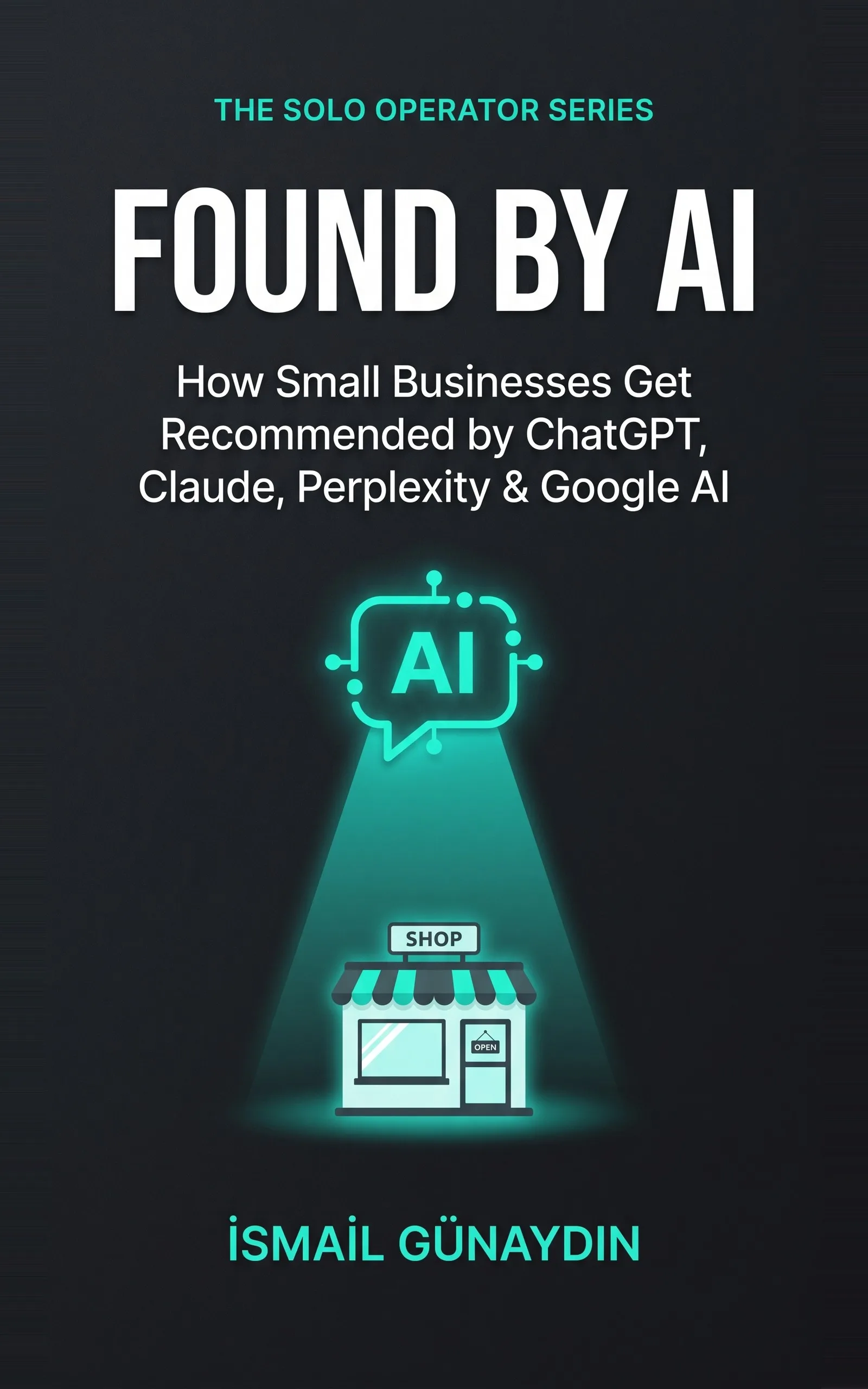
Found by AI
How Small Businesses Get Recommended by ChatGPT, Claude, Perplexity, and Google AI. By İsmail Günaydın, 70 pages.
Where this problem is in the book:
- Introduction: The New Front Door
- Can I Tell What You Are?
- Do I Trust You Enough to Name You?
- Can I Quote You Cleanly?
Links go to Amazon. I wrote this book and earn a royalty on every sale. Amazon sets the price and handles delivery and returns.

Is Found by AI the right book for you?
Yes, if
- You keep hearing GEO and want a plain version
- You were asked to do AI search at a small company with no budget
- You know some SEO and want to know what to add
Skip it if
- You want a long history of search engines
- You run enterprise SEO with a team and paid tools
Fair doubts before you buy
Is GEO just SEO with a new name to sell services?
Partly a label, yes. The book barely uses it. But the thing under the label is real: the numbers show that ranking and being cited by AI move apart. The book stays with five plain questions instead of new acronyms.
Do I need special tools for GEO?
No. The book's tools are one-page sheets and your own questions typed into ChatGPT, Perplexity and Google's AI. Most fixes cost nothing but an afternoon.
Get Found by AI
An AI names a business only after five quiet checks pass, and each check can be fixed with a one-page tool.
Links go to Amazon. I wrote this book and earn a royalty on every sale. Amazon sets the price and handles delivery and returns.
Part of The Solo Operator Series, five short books that can be read in any order.

Questions people ask about this
- What is the difference between GEO and SEO?
- SEO aims to rank a page in a list of links. GEO aims to get a business named inside an AI answer. In a list, the customer chooses. In an answer, the machine chooses a few names. The signals overlap, but they are not the same.
- Is GEO replacing SEO?
- No. The first thing an AI checks is whether it can reach and read your site, which is SEO ground. GEO adds checks on top: can it tell what you are, does it trust you, can it quote you and do you match the real question.
- Does good SEO mean good GEO?
- Not on its own. Ahrefs found the share of Google AI Overview citations taken from top-ten pages fell from about 76% to about 38%. Ranking well helps less than it used to for getting quoted.
- What should a small business do first for GEO?
- Ask ChatGPT, Perplexity and Google's AI the questions your customers ask and see who gets named. Then check that AI bots can reach your site and read your words as text. The book calls these the Snapshot and the Crawler Access Check.
- Is llms.txt part of GEO?
- It is often sold that way. The book says skip it. Google's own engineers said they don't use it and compared it to the keywords meta tag. Making your real pages readable does the job it promises.
- Is GEO the same as AEO?
- They are close cousins. GEO means generative engine optimization, a term from a 2023 research paper. AEO means answer engine optimization. Both aim to get you named inside an AI answer rather than only ranked in a list of links. For a small business the work is the same, so the label matters less than the five checks underneath.
Related problems
- Is SEO dead now that people ask ChatGPT instead of Google?
SEO is not dead, but the question changed. Ranking and being named by AI are different games. Here is what still counts and what to add.
- How does ChatGPT decide which business to recommend? The five checks, in order
How ChatGPT, Perplexity and Google's AI pick which businesses to name: the five checks, in order, and where a small business should start.
- How to get your website quoted in ChatGPT, Perplexity and Google AI answers
AI tools quote the cleanest sentence, not the prettiest paragraph. Here are four rules for writing answers ChatGPT and Perplexity can lift.
- Everything inside Found by AI
Every chapter, who the book is for, and every problem it helps with.