Last updated
How does ChatGPT decide which business to recommend? The five checks, in order
You are about to change your website, and you don't know what the AI wants
You have decided to do something about AI search. Good. You open your site to start editing, and then you stop.
What do you change? The headline? The photos? Do you need more posts? A new file someone mentioned on a forum?
You don't know, because nobody has told you how the AI picks. And guessing feels worse than doing nothing.
So before you touch a single page, here is how the choice works.
Why a pile of tips will not get you named
Most AI search advice comes as a list of tips. Add schema. Write FAQs. Get links. Add llms.txt. You do six of them and nothing moves.
The problem is not the tips. It is the order. The checks an AI runs stack on top of each other. A perfect quote on a page the bot can't read does nothing. A strong review means little if the AI can't tell what you do.
And the old order, where ranking came first, does not hold anymore. The share of Google AI Overview citations taken from top-ten pages fell from about 76% to about 38% (Ahrefs). The AI is reading more widely than the top of Google.
Five gates, and what each one looks for
Gate one: can it find you? Its bot has to get in and find real words. A robots.txt line that turns GPTBot away, a page built by scripts, or services trapped inside an image all fail here.
Gate two: can it tell what you are? An AI does not recommend a vibe. It recommends a thing it can name and sort. It looks for three facts said outright: what you do, who it's for, where. "Empowering your financial future" fits a bookkeeper, a coach and an app, so it fits none. It also checks that your homepage, profiles and listings agree. When they disagree, it reads that as doubt.
Gate three: does it trust you? Your site is your own say-so. So the AI looks for a second voice: a named person behind the business, reviews you earned on a platform you don't own, a mention somewhere you didn't write. In the book's words, you can be good and still be uncorroborated, which just means nobody else has said so where the machine can see.
Gate four: can it quote you? It needs one sentence it can lift whole. The answer first, self-contained, one clear claim, under a heading that matches the real question.
Gate five: are you there when it's asked? Your customer types a problem, not a category. "My heating is clicking and won't turn on, is this dangerous?" is not "HVAC repair near me." The AI matches her words.
Where the AI's shortlist comes from
The five gates are the checks. But where does the AI find the businesses it checks in the first place? For ChatGPT there are two sources.
What the model already learned. Some answers come from text the model read in the past. So what was written about a business before can shape the answer, and that includes an old, wrong fact. That is one reason stale listings matter.
What it finds on the web right now. ChatGPT can search the web when a question needs it, and it shows the pages it used (OpenAI). OpenAI says it uses third-party search providers and its own crawler, OAI-SearchBot. Sites that block that crawler are not shown in ChatGPT search answers (OpenAI crawler docs, checked 2026-10-21).
For a "who should I hire near me" question, current facts matter, like where you are and what you offer today. That is one more reason gate one, letting the bots in, comes first. The live search can only pick from pages it can read.
Can you pay to be recommended?
Not inside the answer, if you take OpenAI at its word. When OpenAI announced ads for ChatGPT on January 16, 2026, it set out a rule it calls answer independence: "Ads do not influence the answers ChatGPT gives you" (OpenAI). It said ads would sit at the bottom of answers, clearly labeled and kept apart from the answer itself.
So an ad can put your business near the answer. It does not, by OpenAI's own rules, put your name in it. The name in the answer still comes from the five gates.
Work the gates in order, a few days each
Here is the one idea to take away. Build the gates in order, because each one makes the next count.
The book paces this across thirty days. Days 1 to 3, run the Snapshot: ask the AIs your customers' questions and see who gets named. Days 4 to 9, open the door and check the bot can read you. The free AI crawler checker helps here. Days 10 to 15, write your identity sentence and repeat it everywhere. Days 16 to 22, start trust, because it is the slowest to grow. Days 23 to 27, rewrite your key answers to be quotable. Days 28 to 30, match the real questions, then run the Snapshot again and compare.
One more thing I would hold on to. One check done fully beats five done halfway. Go deep on the gate your Snapshot showed you failing worst.
This matters more each month. BrightLocal's 2026 research found the share of people using AI to find a local business jumped from about 6% to about 45% in a single year.
One chapter for each gate, with a tool per gate
This is the problem Found by AI was written for. The book is the five gates, one chapter each, with a one-page tool per gate.
The Introduction: The New Front Door names the five questions and gives you the four-minute Snapshot.
Chapter 2, Can I Tell What You Are?, shows how the AI builds a label for you from what, who and where, and why matching profiles raise its confidence.
Chapter 3, Do I Trust You Enough to Name You?, splits trust into three places: on your site, off your site, and the named human. It shows how to earn the first outside mentions with no budget.
The Conclusion: The 30-Day Visibility Build turns the order above into a checkboxed plan.
The free Found by AI workbook has all seven tools. If the AI already knows you but describes you wrong, read ChatGPT describes my business wrong.
The book for this problem
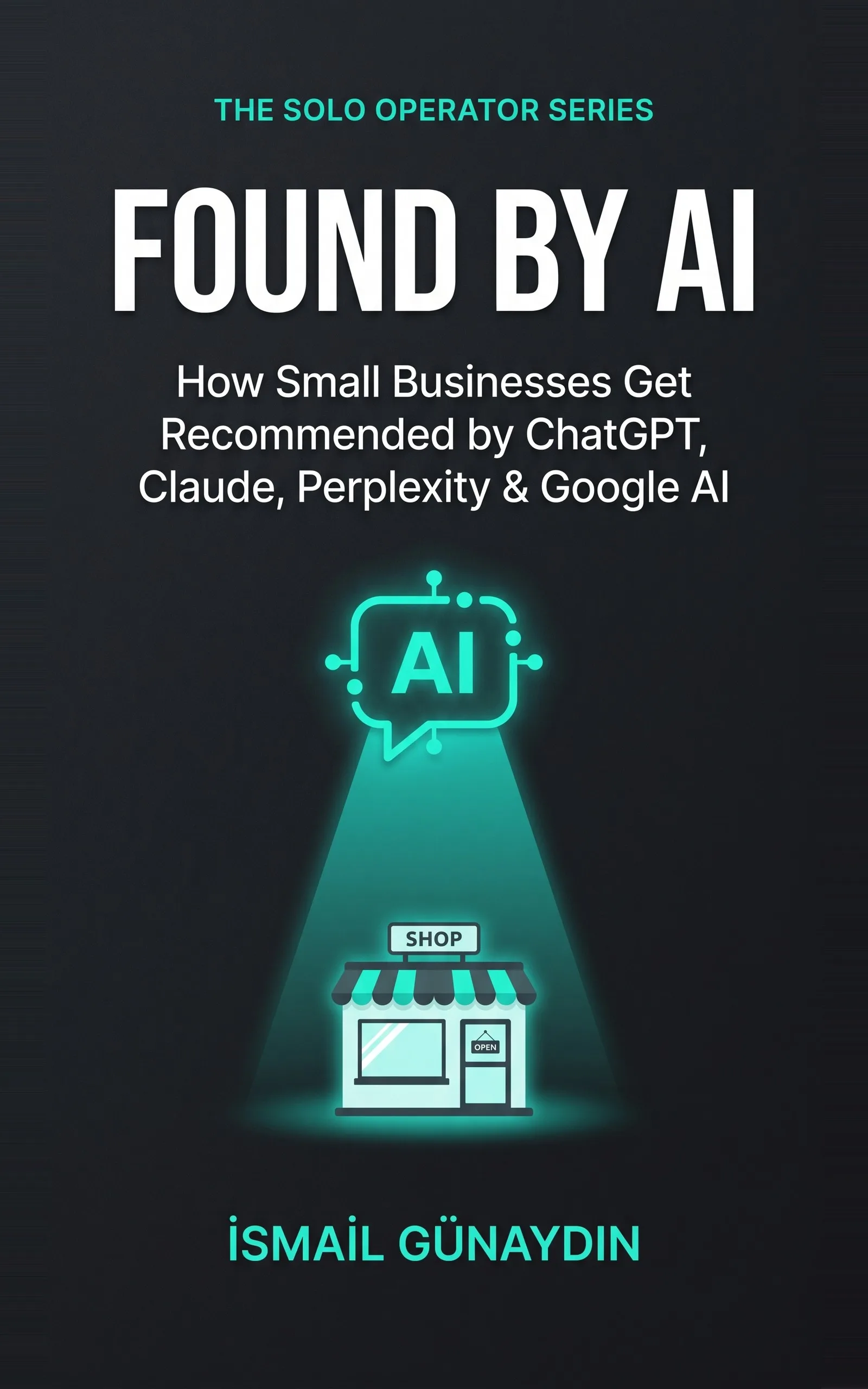
Found by AI
How Small Businesses Get Recommended by ChatGPT, Claude, Perplexity, and Google AI. By İsmail Günaydın, 70 pages.
Where this problem is in the book:
- Introduction: The New Front Door
- Can I Tell What You Are?
- Do I Trust You Enough to Name You?
- Conclusion: The 30-Day Visibility Build
Links go to Amazon. I wrote this book and earn a royalty on every sale. Amazon sets the price and handles delivery and returns.
Is Found by AI the right book for you?
Yes, if
- You want to understand how AI picks businesses before you change anything
- You asked ChatGPT for a business like yours and it named three others
- You like a clear order of steps more than a pile of tips
Skip it if
- You want the inner code of how ChatGPT ranks sources
- You want tricks to game AI answers instead of being easy to read and trust
Fair doubts before you buy
Nobody outside these companies knows how the AI really decides. Isn't this guesswork?
The book is careful here. It does not claim to see inside the model. It says that in effect, every answer is gated on five things, and shows the public numbers that point there. Each check is something you can test yourself in minutes.
Why not just read the free blog posts about AI search?
Many are good. Many also sell llms.txt as a fix, which Google's engineers have said they don't use. The book gives you one order to work in and a tool for each step, so you are not stitching ten posts together.
Get Found by AI
An AI names a business only after five quiet checks pass, and each check can be fixed with a one-page tool.
Links go to Amazon. I wrote this book and earn a royalty on every sale. Amazon sets the price and handles delivery and returns.
Part of The Solo Operator Series, five short books that can be read in any order.
Questions people ask about this
- How does ChatGPT choose which businesses to recommend?
- In effect, it answers five questions about each business. Can I find you? Can I tell what you are? Do I trust you enough to name you? Can I quote you cleanly? Are you there when the question is asked? A business that fails any one of them tends to drop out.
- Does ChatGPT recommend businesses based on Google rankings?
- Not mainly. When Ahrefs checked which pages AI engines cite, only about 12% ranked in Google's top ten. The AI builds its own picture of a business from what it can read and what others say about it.
- Why does the AI need to trust a business before naming it?
- Because naming you is the AI vouching for you to a stranger about to spend money. Your own site is your own word, so the AI looks for a second voice: reviews on platforms you don't own, mentions, a byline, a real named person.
- Do reviews help a business get recommended by AI?
- Honest reviews on a platform you don't own count as an outside voice, which is part of the trust check. The book warns against bought or perfect-looking reviews. A mildly critical review left up reads as more real than a wall of praise.
- How long does it take to get recommended by AI?
- The book lays out a 30-day build, a few days per check. In the book's example, the bookkeeper started being named about a month after she fixed her trust layer. Trust is the slowest check, so start it early and let it grow.
- Can I pay ChatGPT to recommend my business?
- Not inside the answer, by OpenAI's own rules. When it announced ChatGPT ads in January 2026, OpenAI said ads do not influence the answers ChatGPT gives, and that ads are always separate and clearly labeled. An ad can sit below an answer. Being named in the answer still depends on the five checks.
Related problems
- ChatGPT doesn't recommend my business. It names three others instead. Why?
ChatGPT names your rivals and skips you. Here are the five checks an AI runs before it names a small business, and how to see which one you fail.
- ChatGPT describes my business wrong, or can't say what I do. Is it me?
ChatGPT gets your business wrong or calls it something vague. Here is how the AI builds a label for you, and the one sentence that fixes it.
- How to get your website quoted in ChatGPT, Perplexity and Google AI answers
AI tools quote the cleanest sentence, not the prettiest paragraph. Here are four rules for writing answers ChatGPT and Perplexity can lift.
- Why isn't my local business showing up when people ask AI for someone near them?
Nearly half of people now use AI to find a local business. Here is why yours may be missing from the answer, and how to start fixing it.
- Everything inside Found by AI
Every chapter, who the book is for, and every problem it helps with.