Last updated
How to get your website quoted in ChatGPT, Perplexity and Google AI answers
| Rule | Quick test | Before | After |
|---|---|---|---|
| Answer first | Is the first sentence the answer, with no warm-up? | There are a number of factors that go into this decision, and the right answer really depends... | Most freelancers need a bookkeeper once they pass about fifty invoices a month. |
| Self-contained | Paste the sentence alone on a blank page. Does it still make sense? | In that case, it's almost always the smarter call, given everything we covered earlier. | Hiring a bookkeeper is almost always the smarter call once an hour of admin costs more than an hour of your billable work. |
| One clear claim | Does the sentence commit to one thing? | A bookkeeper can sometimes help, and a good accountant might too, while some prefer software... | A bookkeeper is the right first hire for most freelancers who've outgrown spreadsheets but don't yet need a full accountant. |
| Mirror the real question | Is the heading the exact words a customer types? | Optimizing Financial Administration for the Modern Independent Professional | Do I need a bookkeeper if I'm a freelancer? |
What the four rules in the table do
Each row is one test you can run on a paragraph in under a minute. None of them asks if your writing is good. They ask if a machine can lift your sentence and drop it into its answer without fixing it.
The first rule does the most work. Put the answer first. Not the context. Not "it depends." The bare answer, then the nuance underneath. An AI scanning your paragraph reads the first sentence, and if it is a warm-up, it often moves on.
The second rule catches the most people. On your site, every paragraph leans on the one before. "As mentioned above" means nothing once it is lifted, because there is no "above" in the AI's answer. A self-contained sentence names its own subject.
The third rule is about hedging. "In many cases, depending on the business, it can sometimes make sense" holds no claim at all. State the claim. Then put your honest caveats in the next sentence, where they inform instead of dissolve.
The fourth rule is about the heading. Nobody types "Optimizing Financial Administration" into ChatGPT. They type "do I need a bookkeeper if I'm a freelancer?" When your heading uses those words, the AI finds the question and the answer sitting together.
Why this matters more than it did a year ago
The answer is replacing the list. When Google shows an AI summary, people click a normal link about 8% of the time, against 15% with no summary. They click a link inside the summary about 1% of the time (Pew Research Center).
So the sentence the AI lifts now does the job your homepage used to do. If nothing on your page is liftable, you don't get a thin version of the benefit. You get none of it.
And ranking won't save an unliftable page. The share of AI Overview citations taken from Google's top ten fell from about 76% to about 38% (Ahrefs).
The best page on her site, and nothing to quote
Priya, the bookkeeper in the book, had a long, careful page that answered "do I need a bookkeeper as a freelancer?" better than anyone she competed with. The AI never quoted it.
She read it the way a machine would. It was warm and true. Her real answer, the fifty-invoice line, was in there. But it was hidden inside "once you reach a certain volume of invoices." Fog, not a number.
So she rewrote it. The heading became the customer's question. The first sentence became the answer, with the number in it. The caveats moved to their own sentences behind it. She added no new facts.
Then she did the same to two more answers, including the one about price, where careful people hedge the most. She made herself lead with a real range.
A few weeks later a friend forwarded her a Perplexity reply. In the middle sat her own sentence: "Software handles the recording, but a bookkeeper catches the mistakes software makes silently." With a citation back to her page.
Two fixes that look right and fail
Keyword stuffing is the first. It comes from old habits, and it makes a sentence that names the topic and answers nothing.
The second is the wall of text. One long essay, no question headings, no place where an answer sits alone. The answers may be in there. The machine won't do the surgery to get them out.
I would start small. Take your three most important answers, the ones a customer asks to find someone like you, and run them through the four rules. Don't rewrite the whole page.
Put a real number or a named source in the answer
Many guides on this question say the same thing: answers with a checkable fact get quoted more. There is some research behind it.
The 2023 paper that named this field, GEO: Generative Engine Optimization, tested ways of rewriting web content and measured how visible it became in AI answers. Three methods did best: citing sources, adding quotations and adding statistics. The authors report a relative gain of 30 to 40% on their main visibility measure. Making text easier to read and more fluent also helped, by 15 to 30%. Keyword stuffing gave little to no gain.
That was a lab test on research systems, not a promise about ChatGPT. But it points the same way as the book. Priya's answers got lifted after she put real numbers in them: about fifty invoices a month, and $150 to $400 a month for a bookkeeper. A number gives the AI something firm to repeat.
Two rules keep this honest:
- Only use numbers you can stand behind. Your own prices, your own counts, or a figure from a source you link.
- Name the source in the sentence. "Pew Research Center found..." travels with the sentence when it is lifted. "Studies show..." does not.
How to check if you are being quoted
You won't get a report for this, so you check by hand.
- Write down the three questions your rewritten answers cover, in your customer's words.
- Ask each one in ChatGPT, Perplexity and Google's AI.
- Look for your sentence, your name and a source link back to your page.
- Check again from time to time. Answers change, and the book says to update your list of questions every few months.
In the book, Priya found out the way many owners do: a friend forwarded her a Perplexity answer with her own sentence in the middle of it.
The citability chapter, rule by rule
This is the problem Found by AI was written for.
Chapter 4, Can I Quote You Cleanly?, is the full version of the table above. It walks each rule with a before and after, then shows Priya rewriting three real answers and filling the four-line Citability Checklist. It also covers why the AI picks the plainest sentence over the prettiest one.
Chapter 5, Are You There When the Question Is Asked?, makes sure your quotable answers sit under the questions people really ask. Its Prompt-Match Map shows you how to harvest those questions from the AIs, your calls and your inbox.
The free Found by AI workbook has the checklist as a printable page. For how the quote fits into the bigger picture, read GEO vs SEO.
The book for this problem
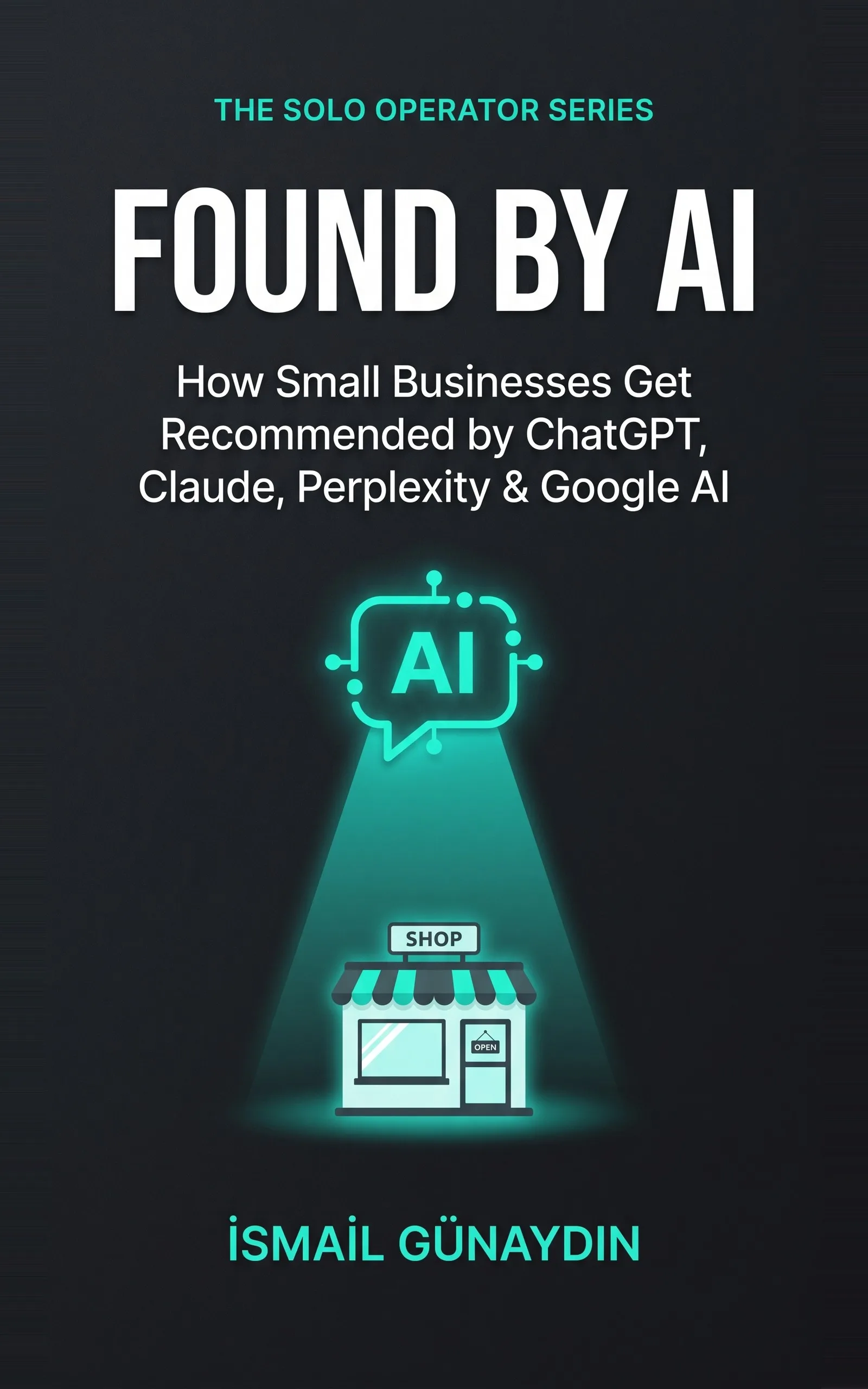
Found by AI
How Small Businesses Get Recommended by ChatGPT, Claude, Perplexity, and Google AI. By İsmail Günaydın, 70 pages.
Where this problem is in the book:
- Can I Quote You Cleanly?
- Are You There When the Question Is Asked?
Links go to Amazon. I wrote this book and earn a royalty on every sale. Amazon sets the price and handles delivery and returns.
Is Found by AI the right book for you?
Yes, if
- You want Perplexity and Claude to quote your site
- Your pages answer the question well and still never get cited
- You write long, careful paragraphs and suspect that is the problem
Skip it if
- You want a keyword list to stuff into your pages
- You want to be quoted without being findable or trusted first
Fair doubts before you buy
Won't writing like this make my site sound robotic?
The book says no, and shows why. You lead with the plain fact, and the warmth moves to the next sentence instead of blocking the view. Skimming humans like the same structure machines do.
Is quotable writing enough to get me named?
No. It is the fourth of five checks. The AI also has to find you, tell what you are and trust you. But once those pass, this is often the step that decides whose sentence ends up in the answer.
Can I just read a copywriting book instead?
Most copywriting books teach you to build toward the point, which is the habit that hides your answer from a machine. This chapter teaches the opposite: the point first, then the build.
Get Found by AI
An AI names a business only after five quiet checks pass, and each check can be fixed with a one-page tool.
Links go to Amazon. I wrote this book and earn a royalty on every sale. Amazon sets the price and handles delivery and returns.
Part of The Solo Operator Series, five short books that can be read in any order.
Questions people ask about this
- How do I get my content cited by ChatGPT?
- Write your key answers so a machine can lift them. Lead with the answer in the first sentence. Make it stand alone, with no this or as above. Make one clear claim. Put the customer's exact question above it as a heading. And make sure the AI can reach and read the page.
- What kind of content does Perplexity quote?
- Clean, self-contained sentences that answer a real question directly. In the book, Perplexity quoted a bookkeeper's line almost word for word: Software handles the recording, but a bookkeeper catches the mistakes software makes silently. It had a citation back to her page.
- Why does AI quote my competitor instead of me?
- Often because their sentence was easier to lift, not because they are better. If your answer sits in the third clause of the fourth sentence, wrapped in it depends, the AI takes a cleaner sentence from someone else.
- Does keyword stuffing help with AI answers?
- No. A sentence crammed with keywords names the topic without answering anything. An AI building an answer needs a claim it can present as true. Answer the question the way you would to a friend.
- Should I add FAQ sections for AI search?
- Plain question and answer content suits AI well because it mirrors the task: a real question with a direct answer under it. Write the questions in your customers' own words, as headings, and put the answer in the first sentence.
- Do statistics and sources help content get quoted by AI?
- They seem to. In a 2023 research paper on generative engine optimization, adding statistics, quotations and source citations gave the biggest visibility gains in AI answers, while keyword stuffing gave little to none. That was a lab test, not a rule for ChatGPT, so use only numbers you can stand behind and name where they come from.
Related problems
- My website traffic dropped after Google AI Overviews started. What do I do this week?
Your Google clicks fell after AI Overviews arrived. Here is what changed, four steps to take this week, and what to stop wasting time on.
- GEO vs SEO: what is the difference, and which one does a small business need?
GEO vs SEO side by side: ranking in a list versus being named in an AI answer. See what each one rewards and which one a small business needs.
- How does ChatGPT decide which business to recommend? The five checks, in order
How ChatGPT, Perplexity and Google's AI pick which businesses to name: the five checks, in order, and where a small business should start.
- Everything inside Found by AI
Every chapter, who the book is for, and every problem it helps with.