Last updated
Do brain training games work, or do you just get better at the game?

| The claim | What the research found | Where it comes from |
|---|---|---|
| You will get better at the games | True. People reliably improve on the tasks they practice. | Simons and colleagues, 2016 review |
| You will get better at similar tasks | Somewhat. The evidence for close cousins of the trained task is weaker. | Simons 2016; Kassai 2019 review in children |
| You will get smarter in general | No. With a fair comparison group, the effect on intelligence was essentially zero. | Melby-Lervåg, Redick and Hulme, 2016, 87 publications |
| It helps at school, at work, and against dementia | The FTC said these ad claims lacked scientific support. | FTC settlement with Lumos Labs, January 5, 2016 |
| You can train away the cost of switching tasks | Practice and getting ready lower the cost. They do not remove it. | Monsell, 2003 review |
| Fast switching drills to a beat forge focus like iron | No source supports it. You mostly get better at the drill. The book marks it MYTH. | The book's myth check |
What the brain game results really say
The table sorts the usual brain game promises from strongest to weakest. Read it from the top down. The top row is true. Each row below it asks the gains to travel further from the game, and the evidence gets thinner as it goes.
Psychologists have names for this. Near transfer means you get better at tasks a lot like the one you trained. Far transfer means the gain shows up somewhere else, like in your job. The 2016 review by Daniel Simons and colleagues looked at the studies the companies themselves cited. It found plenty of evidence for the first, less for close cousins, and little for everyday thinking.
The fourth row is not a study at all. It is a federal agency. On January 5, 2016, the Federal Trade Commission announced that the company behind Lumosity would pay $2 million to settle charges that its ads lacked scientific support.

Ten minutes a day, and the same tired afternoon
You do the app every morning. Your score climbs. The little chart goes up and to the right, and that feels good.
Then it is 3pm. You have a report open, a chat window blinking and an email you keep starting. You jump between them forty times. The report does not move.
So you wonder if you need more training. Maybe a harder level.
Here is the thing nobody in the ads will say, and we will. Your brain did learn. It learned the game.

What to practice instead
The research points somewhere plainer. You get better at what you practice. And one finding is rock solid: every time you switch tasks, you pay a small cost in time and mistakes. Getting ready for a switch lowers the cost. It does not remove it.
A morning with forty switches pays that price forty times. So the useful skill is not switching faster. It is switching less.
You can feel this in two minutes. Write the alphabet from A to Z and time it. Then write 1 to 26 and time it. Then mix them, A1, B2, C3, all the way to Z26. Most people find the mixed round takes longer than the other two added together. Same letters. Same numbers. The extra time is the switching.
Then try a switch budget. Tomorrow, make a tick in your notebook each time you move to a different task. Checking messages counts. At night, count the ticks. The next day, cut that number by a third. Group your messages into two or three blocks, and give your hardest task one long stretch. When you must stop, write one line about where you are and what comes next.
The book marks the alphabet test SOLID, since switch costs are among the most reliable findings in psychology. It marks the budget STORY ONLY, because nobody has tested it as a daily habit yet. It is built from solid findings, and your notebook is the test.
What about dementia, crosswords and older adults?
Many people play brain games to protect their memory as they age. That is a different question from focus at work, so we checked a dementia charity.
Alzheimer's Society says there is no strong evidence that brain training lowers the risk of dementia. It also says that people who do mentally challenging things, like crosswords, puzzles or a new hobby, tend to have lower rates of dementia. Those are studies that watch people, not tests that assign them, so they cannot show the puzzle is the cause.
The same page reports one pooled review where about three sessions of 30 minutes or more a week gave a small gain in thinking and memory. People who trained alone at home, with no supervision, did not improve.
So a crossword you enjoy is a fine habit. It is not a proven shield. The FTC case above was partly about exactly this kind of dementia claim in ads. If you notice real memory changes, that is a talk with your doctor, not a new app.
The chapter that sorts the games from the evidence
This is the problem The Genius Lab was written for: a brain claim you keep hearing, checked against what the studies found.
Switching Fast, and What Switching Costs has both drills above, the full story of the FTC case, the 2016 reviews in plain words, and ways to cut the switches other people push onto you. It also covers the switches that start inside your own head, and where to put them.
Building Rooms in Your Head covers one memory method that does have strong evidence behind it, the memory palace. Our memory palace page shows how to start.
Sleep, Movement, and the Supplement Aisle covers the two things with better brain evidence than any app or pill. They are free, and you already do one of them every night.
The book for this problem
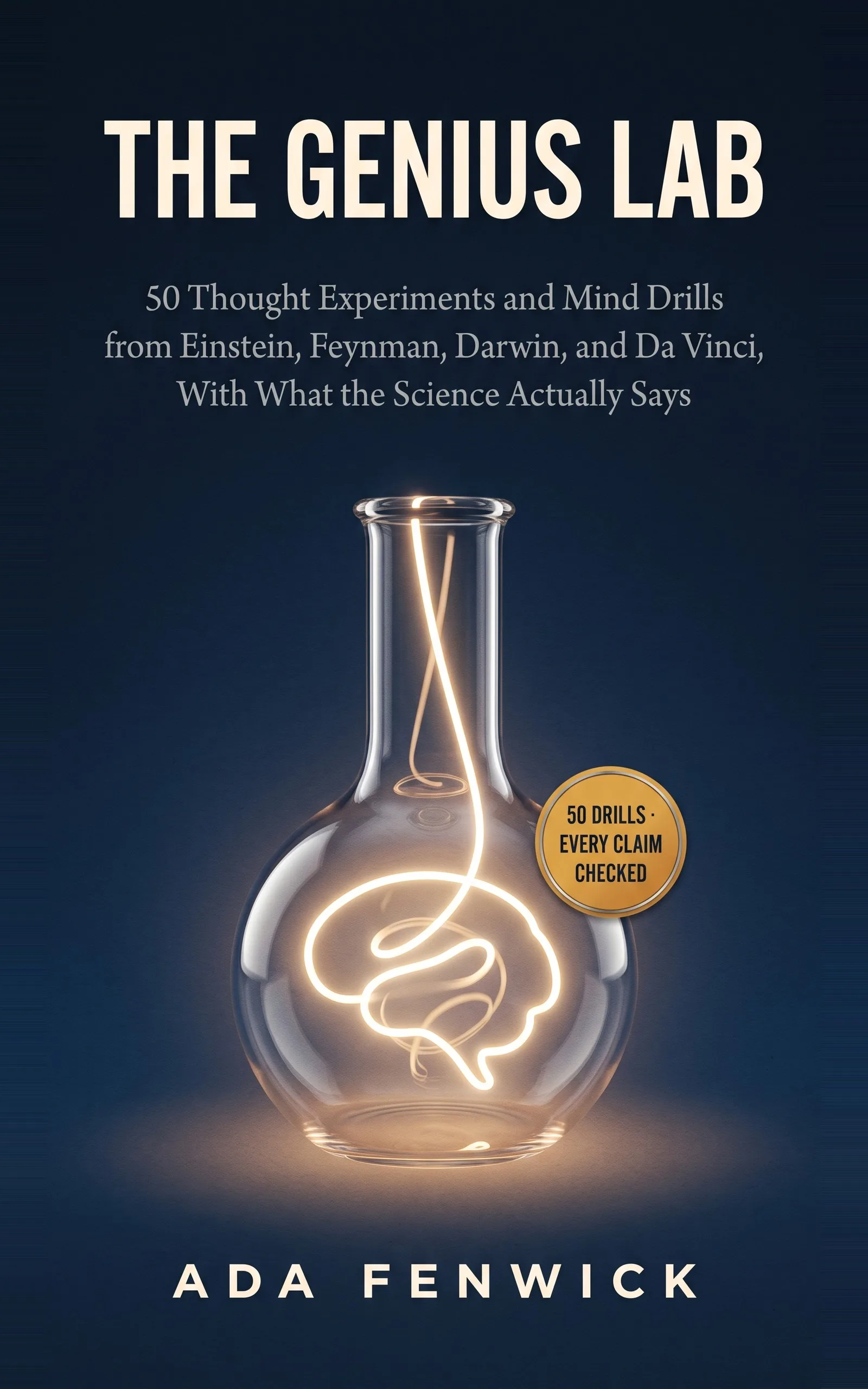
The Genius Lab
50 Thought Experiments and Mind Drills from Einstein, Feynman, Darwin, and Da Vinci, With What the Science Actually Says. By Ada Fenwick, 233 pages.
Where this problem is in the book:
- Switching Fast, and What Switching Costs
- Building Rooms in Your Head
- Sleep, Movement, and the Supplement Aisle
Links go to Amazon. ToolGenX publishes this book under a pen name and earns from every sale. Amazon sets the price and handles delivery and returns.

Is The Genius Lab the right book for you?
Yes, if
- You pay for a brain app and wonder if it is doing anything
- You want better focus at work and keep seeing ads for games
- You want the research in plain words, not a sales page
Skip it if
- You play brain games for fun and are happy with that, which is fine
- You want advice on a medical memory problem, which needs a doctor
Fair doubts before you buy
My app score keeps going up. Doesn't that prove it works?
It proves you are getting better at the app. That part is real, and the reviews agree. The question is whether the gain shows up in the report you are trying to finish, and that is where the evidence runs thin.
Isn't some brain exercise better than none?
Some practice is better than none, but the research says practice is narrow. If you want to focus on long reports, the useful practice is focusing on long reports with fewer interruptions. The book gives you a way to measure and cut your task switches instead.
Get The Genius Lab
Fifty short drills taken from what famous thinkers actually did, each labeled by whether it works for ordinary people, with sixty myths corrected.
Links go to Amazon. ToolGenX publishes this book under a pen name and earns from every sale. Amazon sets the price and handles delivery and returns.
Questions people ask about this
- Do brain training games make you smarter?
- The evidence says no. A 2016 review of working memory training pooled 87 publications and found the effect on intelligence was essentially zero in studies with a fair comparison group. You improve on the trained tasks, and that is mostly where the benefit stops.
- Why did Lumosity get fined?
- On January 5, 2016, the FTC announced that Lumos Labs would pay $2 million to settle charges of deceptive advertising. The company had claimed benefits for school, work and even dementia. The FTC said those claims lacked scientific support. A larger $50 million judgment was suspended.
- What is near transfer and far transfer?
- Near transfer means getting better at tasks very much like the one you practiced. Far transfer means getting better at distant things, like focus at work or general intelligence. Training studies find near transfer and little or no reliable far transfer.
- How can I actually improve my focus?
- Switch less. Every switch between tasks costs you some time and accuracy, and that is one of the most reliable findings in psychology. Count your switches for a day, cut them by a third the next day, group similar tasks, and leave yourself a one-line note when you must stop.
- Are brain games bad for you?
- The book does not say they are harmful. It says they make you better at brain games. If you enjoy them, play them for fun. Just do not expect them to show up in your workday.
- Can brain games prevent dementia?
- That has not been shown. Alzheimer's Society, the UK dementia charity, says there is no strong evidence that brain training lowers your risk of dementia. People who do mentally challenging things like puzzles or new hobbies do tend to have lower rates, but those studies cannot prove the puzzles caused it. If you are worried about your memory, see a doctor.
Related problems
- Do brain supplements work? Thirteen popular ones checked against the human evidence
Lion's mane, magnesium L-threonate, omega-3, creatine and more, each rated by the human studies behind it. No doses, no advice, just the evidence.
- How to build a memory palace when you have never tried one before
A memory palace uses a place you know to hold a list. Here is how to build your first one in 20 minutes, why it works, and what the studies found.
- Stuck on a problem and your brain has stopped working? Do this in the next hour.
Creative block with a deadline? Work hard for 25 minutes, take a real break with no phone, then check. Here is the order, and the study behind it.
- Everything inside The Genius Lab
Every chapter, who the book is for, and every problem it helps with.