Last updated
Do brain supplements work? Thirteen popular ones checked against the human evidence

| Supplement | What is marketed | Best human evidence | Badge |
|---|---|---|---|
| Creatine | Sharper memory, mental energy | Reviews show a modest memory signal, mostly in older adults. One tiny study under sleep loss. Little effect in rested young adults. | PROMISING |
| Omega-3 / DHA pills | Brain building blocks | Large trials in healthy older adults found no benefit for thinking. Eating fish is a separate question. | WEAK |
| Magnesium L-threonate | Raises brain magnesium, more synapses | First described in a 2010 rat study. Two small human trials, both with company ties. | WEAK |
| Uridine + choline + DHA stacks | Builds new synapses | No trials in healthy adults. A medical-food trial in early Alzheimer's missed its main goal. | NO HUMAN EVIDENCE |
| Citicoline | Memory, focus | One company-funded trial in older adults with memory complaints missed its main goal. | WEAK |
| Alpha-GPC | Memory, focus | No good trials in healthy adults. A huge Korean records study linked it to higher stroke risk, which cannot prove cause. | NO HUMAN EVIDENCE |
| Lion's mane mushroom | Grows nerves, new neurons | Nerve-growth claims come from cells and rodents. Small human studies, mostly no effect in healthy adults. | WEAK |
| L-theanine | Calm, better sleep | A 2025 review of 19 studies found small gains in how people rated their own sleep. | PROMISING |
| Caffeine + L-theanine | Calm focus | Short-term gains in attention for an hour or two. Caffeine does most of the work. | PROMISING |
| B12 and folate | Memory | No benefit in people who are not deficient. A real deficiency needs a doctor's diagnosis. | WEAK |
How to read the evidence table
Each row is one supplement. The second column is what the label or the ads promise. The third is the best human evidence the book could find. The last column is the badge.
The book uses four badges for its drills: SOLID, PROMISING, STORY ONLY and MYTH. For the supplement table it adds two more. WEAK means the human studies for the marketed claim are few, small, mixed, tied to the company, or found no benefit in healthy adults. NO HUMAN EVIDENCE means the claim rests on animal or cell studies only.
The three rows we left out of the table, glycine, chamomile and zinc, all rate WEAK too. Not one of the thirteen earns a SOLID.
We are not giving doses, and we are not telling you to start or stop anything. Some of these have real side effects or clash with medicines. The book names fish oil with blood thinners, and chamomile with warfarin. If you take medication or have a health condition, talk to your doctor or pharmacist first, and bring the bottle.
Standing in the brain health aisle
The shelf is bright. One bottle has a glowing brain on it. Another lists a dozen words you have never seen. A month's supply costs about as much as a nice dinner.
Online it gets louder. Special magnesium. Mushroom powder. A "stack" that claims to build new brain wiring.
It all sounds very scientific. And you have no way to check it standing there.
Here is the part the labels skip. In the US, supplements are not approved by the FDA before they go on sale. And what is in the bottle may not match the label. In a study published in 2021, a team led by Pieter Cohen tested ten "cognitive enhancement" products and found five drugs that are not approved in the US. Some were above doses a doctor would prescribe.
That study picked products whose labels already listed unapproved drugs, so it does not describe every brain pill. It does show how loose the market can be.

What a seal on the bottle does and does not tell you
If you buy supplements, the book points to third-party seals such as USP or NSF. According to the National Institutes of Health, those seals check that a product was made properly, holds what the label says, and is not contaminated.
They do not tell you if it works. They do not tell you if it is safe for you.
What about ginkgo?
Ginkgo is one of the oldest memory pills on the shelf, and it is not in the book's table. So we went to the US government's National Center for Complementary and Integrative Health.
Its answer is plain. Ginkgo has not been shown to prevent dementia or slow it down. The biggest test, the GEM study, followed more than 3,000 people aged 75 or older for a median of six years. Some took ginkgo and some took a dummy pill. There was no difference in how many got dementia.
NCCIH also warns that ginkgo may raise the risk of bleeding in people who take blood thinners such as warfarin. Ask your doctor or pharmacist before you try it.

So which supplement is best for memory?
This is the question most people type in. Based on the book's table, there is no clear winner for a healthy adult.
The closest thing to a yes is creatine, rated PROMISING, with a modest memory signal mostly in older adults. Caffeine with L-theanine can help attention for an hour or two, and the caffeine does most of the work.
One case is different. If you are low in vitamin B12, that is a real medical problem. It needs a doctor's diagnosis, not a guess from the supplement aisle. In people who are not low, the book found no memory benefit from B12 or folate.
The book also notes that magnesium can clash with certain antibiotics. That is one more reason to show your pharmacist any bottle before you start it.

Where the better brain evidence is
This is the problem The Genius Lab was written for: a shelf full of brain claims, checked one by one.
Sleep, Movement, and the Supplement Aisle has the full table of thirteen, with the reasoning behind every badge. It also covers the two things that beat every bottle. Sleep after learning helps you keep facts, and there is a simple drill to test it on yourself. Walking helps you come up with ideas: in the first experiment of a 2014 Stanford study, 81 percent of the 48 people came up with more ideas while walking than sitting. The chapter also checks the famous claim that exercise grows part of your brain by 2 percent, and why that number is shaky.
Switching Fast, and What Switching Costs does the same job for brain training apps. Our page on brain training games has the short version.
How to Use the Lab explains the four badges and what each one can hold, so you can weigh the next brain claim you see.
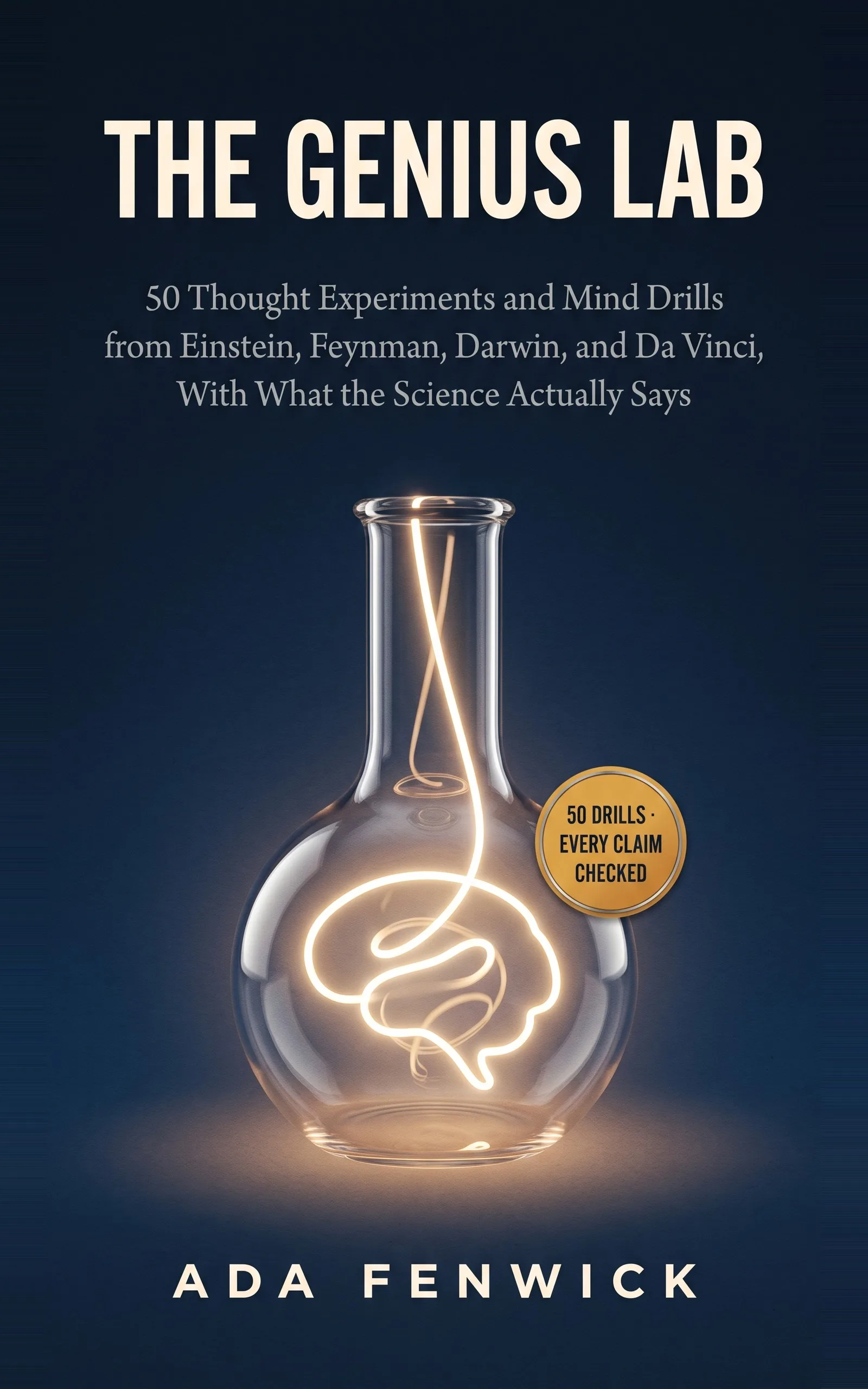
The book for this problem
The Genius Lab
50 Thought Experiments and Mind Drills from Einstein, Feynman, Darwin, and Da Vinci, With What the Science Actually Says. By Ada Fenwick, 233 pages.
Where this problem is in the book:
- Sleep, Movement, and the Supplement Aisle
- Switching Fast, and What Switching Costs
- How to Use the Lab
Links go to Amazon. ToolGenX publishes this book under a pen name and earns from every sale. Amazon sets the price and handles delivery and returns.

Is The Genius Lab the right book for you?
Yes, if
- You stand in the brain health aisle and cannot tell hype from evidence
- You have seen nootropic stacks online and want them checked
- You want the studies in plain words, without anyone selling you a pill
Skip it if
- You want doses or a plan for what to take, which this page will not give
- You have a health condition or take medication and need advice, which is your doctor's job
Fair doubts before you buy
The bottle says clinically studied. Doesn't that mean it works?
Not always. The book found that many human studies were small, done in older adults with memory problems rather than healthy people, or paid for by the company selling the ingredient. Clinically studied tells you a study exists. It does not tell you what it found.
If a supplement rates PROMISING, should I buy it?
The book is clear that a PROMISING badge is not a recommendation to buy anything. It means there is some real human evidence for a narrow claim. Whether anything is right for you is a question for your doctor or pharmacist, with the bottle in your hand.
Get The Genius Lab
Fifty short drills taken from what famous thinkers actually did, each labeled by whether it works for ordinary people, with sixty myths corrected.
Links go to Amazon. ToolGenX publishes this book under a pen name and earns from every sale. Amazon sets the price and handles delivery and returns.

Questions people ask about this
- Do nootropics actually work?
- For most popular brain supplements, the human evidence in healthy adults is thin. Of the thirteen the book checked, three rated PROMISING for narrow claims, most rated WEAK, and two had no human evidence for the marketed claim. None rated SOLID.
- Does lion's mane grow new brain cells?
- That claim comes from studies in cells and rodents. No human study has shown it. The small human studies so far mostly found no effect in healthy adults, so the book rates the claim WEAK.
- Is magnesium L-threonate proven to boost memory?
- No. It was first described in a 2010 rat study by researchers at Tsinghua University and MIT. There are two small human trials, both with ties to the company that sells it. The book rates it WEAK.
- Are brain supplements regulated by the FDA?
- In the US, dietary supplements are not approved by the FDA before they go on sale. A 1994 law set it up that way. The FDA mostly steps in after a product is on shelves, if problems show up.
- What does a USP or NSF seal mean on a supplement?
- According to the National Institutes of Health, these third-party seals check that a product was made properly, contains what the label says, and is not contaminated. They do not tell you whether it works or whether it is safe for you.
- What actually helps your brain if supplements don't?
- The two things with the best evidence are sleep and movement. Sleeping after you learn helps you keep facts and word-based memories, and an easy walk seems to help ideas flow. The book says nothing on the supplement shelf comes close to either.
Related problems
- Do brain training games work, or do you just get better at the game?
Brain games make you better at brain games. Here is what the big 2016 reviews found, what the FTC said, and what to practice instead.
- The Edison nap: how to catch ideas at the edge of sleep, and when to stop
The steel-ball story has no source, but a 2021 study tested the nap. Here are the steps, the stop rules, and what the evidence really shows.
- How to build a memory palace when you have never tried one before
A memory palace uses a place you know to hold a list. Here is how to build your first one in 20 minutes, why it works, and what the studies found.
- Everything inside The Genius Lab
Every chapter, who the book is for, and every problem it helps with.