Last updated
Can a small business compete with big companies? Here is where to start.

The ad that almost made you quit
You scroll past it on a Tuesday. A big brand in your field. Slick video, a famous face, the kind of reach you will never buy. The ad probably cost more than your business will earn in years.
And the thought arrives, the one every small owner has at least once. Who am I kidding? They're a hundred times my size.
In my book, a one-person coffee roaster named Mara has that exact Tuesday. She roasts on one machine in a rented unit. She almost quit that day.
She had the math backwards. So, probably, do you.
Why "work harder and spend smarter" does not close the gap
Most advice for small owners is about doing the big firm's game a bit better. Sharper ads. Lower prices. A website that looks more like a company.
Here is the problem. Every one of those moves puts you on ground where size decides. More money buys more ads. More volume buys lower prices. A bigger team buys more polish. You can work all night and still be a smaller copy of the thing that already has the budget.
For a long time that was simply true. You could be faster, more trusted and more personal, and still lose, because you could not produce enough alone. The edges were real, but you could not press them hard enough for customers to feel.
The hundred times is also your opening
Size is not only power. It is a cost. A company a hundred times your size has a hundred times the meetings, the approvals and the distance between the person who sees a problem and the person allowed to fix it.
Look at what that cost buys you. The big firm cannot decide fast. When McKinsey surveyed executives, only about 37% said their companies made decisions that were both good and fast (McKinsey, 2019). You decide in the time it takes to read an email.
What changed is the tool that lets you press these edges. On writing tasks, AI cut the time by about 40% and raised quality by about 18%, and it helped weaker writers the most (Science, 2023). You are not a trained marketer or designer. You are the person these tools lift hardest.
First, decide what "compete" means for you
Several guides on this question make a good point: decide what winning means before you plan the fight. Beating a national brand across a whole market is one goal. Owning the part of the market that fits you is another.
The book is clear about which one it means. The roaster never outspent the coffee giant, and the book says so. She won the part of the market that was hers, completely: the customers who wanted what only she could give, who stayed and brought others. That was the only part she ever needed.
So write one line before you start. Who exactly do I want to be the obvious choice for? If the answer is "everyone," you are still on the giant's ground.

Where a small business still can't compete
An honest answer has two halves. Here is the half most pep talks skip.
| Where size still wins | Why it holds |
|---|---|
| Price | A big firm has more buying power and can cut prices you cannot match. |
| Reach | It can buy attention from millions at once. |
| Budget | It can outspend you on ads, staff and launches. |
| Doing many jobs at the same time | It pays specialists to work in parallel. AI narrows this one, but does not give you their budget. |
The book does not tell you to beat these. It tells you to stop fighting on them, and to press where the same size works against the big firm: speed, trust, focus and knowing customers by name.

Your first step: a five-line audit in one sitting
Here is one real tool from the book that you can do tonight. Write five lines:
- Speed: how fast I decide and ship.
- Trust: whether customers can see the real person.
- Focus: whether I own one narrow slice or chase everyone.
- Knowing customers: whether I remember them as people.
- AI help: whether I draft what a department would produce.
Next to each, write two things. Where you already hold this edge. And where you have been fighting on their ground instead, meaning price, reach or scale.
Be honest. The book's point is that most solo owners bury edges they already hold. They write "we" when it is just them. They sell to everyone because it feels safe.
Then pick one. Not five. The one you already hold and are not using. The book says it is usually trust or focus. Lean your whole weight on it for the next few weeks.
A 90-day plan for competing from the small side
This is the problem The Unfair Solopreneur was written for.
Introduction: The 100x Myth makes the case that size is a cost, with the data on trust and AI, and gives you the full Unfair Advantage Audit. Speed: You Move While They Meet turns your fast decisions into a weekly habit with the Speed Map. Conclusion: Press the Advantages While the Window Is Open paces all five edges across 90 days, so you are not trying to fix everything at once.
The audit and the six other tools are in the free workbook. For the five edges side by side, see small business vs big company.
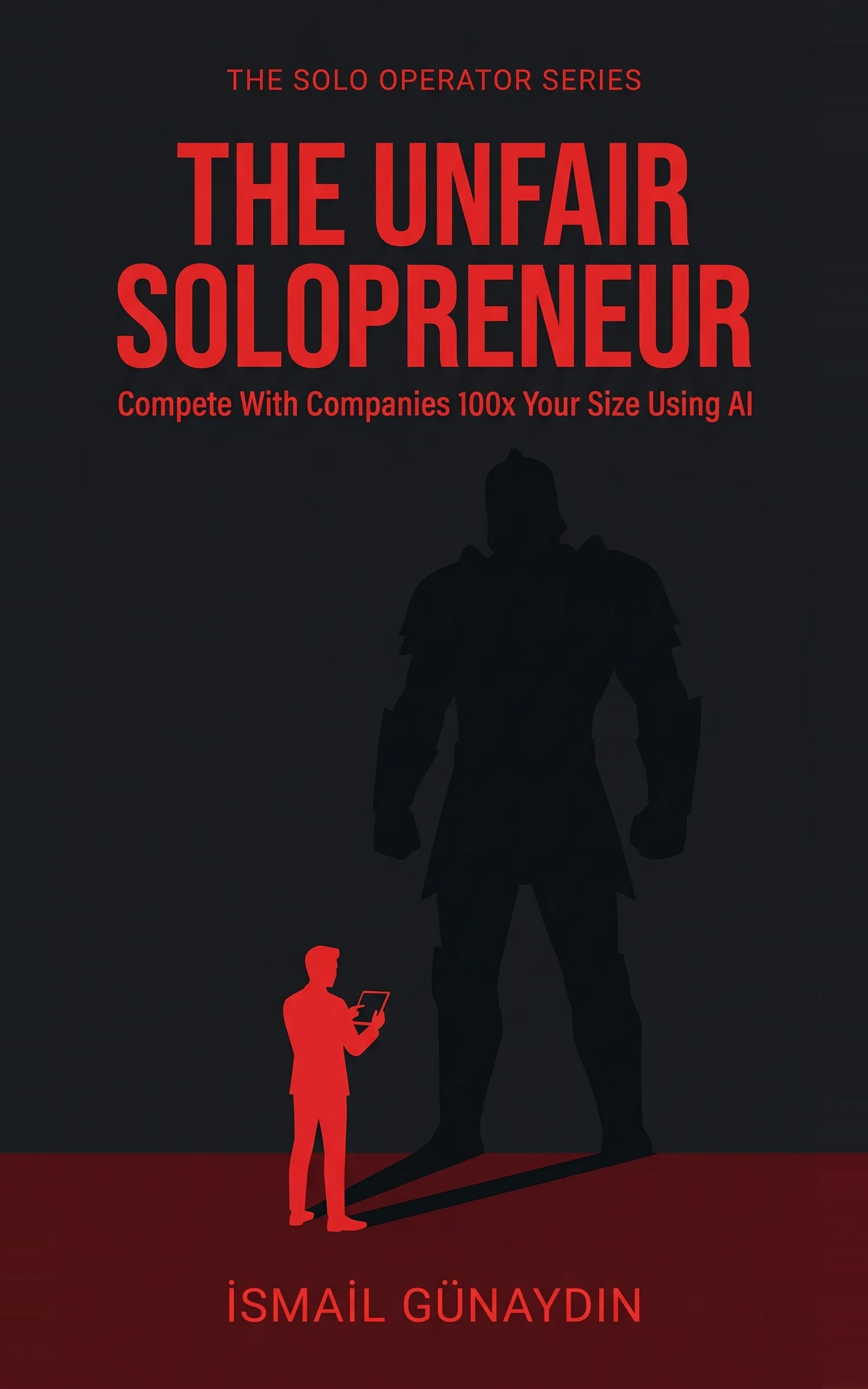
The book for this problem
The Unfair Solopreneur
Compete With Companies 100x Your Size Using AI. By İsmail Günaydın, 60 pages.
Where this problem is in the book:
- Introduction: The 100x Myth
- Speed: You Move While They Meet
- Conclusion: Press the Advantages While the Window Is Open
Links go to Amazon. I wrote this book and earn a royalty on every sale. Amazon sets the price and handles delivery and returns.

Is The Unfair Solopreneur the right book for you?
Yes, if
- You compete with a national chain that outspends you on ads
- You run a business alone or with one or two helpers
- You want a plan with real steps, not a pep talk
Skip it if
- You want to raise money and grow into a big company yourself
- You want a list of tricks without the reasons behind them
Fair doubts before you buy
Isn't this just another 'small is beautiful' book?
No. It is honest that size still wins on price, reach and budget, and it says so in the first pages. It is about the costs that come with size, the ones a big company cannot escape, and how you can use them. It promises advantages, not wins.
Why not just learn this from free blog posts?
You could collect the ideas one by one. The book puts them in an order that builds, with a one-page tool for each and a 90-day plan that paces them. That order is the part most posts skip.
Get The Unfair Solopreneur
Small is not the underdog: speed, trust, focus, closeness to customers and AI are edges a big company cannot copy without stopping being big.
Links go to Amazon. I wrote this book and earn a royalty on every sale. Amazon sets the price and handles delivery and returns.
Part of The Solo Operator Series, five short books that can be read in any order.

Questions people ask about this
- What advantages does a small business have over a big company?
- Five, according to the book. Speed, because you decide alone. Trust, because you are a person and not a logo. Focus, because you can own a slice too small for a big firm. Knowing customers by name, because you have few enough to know. And AI, which gives one person a usable version of a department's output.
- How does a small business compete with a big company on price?
- Mostly, it should not. Price is where size wins, because a big firm can cut costs you cannot match. The book's advice is to move the fight to ground where being small is the reason you win, and let the big company keep the price war.
- Where should a small business start when competing with big companies?
- With an honest audit. Write down the five edges and, for each, mark where you already hold it and where you have been competing on price, reach or scale instead. Then pick the one you hold and are not using. Most often it is trust or focus.
- Is it too late for small businesses to use AI?
- No. The latest federal data shows AI use still lags among the smallest firms even as it climbs among bigger ones. That lag is the opening. Most solo owners are not using these tools well yet, so starting now still puts you ahead of most of your peers.
- How long does it take to start competing differently?
- The book lays it out over 90 days. Week one is the audit. Then roughly two weeks each for speed, trust, focus and knowing customers, and the last two weeks for setting up one AI department. One edge pressed hard beats five admired from a distance.
- Can a small business really compete with big companies?
- Yes, but not everywhere. A small business usually loses on price, reach and budget, so it should not fight there. It can win on speed, trust, a narrow focus and knowing customers by name, because a big company cannot do those things without stopping being big. The book promises advantages, not wins.
Related problems
- Small business vs big company: who has the advantage, and where?
A side-by-side look at where a big company wins, where a small business wins, and why each edge comes from size itself.
- You keep losing clients to bigger companies. Is it really their budget?
If bigger firms keep winning your clients, you may be fighting on their ground. See where size wins, where it loses, and how to move the fight.
- How a small business can use speed to beat bigger competitors
Big companies need months to approve what you can decide in minutes. Here is how to map that gap and spend it on small, fast launches.
- How to pick a niche too small for big companies but big enough for you
Four plain tests for picking a niche a big company will not follow you into, plus the two mistakes that sink most small owners who try.
- Everything inside The Unfair Solopreneur
Every chapter, who the book is for, and every problem it helps with.