Last updated
How to pick a niche too small for big companies but big enough for you

| Test | Fails | Passes |
|---|---|---|
| Is it specific, not just narrow? | Specialty coffee. A thousand sellers, buyers still compare on price | Fresh single-origin light roasts with the roast date, for people who pull their own espresso shots |
| Could ten rivals copy your tagline unchanged? | Yes. You went narrow but not specific | No. It describes your business and almost no one else's |
| Are there enough real buyers in it? | You cannot name actual customers who fit | You can name real people who fit, and there are enough to support you |
| Is it the slice you already serve? | It is the slice that sounds impressive at dinner | It is the group your loyal, repeat buyers already form |
| Can a giant afford to follow? | The slice is big enough to justify their factory, shelf and ad costs | It sits below the line their size draws, so the idea dies in their meeting |
The rules behind the table
The table above has five rows. The first four are tests you run on your own idea. The last one is about the other side. A niche is only safe if a big company cannot afford to want it.
Rule one is the most important, and it fits in one sentence. When your ideal customer describes their need out loud, it should sound like a description of your business. If they say "I should look into single-origin coffee," that is a category with a hundred sellers. If they say "I want light roasts that arrive fresh, with the roast date and a grind setting to start from," and that is exactly what you sell, you found it.
Rules two and three pull in opposite directions on purpose. Rule two stops you from staying too broad. Rule three stops you from going so small that no one is left. You need both. The book's warning example is a slice so fine it only fits left-handed decaf drinkers in one postal code.
Rule four saves you the most time. Do not pick the slice you wish you served. Pick the one your best current buyers already form. They have voted with their wallets. Read the votes you have.
Why the giant stays out
Picture a slice worth what one small owner needs for a good year. To you, that is a whole business. To a big company, it is too small to survive a single meeting.
A manager who wanted to chase it would have to justify the factory time, the shelf space, the ads and the staff hours. All for a market that could never pay back the cost of the machine needed to serve it. So the idea dies. Not because the giant is lazy. Because big has a smallest deal it is allowed to care about, and your slice sits under that line.
That is why a niche you own is safer than a sliver of their market. They can take a sliver back any quarter with a price cut. They cannot take your slice, because taking it was never worth their cost.
A quick check that the slice can pay you
Rule three in the table, enough real buyers, is the one owners guess at most. Many niche guides warn about the same trap: a slice so small that even winning all of it will not cover your costs. You can check it on one sheet, with your own numbers. Count from the bottom up, not from a market report.
- List the real buyers you can name who fit the slice today, from your own customer list.
- Write what one of them spends with you in a year, from your own sales, not a hope.
- Multiply. That is what the slice is worth to you right now.
- Compare it with what you need to cover your costs and pay yourself.
If the number is far short, you have two honest options. Widen the slice by one step, or find where more people like your best buyers gather. If you cannot name enough real people even after that, the book's word for it applies: a hobby, not a niche.
No loyal buyers to read yet? Look where the obsession lives
The book's best advice is to build from the customers who already love you. If you are just starting, you don't have that list yet. The next best place is where people with the same specific need already talk to each other.
In the book, the roaster's niche, home espresso fans, lives in forums, subreddits and local clubs, all full of people with the identical need. Those rooms tell you three things fast. What people in the slice ask about again and again. What they complain the big brands get wrong. And whether there are enough of them to matter.
Read first. Then answer questions under your real name. The people who find your answers useful can become your first buyers, and the start of the list the book tells you to read.
The Sunday the roaster deleted "for everyone"
She was rewriting her website. At the top she typed "great coffee for everyone." It felt ambitious. It felt like what the big brand said on its billboards.
Then she looked at it again. She roasts a few hundred bags a week on one machine. The giant could be coffee for everyone, and it had not made the giant loved. It had made it beige.
So she looked at who actually loved her coffee. Her most loyal, least price-sensitive buyers were all home espresso fans who pulled their own shots and asked her about dialing in their machines. She dropped her medium roasts. Her site now says who it is for and, just as loudly, who it is not for.
The "not for" did the work. Those buyers read it and felt found.
Owning a slice means serving it fully
Here is the rule people skip. Picking the right slice is half the job. The other half is serving it so well that no one could serve it better. A thin niche leaks buyers to whoever goes deeper.
That used to need more than one person. Guides, answers to the same questions, detailed notes for each product. AI changes that. In writing tasks, it cut time by about 40% and raised quality by about 18% (Science, 2023). In support work, it lifted beginners by about 34% (NBER, 2023). The roaster used it to draft a brew guide for each coffee from her own notes and to answer the tenth "my shots are sour" question as carefully as the first.
You bring the craft and the judgment. The tool brings the depth that used to need a hire.
The chapters that walk you through it
This is the problem The Unfair Solopreneur was written for. I think focus is the edge most small owners hold and do not use.
Focus: Own the Slice Too Small for Them gives you the Niche Wedge, a three-line tool: the broad market you were losing in, the specific slice you can own, and why a giant will not follow. It also covers the four ways this goes wrong. Intimacy: Know the Customers They Can Only Segment picks up once you have the slice, and shows how to keep knowing each buyer by name as it grows.
The Niche Wedge is in the free workbook. To see focus next to the other four edges, read small business vs big company.
The book for this problem
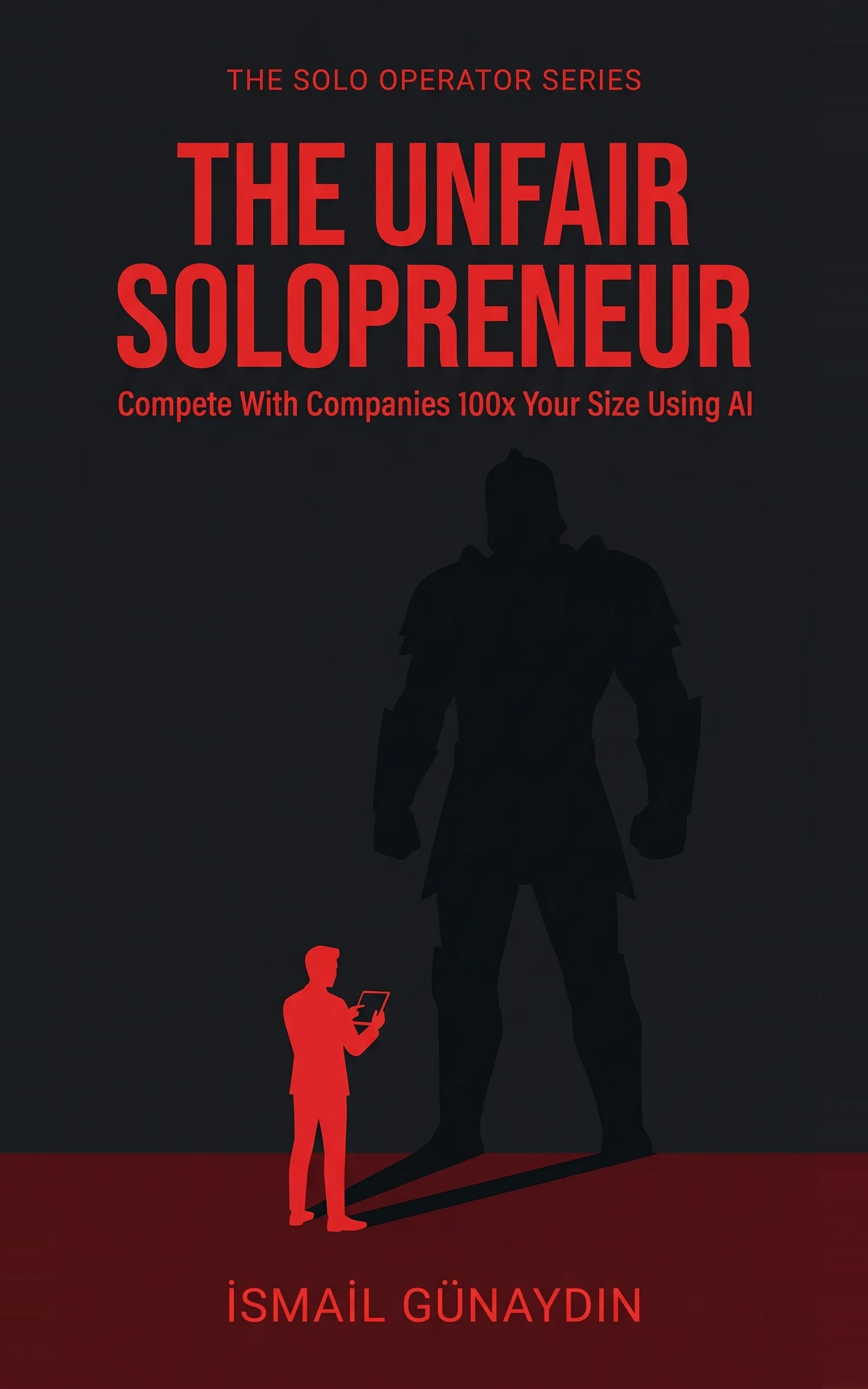
The Unfair Solopreneur
Compete With Companies 100x Your Size Using AI. By İsmail Günaydın, 60 pages.
Where this problem is in the book:
- Focus: Own the Slice Too Small for Them
- Intimacy: Know the Customers They Can Only Segment
Links go to Amazon. I wrote this book and earn a royalty on every sale. Amazon sets the price and handles delivery and returns.

Is The Unfair Solopreneur the right book for you?
Yes, if
- You are deciding whether to go broad or own one small slice
- You sell to everyone and compete with a chain on price
- You worry that a narrow niche means fewer customers
Skip it if
- You want a list of trending niches to jump into
- You want market size numbers for your niche (the book gives tests, not figures)
Fair doubts before you buy
Won't a small niche cap how much I can earn?
The book argues the opposite for a one-person business. A slice you own fully brings buyers who stop price shopping, come back and tell others like them. A sliver of a big market brings a thin trickle of buyers who compare you with everyone. The niche only has to be big enough for one business, not for a giant.
I have read niche advice before. What is different here?
Most niche advice stops at 'go narrow.' The book separates narrow from specific, warns against slicing so fine no one is left, and shows how AI lets one person serve a niche with the depth a small team once needed.
Get The Unfair Solopreneur
Small is not the underdog: speed, trust, focus, closeness to customers and AI are edges a big company cannot copy without stopping being big.
Links go to Amazon. I wrote this book and earn a royalty on every sale. Amazon sets the price and handles delivery and returns.
Part of The Solo Operator Series, five short books that can be read in any order.
Questions people ask about this
- How small is too small for a niche?
- Too small is when you cannot name real customers who fit, or there are not enough of them to support the business. The book's warning example is single-origin light-roast decaf for left-handed home espresso drinkers in one postal code. A slice of one is not a niche. It is a hobby.
- Why don't big companies go after small niches?
- Because a slice that would support one person for a year is too little money for them. To chase it, a product manager would have to justify factory time, shelf space and staff hours for a market that cannot pay back the overhead. The idea dies in the meeting. Their size sets a minimum, and your slice sits below it.
- What is the difference between a narrow niche and a specific one?
- Narrow is a smaller group that still compares you with ten vague options on price. Specific is when you are the obvious choice for exactly that person's need. Specialty coffee is narrow. Fresh single-origin light roasts with the roast date and a grind setting, for people who pull their own espresso shots, is specific.
- How do I find my niche as a small business?
- Look at your current customer list first. Find the buyers who are most loyal, least price sensitive and most likely to recommend you. In the book, the roaster's best buyers were all home espresso fans. The niche was already there, labeled 'some of my customers' instead of 'the business.'
- Can one person serve a niche without hiring?
- More than before. The US Census Bureau has written that generative AI lets a small firm do work that would otherwise need a specialist hire. In a niche, that means guides, answers to repeat questions and detailed product notes, drafted with AI from your own expertise while you keep the craft and the final call.
- How do I know if my niche is big enough to support my business?
- Count from the bottom up. List the real buyers you can name who fit the slice, write what one of them spends with you in a year, multiply, and compare it with what you need to cover costs and pay yourself. If it falls far short, widen the slice one step. If you still cannot name enough real people, it is a hobby, not a niche.
Related problems
- Can a small business compete with big companies? Here is where to start.
Yes, but not on price or reach. Learn the five edges a big company cannot copy, and a first step you can take in one sitting.
- You keep losing clients to bigger companies. Is it really their budget?
If bigger firms keep winning your clients, you may be fighting on their ground. See where size wins, where it loses, and how to move the fight.
- Small business vs big company: who has the advantage, and where?
A side-by-side look at where a big company wins, where a small business wins, and why each edge comes from size itself.
- Everything inside The Unfair Solopreneur
Every chapter, who the book is for, and every problem it helps with.