Last updated
Still working at 65: can you delay Medicare Part B? Start with the size of your employer

Your birthday falls on a Wednesday, and you go to work
You turn 65 on a Wednesday. You drive in, park in the same spot, swipe the same badge. Your health card has not changed. Nothing feels different.
But a clock started months ago. Your seven-month Medicare window opened three months before this birthday, and it will close three months after, whether you use it or not.
So you ask the obvious question at lunch. A coworker says you don't need Part B while you work. Another says you do. Your brother-in-law says it depends. He is the closest to right, and the least helpful.
What nobody says out loud is this: most people at 65 have no idea how many people their company employs. Yet that one number decides most of the answer.

Why "you're covered at work, you're fine" is only half a rule
The usual advice is true for many people. It is not true for everyone. The gap is in two words: "employer size" and "current."
Here is the part nobody mentions. When you have Medicare and a job plan, one of them pays your bills first. That one is the primary payer. The other is the secondary payer. It pays only for costs the first one didn't cover, and it might not pay all of them.
Medicare's rule, from the 2027 handbook and the Who pays first page, sets the line at 20 employees:
- 20 or more employees: the job's plan pays first. Medicare pays second.
- Fewer than 20: Medicare pays first. The job's plan pays second.
There is a twist. A small employer that is part of a multi-employer plan with 20 or more workers in total is generally treated like a big one. And that kind of plan can ask CMS to exempt its small employers. Then Medicare pays first again. Ask the plan if it has done this.
At a small employer, the stakes are clear. Medicare says job coverage "might not pay for health services if you don't have both Part A and Part B." CMS adds that most small-employer plans "require people to sign up for Part A and Part B as soon as they're eligible."
The word "current" matters just as much. These do not count as coverage from current work: COBRA, retiree coverage, VA coverage, a plan you bought yourself, and coverage you get through severance or a layoff.

One letter from your benefits office changes the whole picture
Here is the idea we would hand you first. Before you read another rule, get the employer size in writing.
Ask your benefits office one question: "Does the company have 20 or more employees for Medicare purposes?" Then ask a second: "Does the plan expect me to have Part A and Part B at 65?" Ask them to write the answers down.
With those two answers, the rest of the rules sort themselves out.
If you put off Part B because of job coverage, you get a Special Enrollment Period. That is a sign-up window outside the usual dates. You can sign up any time while you are still covered. Or you can sign up in the 8 months that start the month after the job ends or the coverage ends, whichever comes first.
The book gives a plain case. Your last day at work is in June. The plan keeps you covered through July. The job ended first, in June, so your 8 months run from July through February.
Signing up in that window usually means no Part B late penalty. It doesn't apply if your Medicare is based on End-Stage Renal Disease, or while you are still inside your first seven-month window.
When you are ready, two forms come into it. CMS-40B asks for Part B. CMS-L564 has a section for you and a section for your employer. Part B then generally starts the first of the month after you sign up. You can ask to push that start back up to 3 months, to line it up with the date your job plan stops.
CMS's notes on Medicare enrollment for employers cover the same ground from the employer's side.

The clocks that keep running while you work
Three more things move while you are at your desk.
Your Medigap window waits. It does not start at 65 if you put off Part B. It starts in the first month you have Part B and are 65 or older.
Your drug coverage needs a letter. If your job's drug plan is "creditable," it may let you wait on Part D with no penalty. The plan must tell you whether it is. Keep that letter.
And the HSA. If you or your employer put money into a Health Savings Account, the 6-month reach-back of Part A can make some of it excess, which is taxed. We cover that on the HSA page.

Before your last day at work
When you know your last day, a few jobs are worth doing early. These come from the book's still-working chapter.
- Write down two dates. Your last day at work and your last day of job coverage. The one that comes first starts your 8-month window the month after.
- Ask for Section B of Form CMS-L564 early. Your employer or its plan fills it out. If they can't, Social Security accepts other proof, such as W-2s, pay stubs or a health card with a start date.
- Pick your Part B start date. You can ask to delay it up to 3 months, to line up with the day the job plan stops.
- Find your drug coverage letter. It shows whether your job's drug coverage was creditable.
- Stop HSA deposits in time, if you or your employer put money into one.
- Make two calls to 1-800-MEDICARE. If your group health plan coverage ends, call to update your record. If you are retiring, call to make sure your primary insurance information is right.
Keep proof of the date you apply for Part B, such as the online confirmation or the name of the person you spoke with.

Where the book picks up the still-working case
This is the problem The Year You Turn 65 was written for. Nancy Whitaker puts the whole case in one place and lets you fill it in.
Still Working at 65 has the who-pays-first table with the multi-employer row, the list of coverage that does not count, the 8-month window with its example, both forms and the 3-month start option. It ends with a fill-in page for your own dates.
Seven Months Before You Apply: The Money Account That Has to Stop does the HSA math, month by month, with the IRS limits for 2025 and 2026.
Your Spouse's Clock Runs Separately covers the case where the job plan belongs to your spouse. The 20-employee line then applies to your spouse's employer.
The book is not affiliated with Medicare or Social Security, and it does not tell you whether to delay. Your State Health Insurance Assistance Program (SHIP) offers free counseling, and Social Security can look at your own file and confirm your 8-month dates.
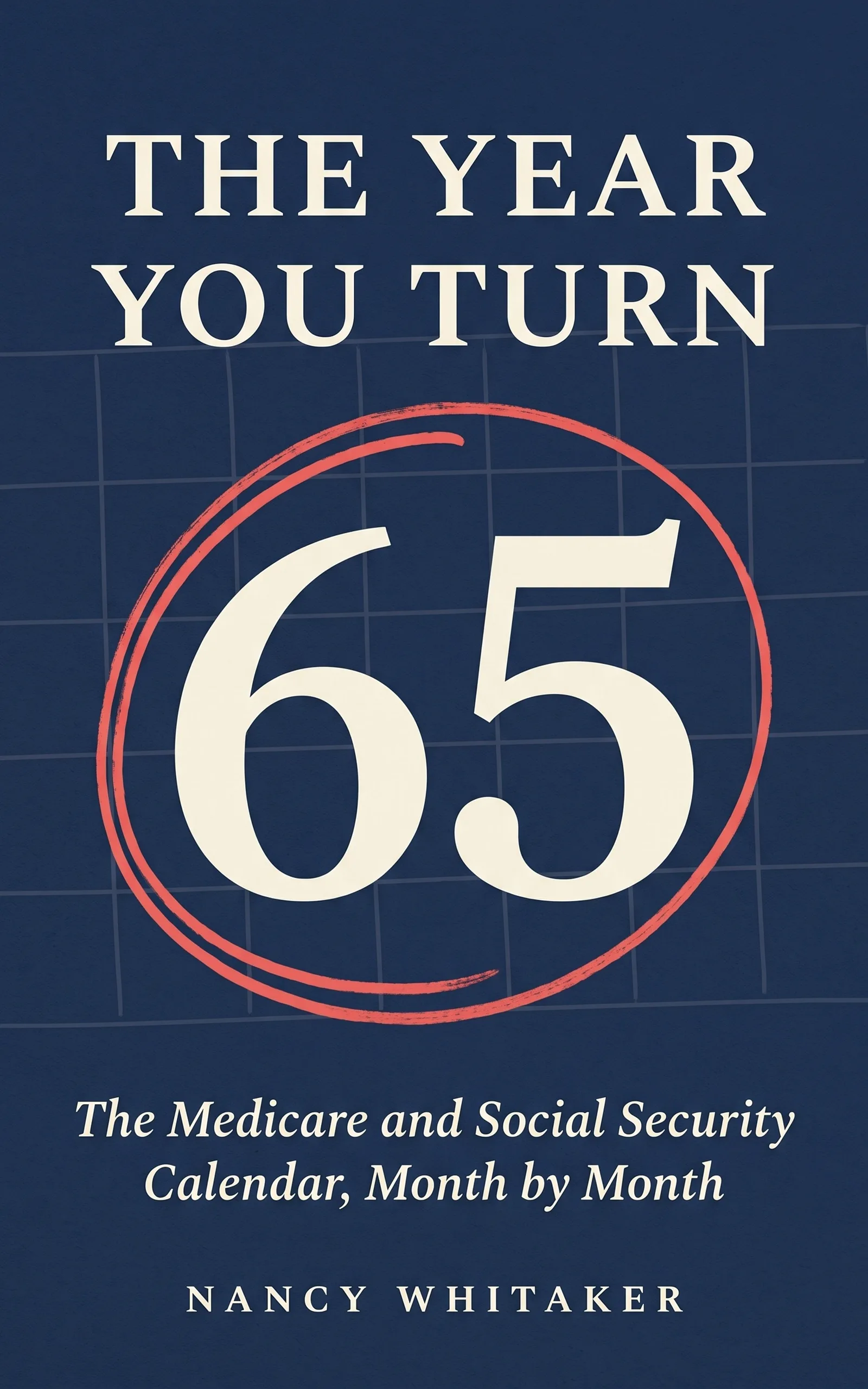
The book for this problem
The Year You Turn 65
The Medicare and Social Security Calendar, Month by Month. By Nancy Whitaker, 162 pages.
Where this problem is in the book:
- Still Working at 65
- Seven Months Before You Apply: The Money Account That Has to Stop
- Your Spouse's Clock Runs Separately
Links go to Amazon. ToolGenX publishes this book under a pen name and earns from every sale. Amazon sets the price and handles delivery and returns.

Is The Year You Turn 65 the right book for you?
Yes, if
- You will still be at your job, or on your spouse's job plan, when you turn 65
- You do not know how many employees your company has for Medicare purposes
- You want to know which forms to ask your benefits office for, and when
Skip it if
- You want someone to say whether waiting on Part B is the right call for you
- Your coverage is COBRA or a retiree plan (that is a different set of rules)
Fair doubts before you buy
My HR person said I don't need Part B. Isn't that enough?
Maybe. HR knows the plan. Medicare's rules turn on the employer's size and on whether the coverage comes from current work. Ask HR two things in writing: does the company have 20 or more employees for Medicare purposes, and does the plan expect you to have Part A and Part B at 65? Then you have proof, not a hallway answer.
Is this just the Medicare handbook in a different order?
The rules are the same, because they have to be. What changes is the order. The book puts the still-working rules in one chapter with a fill-in page: employer size, last day of work, last day of coverage and the 8 months that follow. The handbook spreads those across many pages.
Get The Year You Turn 65
Turning 65 starts several clocks nobody mails you; the book lines them up month by month from your own birthday, with every number sourced.
Links go to Amazon. ToolGenX publishes this book under a pen name and earns from every sale. Amazon sets the price and handles delivery and returns.
Not affiliated with Medicare, the Social Security Administration, or any government agency. This book lays out published rules and dates. It is not legal, tax, medical or financial advice. For your own record, call your State Health Insurance Assistance Program (SHIP) or Social Security.

Questions people ask about this
- Do I need Medicare Part B if my employer has fewer than 20 employees?
- At fewer than 20 employees, Medicare pays first and the job's plan pays second. Medicare warns that job coverage might not pay for care if you lack both Part A and Part B, and CMS says most small-employer plans require you to sign up when you are eligible. Ask your plan, in writing, what it expects.
- How long do I have to sign up for Part B after I stop working?
- Eight months. The window starts the month after the job ends or the coverage ends, whichever happens first. You can also sign up any time while you are still covered by the group health plan.
- Does COBRA count as employer coverage for Medicare?
- No. To Medicare, COBRA is not coverage based on current employment. Neither is a retiree plan. The 8-month window starts when the job ends, whether or not you choose COBRA, and no new window opens when COBRA ends.
- What forms do I need to sign up for Part B after leaving my job?
- Two, usually. Form CMS-40B asks for Part B. Form CMS-L564 has a Section A for you and a Section B for your employer or its plan, to show your job coverage. If the employer can't fill out Section B, Social Security accepts other proof, such as W-2s or pay stubs.
- Should I sign up for Part A while I'm still working?
- The book does not tell you to, or not to. It gives the rule. If you qualify for Part A with no premium, you can sign up any time after you are first eligible. When you sign up later, Part A reaches back up to 6 months. That matters a great deal if you or your employer put money into an HSA.
- Can joining a Medicare drug plan affect my job's health coverage?
- It can. The Medicare handbook warns that joining a Medicare drug plan may cause you to lose your employer or union health coverage. Talk to your benefits office before you join one. If your job's drug coverage is creditable, it may let you wait on Part D without a penalty, so keep the letter that says so.
Related problems
- When to stop HSA contributions before Medicare: the six months that reach backward
Part A can start up to 6 months before you apply, and HSA money put in for those months is excess. Count your last safe month, step by step.
- Missed your Medicare Part B sign-up? How the late penalty works and what to do now
Missed your Part B window? The penalty is 10% for each full 12 months you went without it. Here is the math in 2026 dollars and your next window.
- When do you sign up for Medicare at 65? The seven-month window, month by month
Your Medicare sign-up window is seven months long and built around your birthday. See when it opens, when it closes and when Part B starts.
- I'm healthy at 65. Can I wait and buy Medigap later? The six-month window that comes once
Your Medigap window lasts 6 months, starts when you have Part B at 65 or older, and does not repeat. See what changes once it closes.
- Everything inside The Year You Turn 65
Every chapter, who the book is for, and every problem it helps with.