Last updated
Get Startup Launch Arsenal ($39)Pitch Deck Slide Order: Build a Seed Deck the Way Investors Read It
A pitch deck is the short set of slides you show investors to explain your company and ask for money. The order of those slides matters, because investors read them as a story: first the pain, then your fix, then the proof. Get the order wrong and even a good company sounds confused. This page walks through the order seed investors expect and what goes on each slide.
Why does pitch deck slide order matter so much?
Pitch deck slide order matters because investors read your deck as one story, and a story told out of order is hard to follow. Each slide answers the question the last one raised. Show the market before the problem, and the investor does not yet know why the market matters.
This is where most first decks go wrong:
- Too many feature slides. Founders love the product, so it gets four slides. The problem gets one line.
- Traction hidden at the back. Your best numbers sit on slide nine, after the investor has already decided how they feel.
- A vague market slide. "The market is huge" says nothing. Investors want to know who buys and how many of them exist.
- No clear ask. The deck ends without saying how much money you want and what it buys.
One habit from my own work helps here: test the idea before you tell its story. Before I start a long project now, I score the idea. My first idea for my most recent book scored 3.9 out of 10 on my research skill, a Kill. A narrower one scored 6.7, and the one I built scored 7.1. A deck is the same kind of test, done in front of people with money.
None of these are hard to fix. They just need a fixed order and a clear job for every slide.
How to order your seed pitch deck slides by hand, step by step
A seed pitch deck works best in a set order: title, problem, solution, why now, market, business model, traction, team, ask. This order mixes two well known public guides: Aaron Harris's seed deck template at Y Combinator and Sequoia's guide to writing a business plan. Here is what each slide must do.
- Title. Your company name and one line that says what you do. Sequoia calls this the company purpose: one plain sentence, no buzzwords.
- Problem. Who hurts, and how. Use a real example of a person or business that has this problem. Explain why the ways they solve it today fall short.
- Solution. What you do, in as few words as you can. Describe the concrete benefit, not the technology. "Invoices get paid in 3 days instead of 30" beats "AI-powered payments platform".
- Why now. Why could nobody build this five years ago? A new law, a new technology or a change in how people behave. Sequoia puts this slide straight after the solution.
- Market. Who your customer is and how many of them exist. Build the number from the bottom up: number of possible customers times what each one pays you per year. Investors trust this more than a big number copied from a report.
- Business model. How you make money: what you charge, who pays and how often. If you are not sure of your price yet, say how you plan to test it. I wrote up one method in pricing a digital product with Van Westendorp.
- Traction. Proof that people want it: revenue, users, growth per month, signed pilots. Make the numbers clear and dated. The YC template says your curve will not be smooth, and that is fine. If traction is your strongest slide, move it up to just after the solution, as YC does.
- Team. Why the founders are the right people for this problem. Keep it to the founders and key hires. The YC template is blunt here: nobody cares about your advisors.
- The ask. How much money you are raising and what it buys. Name the milestones you will reach with it, ideally where you expect to be in about a year.
A few habits help every slide:
- One idea per slide. If a slide needs two headlines, it is two slides.
- Write the headline as a sentence. "Small shops lose 4 hours a week on invoices" says more than "Problem".
- Read only the headlines. If the story still makes sense, the order is right.
- Keep spare slides in an appendix. Competition, detailed financials and product screenshots can live there until someone asks.
Y Combinator also has a short guide on how to design a better pitch deck. The short version: plain, large text that someone can read from the back of a room.
Where the competition slide goes, and other orders compared
Most guides agree on the core slides and differ on where competition, team and financials sit. Sequoia's guide puts competition in the main flow, right after the market. If investors in your space always ask "who else does this?", follow Sequoia and keep it in the deck, not the appendix.
| Slot | This page | Sequoia's business plan | Kit README |
|---|---|---|---|
| 1 | Title | Company purpose | Problem |
| 2 | Problem | Problem | Solution |
| 3 | Solution | Solution | Market size |
| 4 | Why now | Why now? | Product |
| 5 | Market | Market potential | Business model |
| 6 | Business model | Competition / alternatives | Traction |
| 7 | Traction | Business model | Go-to-market |
| 8 | Team | Team | Team |
| 9 | The ask | Financials | Financials |
| 10 | Appendix | Vision | Ask |
For length, Guy Kawasaki's 10/20/30 rule is a good check: ten slides, no more than twenty minutes, and no font smaller than thirty points.
Once the deck is done, the next job is the launch. Our post on shipping a digital product as a solo founder covers what that looked like for me.
The faster way: a pitch deck skill that drafts slides in investor order
The faster way is to let a skill ask for your facts and draft the slides in a set order. You spend your time on your own story, not on deciding what comes next. Startup Launch Arsenal does this as part of 10 founder skills. A skill is a saved set of instructions Claude Code loads when a task matches it, like a recipe card for one job.
One rule inside the investor materials skill is worth knowing: every investor document must agree with every other one. Before it writes, it collects one list of facts, such as traction, pricing, raise size, use of funds and team. If two numbers conflict, it stops and asks you to settle them first. That is the mistake that gets founders caught on a second call.
How to use it, step by step
- Buy and download. Polar or Gumroad sends the files right after payment.
- Install the skills. Copy the ten folders inside
skillsinto~/.claude/skills. They run in Claude Code as slash commands, and no setup script is needed. - Run
/product-marketing-contextonce. It writes a positioning document that the other skills read, so you answer the basic questions only one time. - Run
/investor-materials pitch deckand answer its questions about your problem, customer and numbers. - Check the order it uses. The README gives a 10-slide order: problem, solution, market size, product, business model, traction, go-to-market, team, financials and ask. The skill file itself suggests a slightly longer flow, with a company and wedge slide first and competition, use of funds and an appendix at the end. Pick one and keep it.
- Run
/pricing-strategyif your business model slide still has a guessed price. It covers the four Van Westendorp questions. You still have to run the survey yourself. - Plan the launch with
/launch-strategyand/launch-checklist. The plan uses owned channels such as your newsletter, rented channels such as social media, and borrowed channels such as press and communities.
What the output looks like
You get slide-by-slide text in investor order, built from your list of facts, with a note on what proof each slide needs. There are no design files. You paste the text into Google Slides, Keynote or your deck tool of choice, or ask the slides skill for a plain HTML version.
How much time it saves
I have not timed a deck draft with the toolkit against one from a blank file, so I will not give you a number. The bigger saving is in the meeting itself. When every slide has one job and every number matches, you can answer "why now?" or "how did you get to that price?" without flipping back through the deck.
// what it looks like
Inside Startup Launch Arsenal
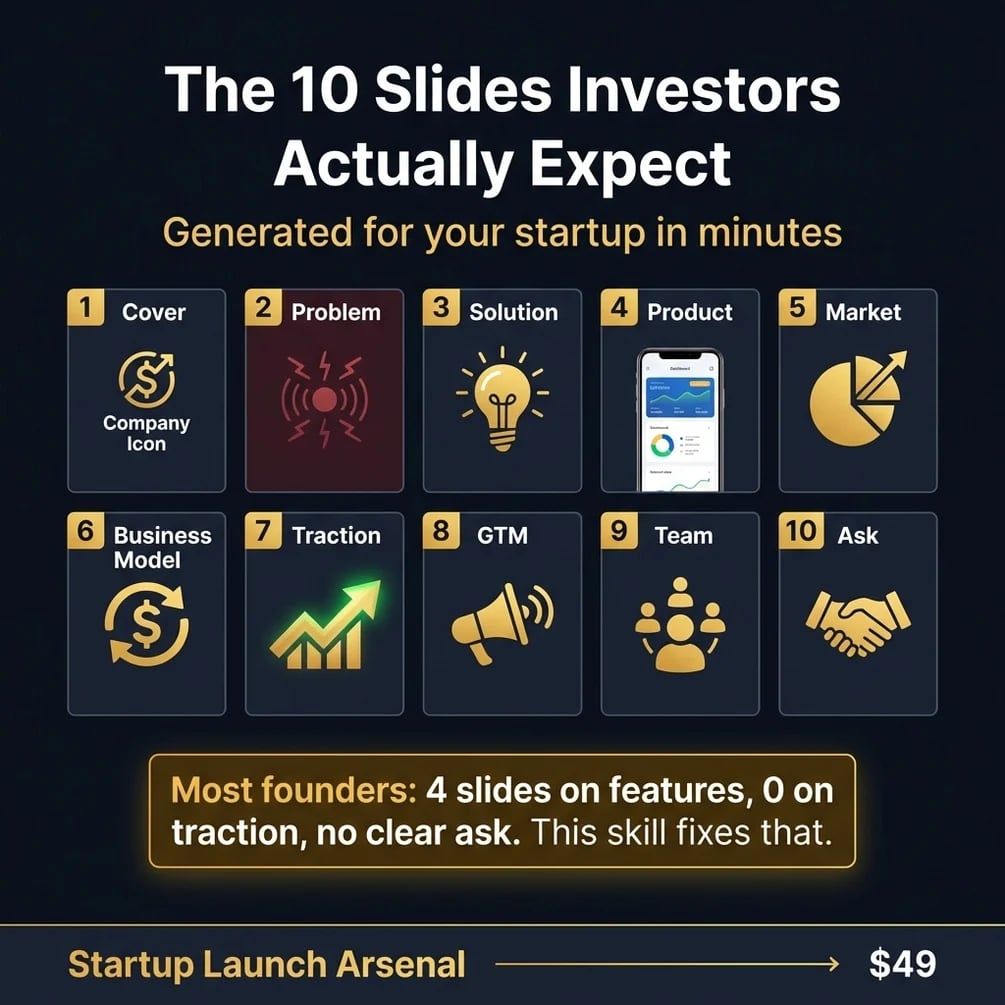
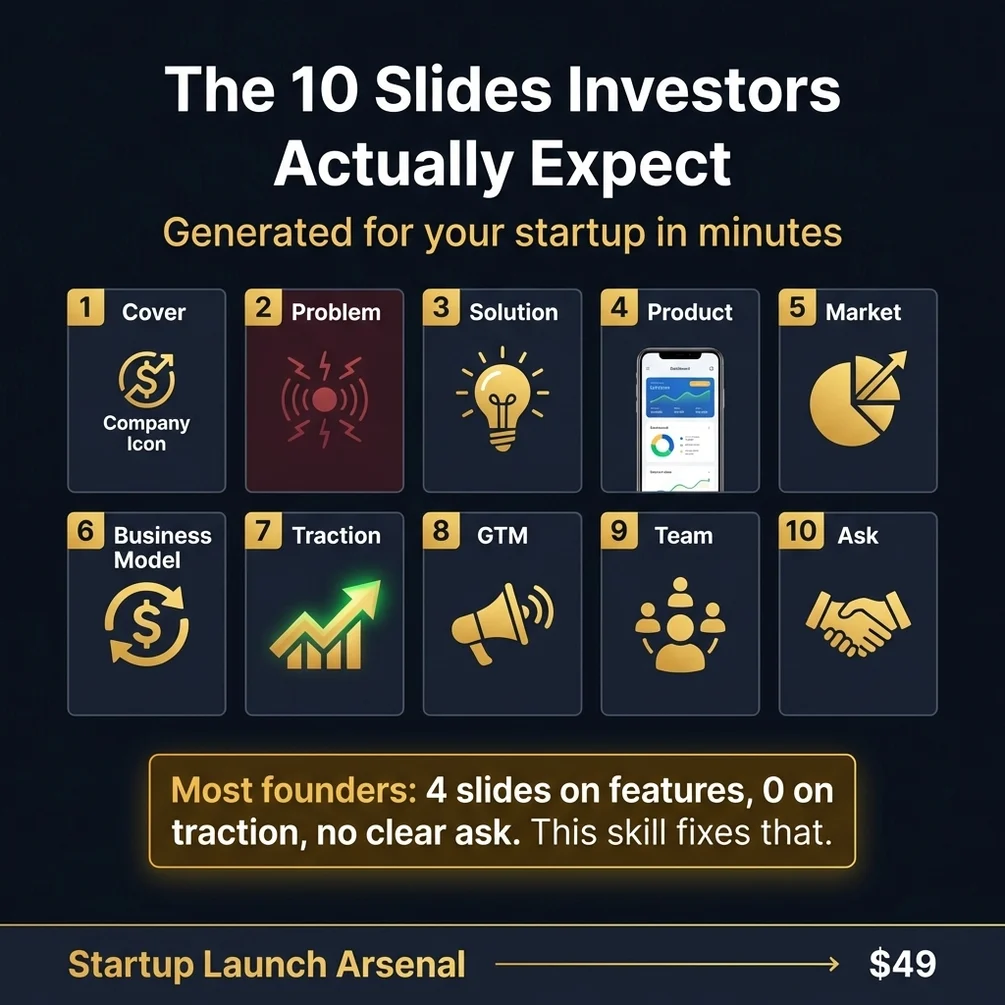
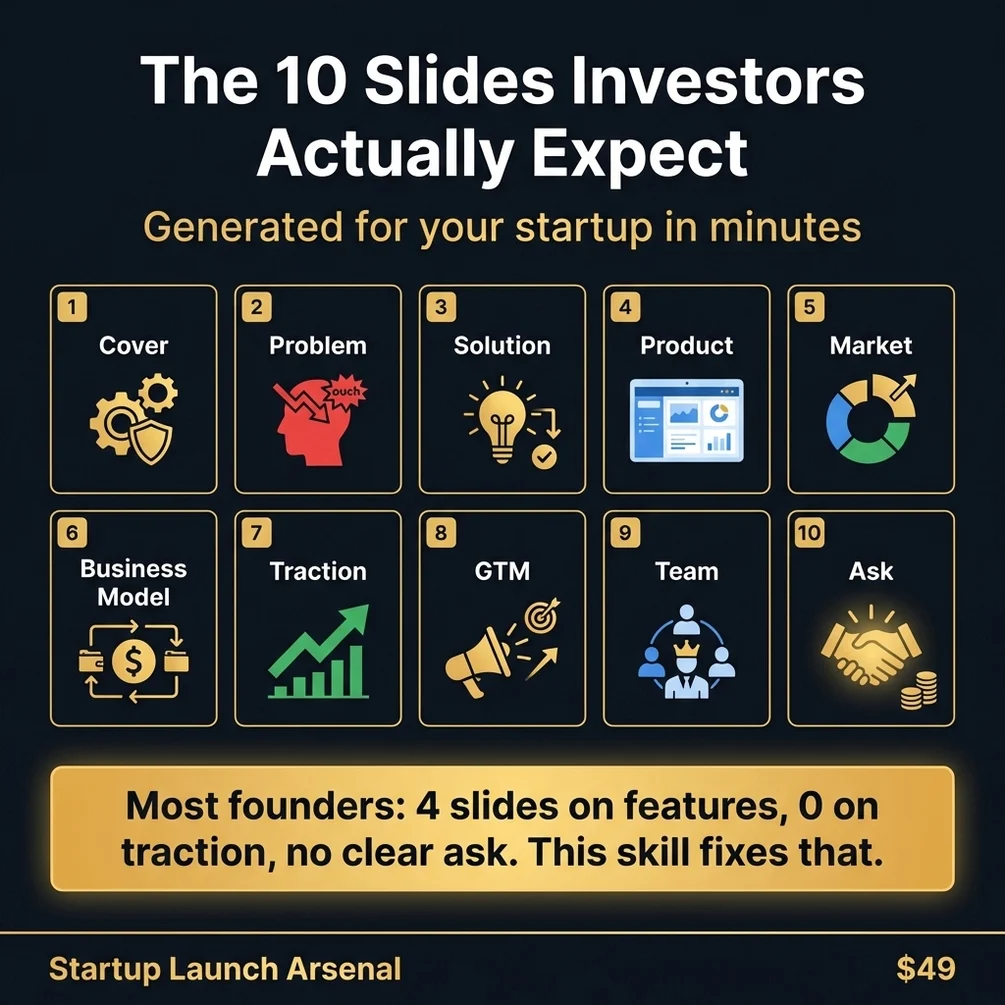
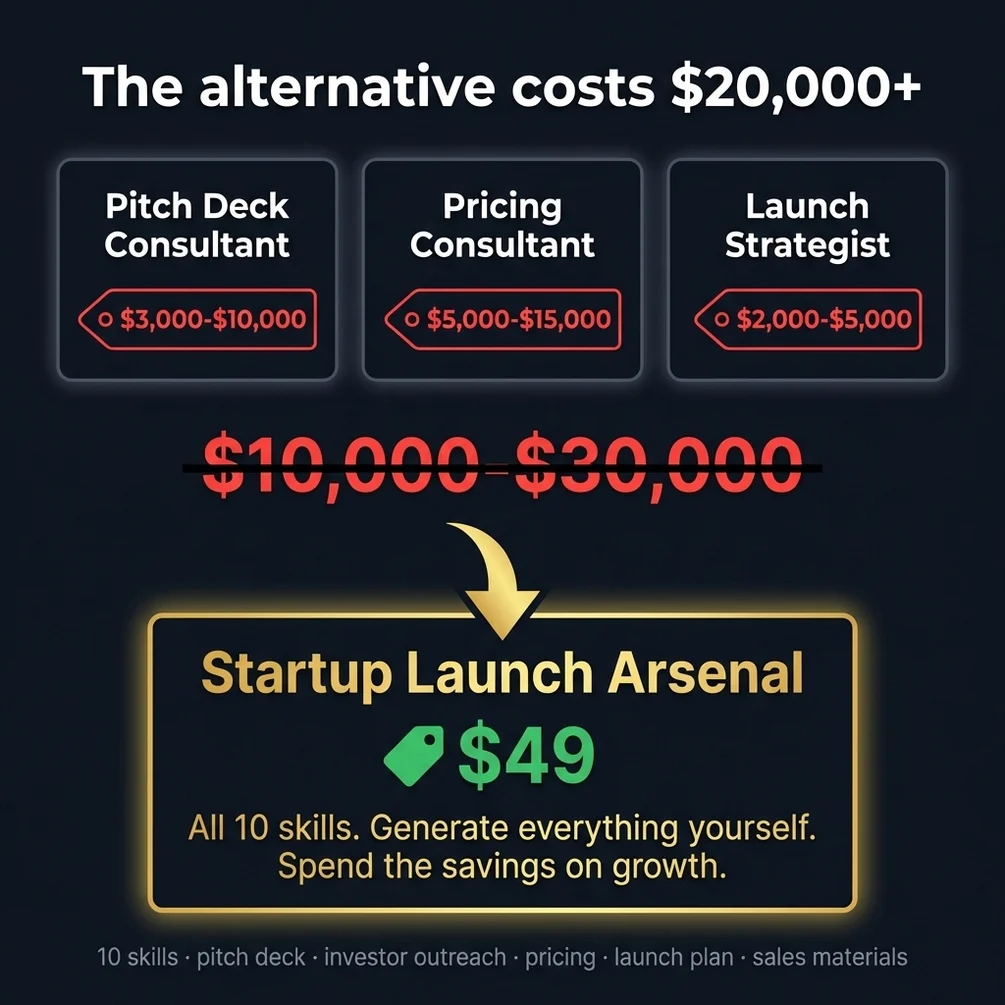
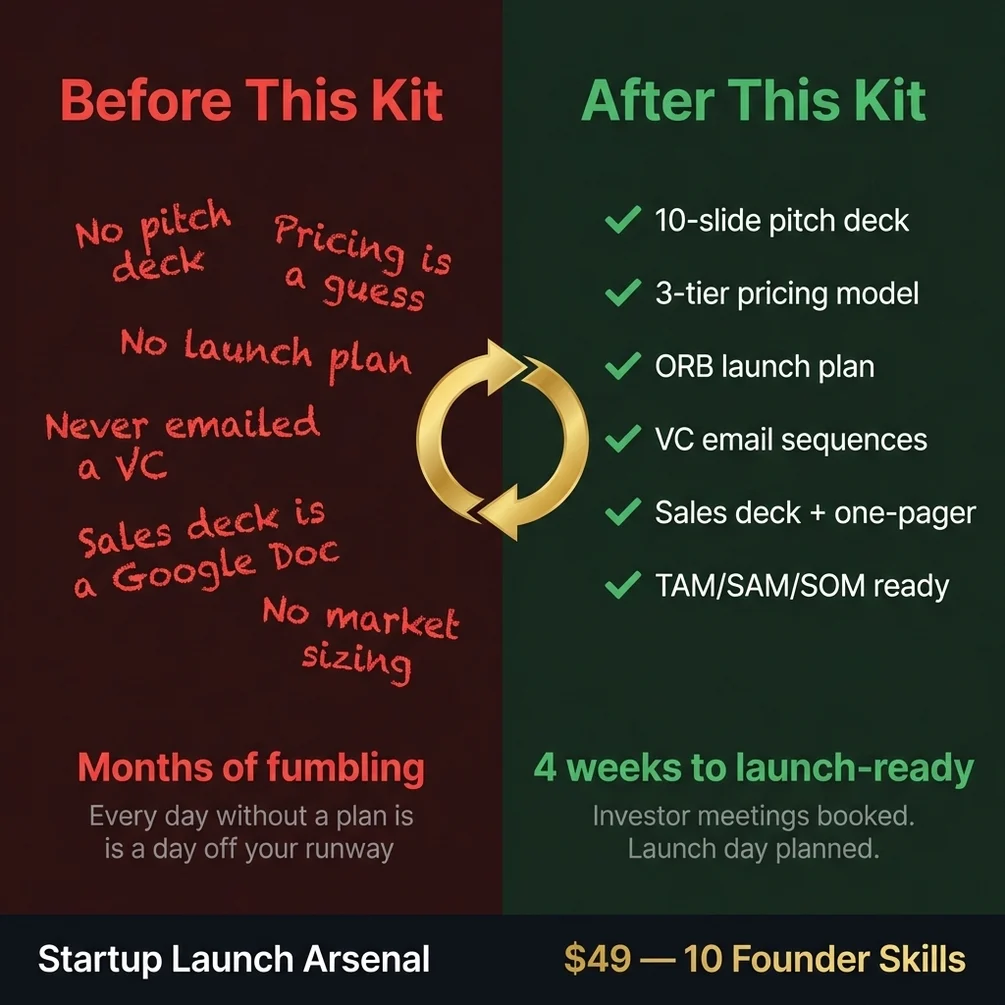
Want a skill that drafts every slide in investor order from your own facts? Startup Launch Arsenal has one.
Get Startup Launch Arsenal, $39 one-time// side by side
By hand vs a generic AI prompt vs Startup Launch Arsenal
The slide order is the same in all three columns, because it comes from how investors read. What changes is how long it takes to fill each slide, and whether you can defend every page when an investor pushes back.
| Criterion | By hand | Generic AI prompt | Startup Launch Arsenal |
|---|---|---|---|
| Getting a first full draft | Slow; you decide order and content from a blank file | Fast, but the slides read like every other AI deck | The skill asks for your facts, then drafts; I have not published a timing |
| Slide order | You piece it together from blog posts | Usually close, but it changes between chats | A set order from problem through ask, written into the README and the skill |
| What goes on each slide | Guesswork until someone gives you feedback | Generic bullet points | Drafted from one list of your own facts, checked so every number agrees |
| Price on the business model slide | Often copied from a competitor | A suggested price with no data behind it | A pricing skill with value metrics, three tiers and the four Van Westendorp questions |
| Launch plan | Post on Product Hunt and hope | A long list of channels with no order | A five-phase launch plan using owned, rented and borrowed channels |
| Cost | Free, plus your weekends | Your existing AI plan | $39 once, plus your Claude plan |
// in the download
What is inside Startup Launch Arsenal
Startup Launch Arsenal is a set of 10 founder skills for Claude Code. They cover the pitch deck, investor outreach, market research, pricing and a launch plan, from a rough idea to an investor-ready story.
- 10 founder skills for Claude Code, each a folder with a SKILL.md file
- investor-materials: pitch decks, one-pagers, investor memos and accelerator applications
- product-marketing-context: a positioning document the other skills read first
- market-research: competitors and bottom-up or top-down market sizing
- pricing-strategy: value metrics, three tiers, freemium or trial, and the Van Westendorp questions
- launch-strategy and launch-checklist: a five-phase launch plan and a pre-launch checklist of 60 or more items
- investor-outreach and cold-email: cold emails to investors, intro requests and follow-ups
- slides: turns your content into HTML slides, with Chart.js for charts
What you do not get
- No PowerPoint, Keynote or Google Slides template files.
- No example decks from real companies.
- No survey form or pricing sheet. The pricing skill explains the method; you run the survey.
Who Startup Launch Arsenal is for, and who should skip it
This toolkit fits early founders who have a meeting coming, a deck they do not trust, and Claude Code installed. It does not fit founders who already raised a round and shipped a launch.
It is for you if
- You have an investor meeting on the calendar and a deck you do not trust.
- You have been searching "pitch deck order seed stage" on a Sunday night.
- You set your price by copying a competitor and rounding down.
- You can build the product but the fundraising rituals feel like a foreign language.
It is not for you if
- You want a designed slide template to drop text into. This kit writes the content, not the design file.
- You do not use Claude Code and do not want to. The skills are built to run there.
- You already raised a round and shipped a launch. This system starts earlier than where you are.
// frequently asked
Questions buyers ask
- What is the right order for pitch deck slides?
- The common seed order is title, problem, solution, why now, market, business model, traction, team and the ask. If your traction is strong, move it up right after the solution, which is where Y Combinator's seed template puts it. Strong numbers should never wait until slide eight.
- How many slides should a seed pitch deck have?
- About ten main slides is a common target. Y Combinator's template treats each topic as one slide, or a small set of up to three. Anything you cannot fit can go in an appendix you only open when an investor asks.
- What if I have no traction yet?
- Show the strongest early proof you have instead: a waitlist, signed letters of intent, pilot users or interviews with real customers. Then move the team slide earlier, because at the very start, investors are mostly betting on the founders.
- Do I need design skills to use Startup Launch Arsenal?
- No. The toolkit helps you write what goes on each slide and in what order. You can drop that text into Google Slides, Keynote or any deck tool and keep the design plain. The slides skill can also build simple HTML slides. Clear words beat pretty slides at seed stage.
- Does it work with ChatGPT?
- The skills target Claude Code, where each one runs as a slash command such as /investor-materials. They are plain text files, so you can read them in any editor or paste one into ChatGPT as instructions. The guided flow works best in Claude Code.
- Is it a one-time payment?
- Yes, Startup Launch Arsenal costs $39 once. There is no subscription. Polar or Gumroad sends the download right after payment.
- Does it include slide templates or example decks?
- No. There are no PowerPoint or Keynote files and no example decks from real companies. The investor materials skill asks for your facts and drafts the slide text in order. You then paste that text into the deck tool you already use.
- Is this for fundraising or bootstrapping?
- Both, but the deck and investor pieces lean toward fundraising. Bootstrapped founders get the most from the pricing and launch parts, and the deck doubles as a customer pitch once you remove the investor slides.
Get Startup Launch Arsenal
Startup Launch Arsenal costs $39 as a one-time payment. You get an instant download, lifetime access to every v1 update, and no subscription.
// next problem
Related problems
- How to calculate your startup runway
Investors ask about runway and payback on the first call. Work them out before you build the ask slide.
- Getting traffic but no sales after launch
If the launch brings visitors who do not buy, the landing page is the next thing to check.
// Also on this topic
- guideValue-based pricing vs hourly: which one should a freelancer use?
Hourly, cost-plus, project or value-based pricing? A side-by-side table of the four ways to price, what caps each one, and how to move up.
- guideWhat to sell after your first digital product, so the second one sells the first
One product is one income line. How to pick a second offer that sits below or above the first, and connect them so each one leads to the next.
- free toolPricing calculator
Floor, anchor and premium price band, with revenue after fees.
- bookThe One-Person Million
Build a Real Business With AI Doing the Work