Last updated
Which parts of client work can AI deliver, and which parts must stay yours?
| Delivery step | AI-run or human | Why |
|---|---|---|
| Send the welcome message after payment | AI-run | Same every order. No judgment in it. |
| Ask for brand files, content and access | AI-run | Same checklist every time. |
| Chase the buyer when they go quiet | AI-run | A dated reminder, not a decision. |
| Sum up the buyer's brief into a clean spec | AI-run | A first draft you read and fix in two minutes. |
| Build the rough first draft from the template | AI-run | The rough 80%. A draft, not the final work. |
| Design choices: layout, order, taste | Human | This is what the buyer paid for. |
| Final quality and polish | Human | Your name goes on it. |
| Answer repeat how-do-I questions | AI-run | Drafted from your real answers, in your voice. |
| Decide if a request is a good idea or a kind no | Human | A judgment call no rule covers. |
| Handle an unhappy buyer | Human | A relationship moment. A person has to land it. |
How to read this map
The table is one real delivery, walked step by step the way a buyer lives it. It runs from the moment money lands to the moment the buyer is happy.
Each row gets one of two marks. AI-run means a system can do it the same way every time with no taste needed, or make a first version you then finish. Human means it holds the craft, a real judgment call or a moment with a person.
The third column is the rule that keeps you safe. Every mark needs a one-line reason. If you cannot write the reason, you have not looked at the step closely enough.
Count the rows. Seven of the eleven steps in the book's full map are AI-run. Four are human, and those four are the reason anyone chose this designer over a cheaper option.

The three zones that hand off cleanly
Lists of "AI for freelancers" mix everything together: drafting, admin, images, code. For delivering client work, the book sorts it into three zones. Everything in the table above falls into one of them.
Onboarding. The moment a buyer pays, the same sequence has to happen. The welcome message. The request for content, brand colors, access and answers to your standing questions. The reminder when they go quiet. Setting up the project folder. None of it needs your head, and it is the part solo owners most often do late, because it is dull. Tied to the payment, it runs the same way on the fortieth order as on the first.
First drafts. Not the finished work. The rough first version of it. For the book's designer, that meant the first site built from the template, the buyer's brief poured into it, placeholder copy from their answers, a starting layout. AI does the first 80%. Your judgment turns the last 20% into something you would put your name on.
Support answers. The same forty questions arrive in different words. How do I change this, where is my file, what is included, when is it ready. Most have one right answer that never changes. A support layer drafts replies from your own written answers, in your voice, and sends the new or upset ones to you. You stop being the help desk and become the person they escalate to.
One more row from the book's full map did not fit in the table above. Sending the final handover and the next-step offer is AI-run too, once you have approved the work. It is standard every time, and it points the buyer to your next offer.

The rules, in the order you apply them
Rule one: map before you build. Do it on paper, for one product, the one that sells. Write every step, even the small ones. Do not start by automating whatever annoyed you this week.
Rule two: never hand over the gift. The line is not "automate the slowest step." Design work is often the slowest step, and it is exactly the step to keep. If a step answers "why did they choose me?", it stays human, however long it takes.
Rule three: build one row at a time. Start with the cheapest, most repeated row. In the book that was onboarding, because it fired on every sale and needed zero taste. Let it run clean across about ten real orders before you add the next.
Rule four: keep the human where the human is the value. When a buyer is upset or a request needs a real decision, a canned reply reads as exactly what it is. The engine clears the routine so you can show up for those moments.
Midnight, and the ninth welcome email this week
You built a product so you would stop trading hours. It worked. Orders are coming in.
And now it is past midnight. You are not designing. You are writing the same "here is how to get started" email for the ninth time this week.
The obvious fix is a hire. A part-time helper for onboarding and the easy emails. You do the sum, and the helper eats most of the margin that made the product worth building.
That is the moment to stop and map. In the book, the designer did exactly that before he posted the job. The part he feared was the whole job turned out to be four lines. The rest was wrapping he had been folding by hand.
Why AI helps you more than it helps a big firm
Here is the part I find most hopeful. A study by Brynjolfsson, Li and Raymond at NBER found AI help raised output in support work by about 14% on average. The least experienced workers gained about 34%. The most seasoned barely moved.
A one-person business is a beginner at most of its own delivery. You may be an expert at one craft and new at the onboarding, the support replies and the first drafts around it. That is the profile that gains the most.
Writing work follows the same pattern. In a study in Science by Noy and Zhang, AI cut the time for writing tasks by about 40% and raised quality by about 18%, with the weaker writers gaining most.

The chapter built for this
This is the problem The One-Person Million was written for.
Chapter 4, The Engine: Let AI Do the Delivery, explains why hiring eats the gains of a product, the three zones of delivery that hand off cleanly, and the line AI must never cross. It walks through the full eleven-row map shown above and the four ways people build an engine wrong. It ends with Tool 4, the Delivery Engine Map: one product, every step, two marks and a reason for each.
The map is in the free workbook. If orders are piling up right now, read too many orders to deliver alone first.
The book for this problem
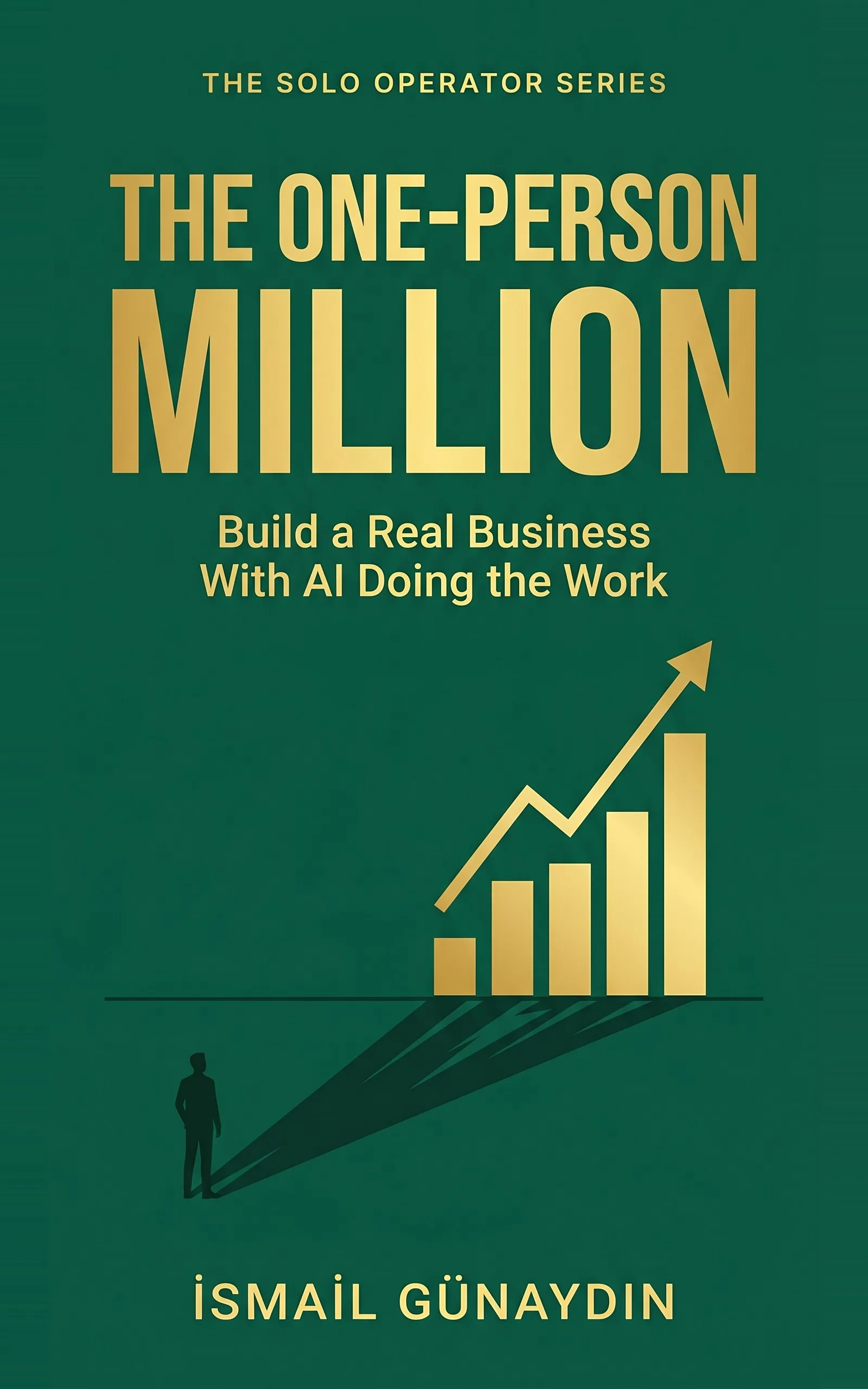
The One-Person Million
Build a Real Business With AI Doing the Work. By İsmail Günaydın, 66 pages.
Where this problem is in the book:
- The Engine: Let AI Do the Delivery
Links go to Amazon. I wrote this book and earn a royalty on every sale. Amazon sets the price and handles delivery and returns.

Is The One-Person Million the right book for you?
Yes, if
- You want AI to deliver part of your service, not only write drafts
- You are writing the same welcome email for the ninth time this week
- You are about to hire help just to keep up with orders
Skip it if
- You want AI to make the whole deliverable end to end
- Your product has not sold yet
Fair doubts before you buy
Isn't it risky to let AI talk to my customers?
It is if you hand it the wrong steps. The book keeps every upset buyer and every judgment call human. AI drafts replies only for the repeat questions that have one right answer, from answers you wrote yourself, and sends the new or upset ones to you.
Can't I just hire an assistant instead?
You can, but a hire turns every extra sale into a slice of wages. The book's designer did the sum on a Sunday night and saw the assistant would eat most of the margin that made the product worth building. Mapping the steps first showed him most of the load was not craft at all.
Get The One-Person Million
Income tied to your hours has a fixed ceiling; five layers (offer, price, product, engine, stack) lift it without adding hours.
Links go to Amazon. I wrote this book and earn a royalty on every sale. Amazon sets the price and handles delivery and returns.
Part of The Solo Operator Series, five short books that can be read in any order.

Questions people ask about this
- What tasks can AI do in client delivery?
- The routine scaffolding: welcome messages, asset requests, reminders, brief summaries, rough first drafts and answers to the same repeat questions. These are the same every time and need no taste.
- What should a freelancer never hand over to AI?
- The thing the client chose you for, any real judgment call and any moment with an unhappy client. Hand over the design eye and you have automated away the only reason anyone bought from you instead of a cheap template.
- How do I start automating my service delivery?
- Write down every step from payment to a happy buyer. Mark each one AI-run or human, with a one-line reason. Then build the cheapest, most repeated step first, usually onboarding, and let it run clean before you add the next.
- Does AI really help small businesses more than big ones?
- The research points that way. An NBER study found AI raised support output about 14% on average and about 34% for the least experienced workers. A solo owner is a beginner at most of the jobs around their one craft, which is the profile that gains most.
- Should I automate delivery before my product sells?
- No. The book says to sell by hand until delivery truly hurts. With no volume, an engine is a way to avoid the harder job of making the thing sell.
- Can AI make the whole deliverable for my client?
- The book says no. Let it build the rough first version, about the first 80%, from your template and the client's brief. Then your judgment shapes the last 20%: the design choices, the polish and the final check. If AI ships the whole thing untouched, you have automated away the reason the client chose you over a cheap template.
Related problems
- Too many orders to deliver alone? Before you hire help, do this
Your product finally sells and delivery is burying you. A fast plan to clear the load this week without giving your margin to a new hire.
- How to productize a service when you are the only one doing the work
Turn a custom service into a fixed package, then a product. Three tests to pick what to productize first, and why you should slide, not leap.
- What to sell after your first digital product, so the second one sells the first
One product is one income line. How to pick a second offer that sits below or above the first, and connect them so each one leads to the next.
- Everything inside The One-Person Million
Every chapter, who the book is for, and every problem it helps with.