Last updated
1957 prices vs today: what got cheaper, what got dearer

| Item | 1957 | In today's money | Actually today |
|---|---|---|---|
| Bread, per pound | 18.8 cents | $2.24 | $1.82 |
| Milk, per quart | 23.4 cents | $2.79 | about $1.06 |
| Eggs, per dozen | 57.3 cents | $6.83 | $2.27 |
| First-class stamp | 3 cents | 36 cents | 82 cents |
| Federal minimum wage | $1.00 an hour | $11.92 | $7.25 |
| Median income | $5,000 a year | $59,600 | $83,730 (household, 2024) |
The one number that makes this table honest
Most 1957 lists print the old price next to today's and let you gasp. Bread was nineteen cents! It is a cheap trick, because it leaves out what a dollar was worth.
So start with one number. The consumer price index, the government's measure of what ordinary things cost, stood at 28.1 in 1957. In August 2026 it stood at 334.98. Divide one by the other and you get 11.92. You can check both on FRED, the St. Louis Fed's data site.
So a 1957 dollar is about $11.92 today. Multiply each 1957 price by that, and you get what it should cost now if only money had changed. The third column shows that. The fourth shows what it really costs.

What $5, $20 or $100 from 1957 is worth today
People often search for one round sum. Multiply by 11.92 and you have it.
| 1957 amount | In August 2026 money |
|---|---|
| $1 | $11.92 |
| $5 | $59.60 |
| $20 | $238.40 |
| $100 | $1,192 |

Why online calculators give slightly different answers
Search this and you will see $11.74, $11.92 and $11.99 for the same 1957 dollar. None of them is a mistake. They just pick different months.
The 28.1 figure is the average for all of 1957. Some calculators use the latest month of data at the end. Others use a full-year average, or a different month in 1957 to start. Move either end by a few months and the answer moves by a few cents.
So do not worry about the second decimal. Any answer close to twelve is right. What matters is that you multiply the 1957 price before you compare it.

Prices hardly moved in the first years
A 1957 baby was born into calm prices. The book follows the same index through their childhood, with 1957 set to 1.
| Year | Prices compared with 1957 |
|---|---|
| 1960 | 1.05 |
| 1962 | 1.08 |
| 1965 | 1.12 |
| 1975 | 1.92 |
| 1980 | 2.93 |
That is a rise of twelve percent in eight years, then a jump. Between 1965 and 1980, prices more than doubled again. So "prices in 1957" were close to prices in 1962. That stops being true by the time they were a teenager.

Food came out cheaper, the stamp did not
Read the table down and three lines go down. Bread is about a fifth cheaper than it was, in real terms. Milk costs about a third of what it did. So do eggs.
That is the opposite of what most of us expect. Food did not get dearer over a lifetime that started in 1957. It got much cheaper. The reason is farming. One worker in about ten was on a farm in 1957. Far fewer feed far more people now.
The stamp went the other way. Three cents then is 36 cents now, and the real price is 82 cents. Income went up, and comfortably so, even with the warning that families and households are counted differently.

The line that went backwards
Then there is the minimum wage.
In 1957 the federal floor was one dollar an hour. In today's money, that is $11.92. The federal minimum today is $7.25, and it has not moved since 2009. The Department of Labor keeps the full history.
So the legal floor under an hour of work buys about thirty-nine percent less than it did the week a 1957 baby was born. Not less than some peak in between. Less than 1957. Six lines, and that is the only one that went the wrong way.

Where this comparison comes alive
Picture a 70th birthday. Someone says, "Bread was nineteen cents when you were born." Everyone laughs. Then the birthday guest says the family still counted every penny of it.
Both are true. That is the point of doing the math. The table tells you what happened to the country. It cannot tell you what happened to one family.
A table also leaves things out. Nobody counted how far a nine-year-old could ride a bike, or how many adults on the street knew your name. Those changed too, and there is no index for them.

The chapter with the full arithmetic
This is the problem The Year You Arrived: 1957 was written for. We trust its numbers because each one is sourced at the back.
The Numbers is the chapter behind this page. It does the math for each line, then follows factory jobs from about three workers in ten in 1957 down to 7.9 percent in August 2026.
What Things Cost has the full 1957 shopping list, from round steak to cabbage, and what an hour of work bought.
What Disappeared covers the things that left no price at all: the milkman, the coal cellar, the man who filled your tank.
For the 1957 prices on their own, see our page on what things cost in 1957.
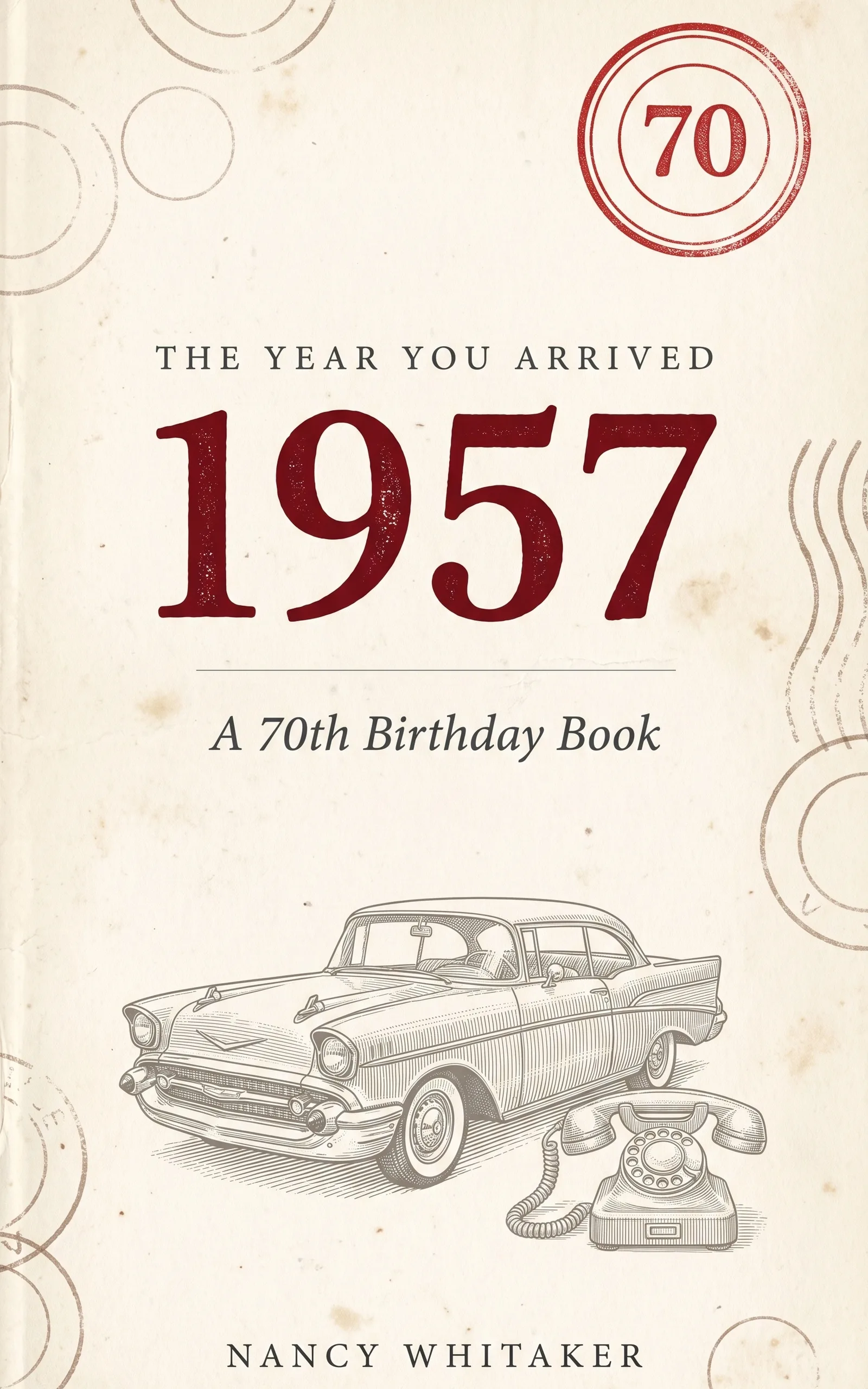
The book for this problem
The Year You Arrived: 1957
A 70th Birthday Book of Real Prices, Headlines and Everyday Life, From the World You Were Born Into to the One You Grew Up In. By Nancy Whitaker, 170 pages.
Where this problem is in the book:
- The Numbers
- What Things Cost
- What Disappeared
Links go to Amazon. ToolGenX publishes this book under a pen name and earns from every sale. Amazon sets the price and handles delivery and returns.

Is The Year You Arrived: 1957 the right book for you?
Yes, if
- You want to compare 1957 and today without the cheap trick of raw prices
- You are writing a toast or card for someone born in 1957
- You like to check the math yourself
Skip it if
- You want a full study of wages and wealth since 1957
- You want prices for cars or houses, which the book does not give for 1957
Fair doubts before you buy
Can't I just use an online inflation calculator?
Yes, and the book shows you how: it divides the August 2026 price index by the 1957 one, so you can check it on a napkin. What a calculator will not give you is the 1957 price to start from. The book's food prices come from the original 1959 government bulletin.
Isn't income the real story, not bread?
The book covers that too, with a warning. Median family income was $5,000 in 1957, about $59,600 in today's money. Median household income in 2024 was $83,730. Families and households are not quite the same thing, so treat the gap as a direction, not an exact number.
Get The Year You Arrived: 1957
A 70th birthday book that tells the year they cannot remember with sourced prices and headlines, then asks about the years they can.
Links go to Amazon. ToolGenX publishes this book under a pen name and earns from every sale. Amazon sets the price and handles delivery and returns.

Questions people ask about this
- What is $1 in 1957 worth today?
- About $11.92. The consumer price index was 28.1 in 1957 and 334.98 in August 2026. Divide the second by the first and you get 11.92.
- Was food cheaper in 1957 than today?
- No, food is cheaper now in real terms. A quart of milk was 23.4 cents in 1957, which is $2.79 in today's money. Today a quart works out to about $1.06. Eggs and bread are cheaper too, once you adjust for inflation.
- Was the minimum wage worth more in 1957?
- Yes. The federal minimum was $1.00 an hour in 1957, which is $11.92 in today's money. The federal minimum today is $7.25 and has not moved since 2009. It buys about thirty-nine percent less.
- What did a stamp cost in 1957 compared to now?
- Three cents, which is about 36 cents in today's money. A stamp now costs 82 cents, so mailing a letter costs more than twice as much in real terms.
- Why did food get so much cheaper since 1957?
- Farming changed. Farm work employed 9.6 percent of working Americans in 1957. It employs a small share of that now and feeds nearly twice as many people.
Related problems
- What things cost in 1957: milk, bread, eggs, gas and a stamp
What did milk, bread, eggs and gas cost in 1957? A table of real prices from the government's own records, with the months that moved.
- What happened in 1957, month by month, from Elvis to Sputnik
What happened in 1957? One key event for each month, from Elvis in January to Sputnik and the Vanguard rocket, with dates you can check.
- The 70th birthday party is this weekend and you need quiz questions about 1957
Need a 1957 quiz for a 70th birthday party, fast? Twelve questions with answers, all checked, plus party ideas built on the year.
- Everything inside The Year You Arrived: 1957
Every chapter, who the book is for, and every problem it helps with.